
Table of Contents
ToggleThe Winning Team Summary in English
The Winning Team by Githa Hariharan is a humorous story about how fear, hatred and false ideas about enemies can destroy peace and happiness.
A strong and frightening stranger comes to a city and claims to be a great war hero. He tells the people that every city must have enemies and that they must prepare for war. Although the city has no enemies, the frightened people make him their all-powerful mayor.
The new mayor changes the peaceful city completely. He builds higher walls, appoints spies and weapon-makers, and prepares everyone for an imaginary war. He also orders the people not to laugh, saying that they must spend all their time hating their enemies. As a result, the city becomes silent, and music, dancing, sports, festivals and laughter disappear.
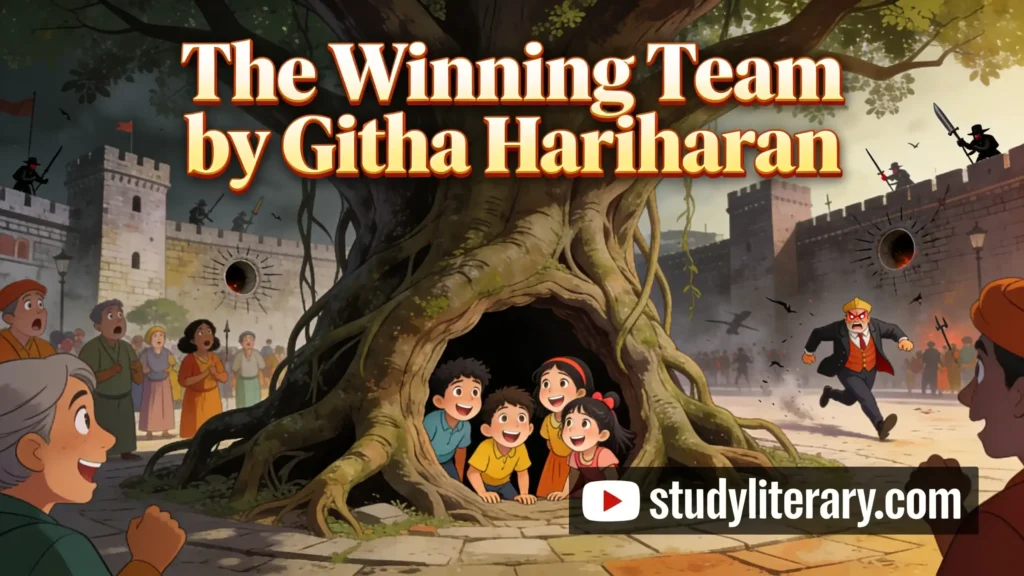
Old Birbal decides to oppose the mayor. With the help of four children—Gopal, Ramu, Nasira and Akbari—he makes people believe that the old banyan tree in the city square has started laughing. The children hide inside the hollow tree and laugh and throw stones at anyone who comes near it. Soon, everyone, including the mayor’s spies, weapon-maker and astrologer Motubhai, starts laughing.
The mayor becomes frightened because Motubhai had once predicted that he would die when the city was filled with fun and laughter. Realising that laughter has returned, the mayor secretly runs away from the city. As soon as he leaves, the four children come out of the tree, and the people celebrate with clapping, music, dancing and laughter.
The story shows that fear and hatred can be used to control people, while courage, humour, friendship and happiness can defeat oppression. The real winning team is not the army but Birbal and the children, who restore joy and freedom to their city.
The Winning Team Summary in Hindi/Urdu
The Winning Team Githa Hariharan ki ek mazedaar kahani hai. Is kahani mein bataya gaya hai ki dar, nafrat aur jhoothe dushmanon ka khayal logon ki shanti aur khushi ko barbaad kar sakta hai.
Ek din ek majboot aur darawna ajnabi ek shehar mein aata hai. Woh khud ko ek bahadur war hero batata hai. Woh logon se kehta hai ki har shehar ke kuchh na kuchh dushman zaroor hote hain aur unse ladne ke liye taiyar rehna chahiye. Haalanki shehar ka koi dushman nahi tha, phir bhi log dar jaate hain aur us ajnabi ko apna mayor bana dete hain.
Naya mayor shehar ko poori tarah badal deta hai. Woh unchi deewarein banwata hai, spies (jasoos) aur weapon-makers (hathiyar banane wale log) rakhta hai aur logon ko ek aisi war ke liye taiyar karta hai jo asal mein thi hi nahi. Woh logon ko hansne se bhi mana kar deta hai aur kehta hai ki unhe apna poora samay dushmanon se nafrat karne mein lagana chahiye. Is wajah se shehar mein hansi, music, dance, sports aur festivals sab band ho jaate hain. Shehar bilkul shaant aur udaas ho jaata hai.
Old Birbal mayor ke khilaaf kuchh karne ka faisla karta hai. Woh chaar bachchon—Gopal, Ramu, Nasira aur Akbari—ki madad leta hai. Woh bachchon ko shehar ke square mein lage ek purane banyan tree ke khokhle tane ke andar chhupa deta hai.
Birbal ek afwaah phailata hai ki woh purana banyan tree hansne laga hai. Jab bhi koi tree ke paas se guzarta, bachche andar se zor-zor se haste. Ve kabhi-kabhi tree ke andar se patthar bhi phenkte. Dheere-dheere mayor ke spies, weapon-maker aur astrologer Motubhai bhi hansne lagte hain.
Mayor bahut dar jaata hai, kyunki Motubhai ne pehle bhavishyavani ki thi ki jab shehar mein fun aur laughter wapas aa jayega, tab mayor mar jayega. Jab mayor ko pata chalta hai ki log phir se hans rahe hain, to woh dar ke maare shehar chhodkar bhaag jaata hai.
Mayor ke jaate hi chaaron bachche banyan tree se bahar aa jaate hain. Log taali bajate hain, gaate hain, music bajate hain, dance karte hain aur hanskar khushi manate hain.
Kahani humein sikhati hai ki dar aur nafrat se logon ko control kiya ja sakta hai, lekin himmat, mazaak, dosti aur khushi zulm ko hara sakte hain. Is kahani ki asli winning team Birbal aur chaar bachche hain, kyunki unhone bina kisi war ke shehar mein khushi aur azaadi wapas la di.
The Winning Team Vocabulary
| Word | Simplest English Meaning | Roman Hindi Meaning |
|---|---|---|
| Tough-looking | Looking strong and rough | Mazboot aur kathor dikhne wala |
| Stranger | An unknown person | Ajnabi vyakti |
| Defeated | Won against someone | Hara diya |
| Impressive | Very attractive or powerful | Prabhavshaali / bahut achha lagne wala |
| Scars | Marks left on the skin after an injury | Chot ke nishaan |
| Offer | To say that you are ready to help | Madad karne ki peshkash |
| Gentle | Kind and soft in behaviour | Naram aur dayalu |
| Impossible | Cannot happen or be done | Jo ho hi nahi sakta |
| Astrologer | A person who predicts the future using stars | Jyotishi |
| Hesitantly | In an unsure or nervous way | Jhijhakte hue |
| Secret | Known by only a few people | Gupt / chhupa hua |
| Beamed | Smiled happily | Khushi se muskuraya |
| Enemies | People who are against you | Dushman |
| Dramatic | Very exciting or emotional | Natakiya / bahut prabhavshaali |
| Wasting | Using time without a useful purpose | Samay barbaad karna |
| Defeat | To win against someone | Hara dena |
| Innocent | Not knowing about something bad | Anjaan / bhola |
| Battle | A fight between armies | Yudh / ladai |
| Mean | Unkind or cruel | Bura / nirdayi |
| All-powerful | Having complete power | Sabse adhik shaktishaali |
| Prepare | To get ready | Taiyar karna |
| Peculiar | Strange or unusual | Ajeeb / anokha |
| Spy-hole | A small hole used to secretly watch | Chhota suraakh jisse chupkar dekha ja sake |
| Disguise | A way of changing one's appearance to hide identity | Bhes badalna |
| Palatial | Very large and luxurious | Mahal jaisa bahut bada aur shandaar |
| Weapon-maker | A person who makes weapons | Hathiyar banane wala |
| Flattering | Praising someone to please them | Khush karne ke liye tareef karna |
| Prediction | A statement about what may happen in the future | Bhavishyavani |
| Overflow | To become so full that something comes out | Itna bhar jaana ki bahar nikalne lage |
| War footing | A condition of being fully ready for war | Yudh ke liye poori tarah taiyar rehna |
| Regarded | Considered or thought of as | Maana gaya / samjha gaya |
| Glorious | Great and deserving praise | Mahaan / gauravshaali |
| Laughter | The sound or act of laughing | Hansi |
| Inspiration | A good idea that motivates you | Prerna / achha vichaar |
| Hollow | Empty inside | Andar se khaali |
| Trunk | The thick main stem of a tree | Ped ka mota tana |
| Unsuspecting | Not knowing that something is going to happen | Jise kisi khatre ka andaaza na ho |
| Regime | A government or system of rule | Shaasan / hukumat |
| Rumour | Unconfirmed information spread among people | Afwaah |
| Spread like wildfire | Spread very quickly | Bahut tezi se phailna |
| Giggle | To laugh quietly and lightly | Dheere-dheere khilkhilakar hansna |
| Infected | Affected by something that spreads | Prabhavit hona / lag jaana |
| Helplessly | Without being able to control something | Bebasi se |
| Furious | Extremely angry | Bahut zyada gusse mein |
| Hoarse | Rough or unclear voice | Bhari aur khurduri awaaz |
| Chop | To cut into pieces | Kaatna |
| Pelted | Hit repeatedly with things thrown | Baar-baar cheezon se maarna |
| Teasing | Making fun of or annoying someone | Chhedna / mazaak udaana |
| Possessed | Controlled by an evil or magical force | Kisi buri ya jaadui shakti ke kabze mein |
| Fright | Sudden strong fear | Achanak bahut dar |
| Burst | A sudden large amount of something | Achanak zor se phoot padna |
| Clapping | Hitting hands together to show appreciation | Taali bajana |
| Chorus | Many people making the same sound together | Bahut logon ka ek saath bolna/gaana |
| Cheering | Shouting happily to show support | Khushi se zor-zor se jai-jai karna |
| Crawling | Moving on hands and knees | Haath-pair ke bal chalna |
| Astonished / Shocked | Very surprised | Bahut hairaan / chakit |
The Winning Team Question and Answer
A. Answers to the Questions
1. What did the stranger warn the people of the city about?
The stranger warned the people that they must have enemies who might want their water, money, or even consider them enemies, and that an enemy could attack them at any time. He therefore urged them to prepare for war.
2. How did the city prepare for war?
The city built taller walls, installed spy-holes, opened shops selling disguises, and gathered war experts, weapon-makers and spies. The mayor also ordered the people to live, eat and breathe with hatred for their supposed enemies.
3. What happened to the city’s laughter after the new mayor took charge?
The mayor banned laughter, declaring anyone who laughed would be regarded as an enemy of the city. As a result, laughter disappeared, and music, dancing, sports and festivals also died out, making the once-happy city silent and gloomy.
4. What was Birbal’s plan to save the city?
Birbal gathered Gopal, Ramu, Nasira and Akbari and hid them inside the hollow trunk of an old banyan tree. They made the tree appear to laugh whenever people passed by, causing laughter to spread through the city and eventually breaking the mayor’s control.
5. Who made up the winning team?
The winning team consisted of Birbal and the four children—Gopal, Ramu, Nasira and Akbari.
6. Why did the mayor leave? What were the people’s reactions when the mayor left?
The mayor left because laughter had returned to the city, which reminded him of Motubhai’s prediction that he would die when the city overflowed with fun and laughter.
After he fled, the people clapped, cheered, laughed, played drums and guitars, danced and celebrated the return of happiness and freedom.
B. Complete these sentences in your own words.
1. The tough-looking stranger did not believe Birbal because
he thought that it was impossible for a city to have no enemies.
2. People started wearing disguises because
the mayor wanted them to be prepared for war and to protect themselves from their supposed enemies.
3. The city became a silent place because
the mayor banned laughter and declared that anyone who laughed would be treated as an enemy.
4. Birbal came up with a plan because
he wanted to restore laughter and happiness to the city and free the people from the mayor’s cruel rule.
5. The tree-cutters could not cut down the banyan tree because
the children hiding inside the hollow trunk threw stones at them, and the tree-cutters were laughing so much that they could hardly hold their axes.
C. Read these lines and answer the questions with reference to the context:
1. Read the following quotation and answer the questions:
“So from today, no laughter in this city. Anyone who laughs will be regarded as an enemy of our great and glorious city.”
a. Who said these words?
The mayor said these words.
b. To whom were these words spoken?
He said them to the people of the city.
c. Why did the mayor ban laughter?
He wanted the people to concentrate completely on war and hatred for their supposed enemies. He believed that there was no place for fun and laughter when they were preparing for war.
d. What happened after laughter was banned?
The city became silent and joyless. Laughter died, and activities such as dancing, music, sports and festivals also disappeared.
2. Read the quotation and answer the questions:
“The rumour was that in their laughterless city, there was a big old banyan tree in the city square that had taken to laughing.”
a. Who spread the rumour?
Birbal made sure that the rumour spread.
b. Was the tree really laughing?
No. The four children were hiding inside the hollow tree and laughing.
c. Why did Birbal spread this rumour?
He wanted to bring laughter back to the city and challenge the mayor’s rule.
d. What happened when people heard the laughter?
Many people, including the mayor’s men and Motubhai, started laughing themselves.