

Tenses
Tenses are forms of verbs that tell us when an action happens—whether it happens in the present, happened in the past, or will happen in the future. They also help us understand whether an action is regular, happening at a particular time, already completed, or continuing for some time.
There are three main times in English:
Present Tense – tells us about an action that happens now, regularly, or generally.
Example: She goes to school every day.Past Tense – tells us about an action that happened before now.
Example: She went to school yesterday.Future Tense – tells us about an action that will happen later.
Example: She will go to school tomorrow.
Each tense has four forms:
Simple – describes a regular, usual, general, or completed action.
Example: I play cricket.Continuous – describes an action that is, was, or will be in progress at a particular time.
Example: I am playing cricket.Perfect – describes an action that has been completed before a certain time or has a connection with another time/action.
Example: I have played cricket.Perfect Continuous – describes an action that started earlier and continued for a period of time, often showing how long it has been happening.
Example: I have been playing cricket for two hours.
In short: Tenses help us understand the time of an action as well as its state—whether it is regular, in progress, completed, or continuing.
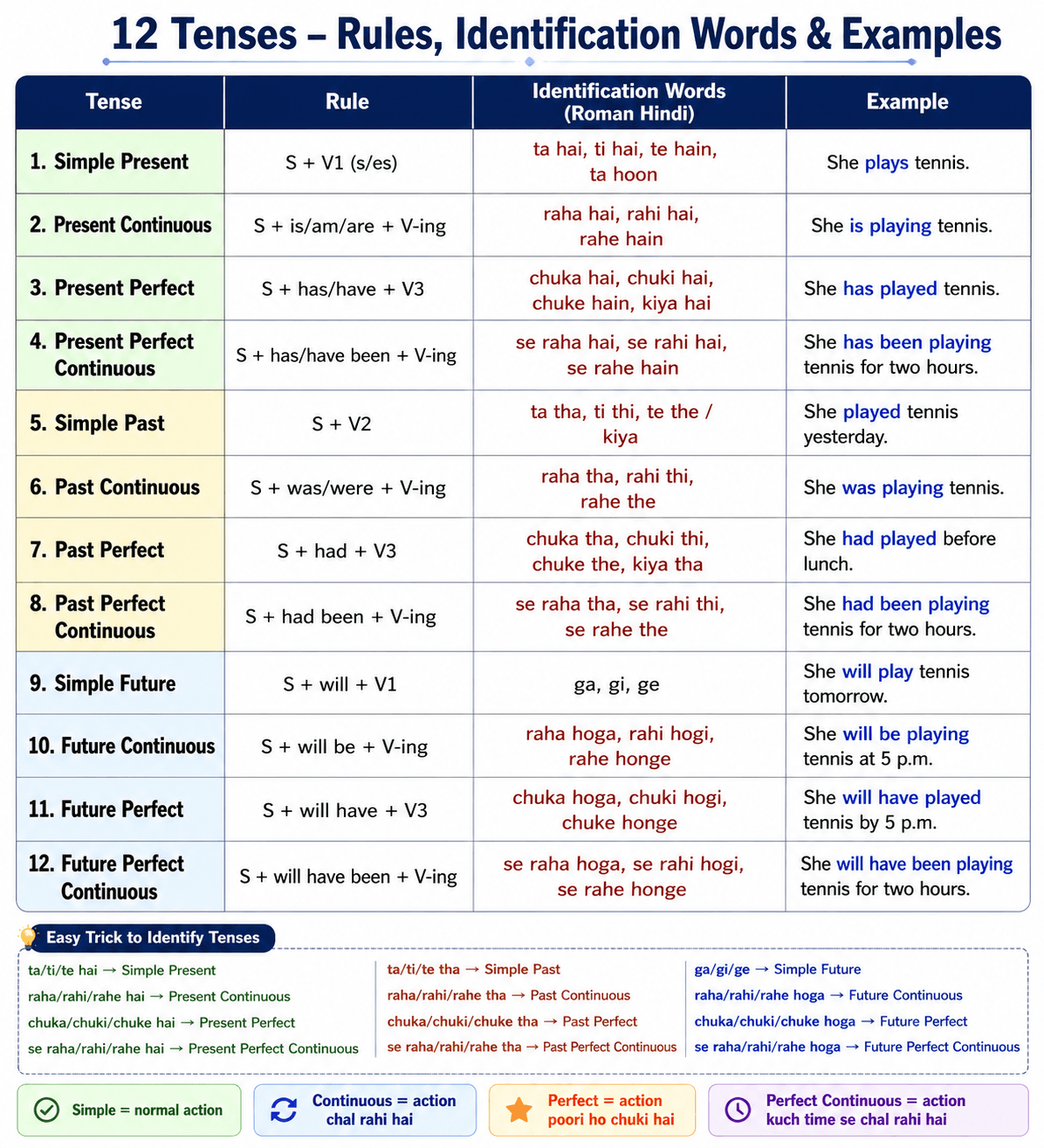
12 Tenses – Rules, Identification Words & Examples
| Tense | Rule | Identification Words (Roman Hindi) | Example |
|---|---|---|---|
| 1. Simple Present | S + V1 (s/es) | ta hai, ti hai, te hain, ta hoon | She plays tennis. |
| 2. Present Continuous | S + is/am/are + V-ing | raha hai, rahi hai, rahe hain | She is playing tennis. |
| 3. Present Perfect | S + has/have + V3 | chuka hai, chuki hai, chuke hain, kiya hai | She has played tennis. |
| 4. Present Perfect Continuous | S + has/have been + V-ing | se raha hai, se rahi hai, se rahe hain | She has been playing for two hours. |
| 5. Simple Past | S + V2 | ta tha, ti thi, te the / kiya | She played tennis yesterday. |
| 6. Past Continuous | S + was/were + V-ing | raha tha, rahi thi, rahe the | She was playing tennis. |
| 7. Past Perfect | S + had + V3 | chuka tha, chuki thi, chuke the, kiya tha | She had played before lunch. |
| 8. Past Perfect Continuous | S + had been + V-ing | se raha tha, se rahi thi, se rahe the | She had been playing for two hours. |
| 9. Simple Future | S + will + V1 | ga, gi, ge | She will play tennis tomorrow. |
| 10. Future Continuous | S + will be + V-ing | raha hoga, rahi hogi, rahe honge | She will be playing at 5 p.m. |
| 11. Future Perfect | S + will have + V3 | chuka hoga, chuki hogi, chuke honge | She will have played by 5 p.m. |
| 12. Future Perfect Continuous | S + will have been + V-ing | se raha hoga, se rahi hogi, se rahe honge | She will have been playing for two hours. |
| Tense | Rule | Identification Words (Roman Hindi) | Example |
|---|---|---|---|
| 1. Simple Present | S + V1 (s/es) | ta hai, ti hai, te hain, ta hoon | She plays tennis. |
| 2. Present Continuous | S + is/am/are + V-ing | raha hai, rahi hai, rahe hain | She is playing tennis. |
| 3. Present Perfect | S + has/have + V3 | chuka hai, chuki hai, chuke hain, kiya hai | She has played tennis. |
| 4. Present Perfect Continuous | S + has/have been + V-ing | se raha hai, se rahi hai, se rahe hain | She has been playing for two hours. |
| 5. Simple Past | S + V2 | ta tha, ti thi, te the / kiya | She played tennis yesterday. |
| 6. Past Continuous | S + was/were + V-ing | raha tha, rahi thi, rahe the | She was playing tennis. |
| 7. Past Perfect | S + had + V3 | chuka tha, chuki thi, chuke the, kiya tha | She had played before lunch. |
| 8. Past Perfect Continuous | S + had been + V-ing | se raha tha, se rahi thi, se rahe the | She had been playing for two hours. |
| 9. Simple Future | S + will + V1 | ga, gi, ge | She will play tennis tomorrow. |
| 10. Future Continuous | S + will be + V-ing | raha hoga, rahi hogi, rahe honge | She will be playing at 5 p.m. |
| 11. Future Perfect | S + will have + V3 | chuka hoga, chuki hogi, chuke honge | She will have played by 5 p.m. |
| 12. Future Perfect Continuous | S + will have been + V-ing | se raha hoga, se rahi hogi, se rahe honge | She will have been playing for two hours. |
Easy Trick to Identify Tenses
ta/ti/te hai → Simple Present
raha/rahi/rahe hai → Present Continuous
chuka/chuki/chuke hai → Present Perfect
se raha/rahi/rahe hai → Present Perfect Continuous
ta/ti/te tha → Simple Past
raha/rahi/rahe tha → Past Continuous
chuka/chuki/chuke tha → Past Perfect
se raha/rahi/rahe tha → Past Perfect Continuous
ga/gi/ge → Simple Future
raha/rahi/rahe hoga → Future Continuous
chuka/chuki/chuke hoga → Future Perfect
se raha/rahi/rahe hoga → Future Perfect Continuous
Exercise 19
1. Fill in the blanks with the correct forms of the Verbs given within brackets:
📝 Fill in the Blanks
Choose the correct form of the verb given in brackets
2. In each of the following, underline the correct part of the predicate that matches the first part of each sentence:
3. Tick the best verb of your choice and write its number in the blank: