

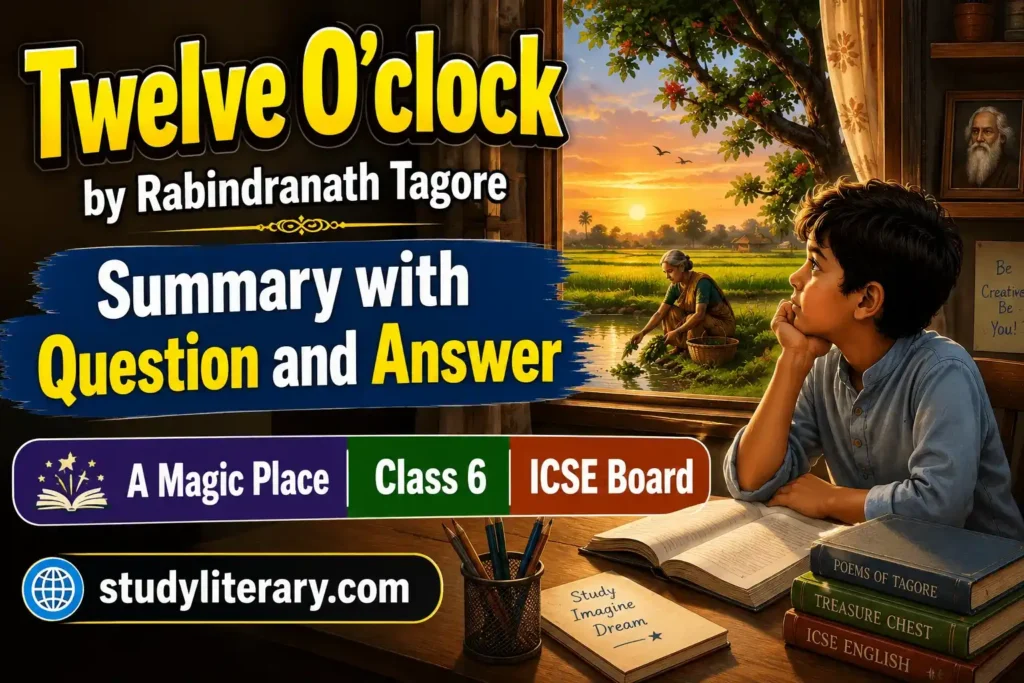
Twelve O’clock Summary with Question and Answer
Table of Contents
ToggleTwelve O’clock Line by Line in Hindi/Urdu
Mother, I do want to leave off my lessons now.
Maa, main ab apni padhai band karna chahta hoon.
I have been at my books all the morning.
Main poori subah se lagataar apni kitaabein padh raha hoon.
You say it is only twelve o’clock.
Aap kehti hain ki abhi sirf baarah baje hain.
Suppose it isn’t very late; can’t you ever think it is afternoon when it is only twelve o’clock?
Maan lijiye ki abhi bahut der nahi hui hai; lekin kya aap yeh nahi soch sakti ki abhi dopahar ho gayi hai, jabki sirf baarah baje hain?
I can easily imagine now that the sun has reached the edge of that rice-field,
Main aasani se kalpana kar sakta hoon ki ab suraj us dhaan ke khet ke kinaare tak pahunch gaya hai.
and the old fish-woman is gathering herbs for her supper by the side of the pond.
Aur woh boodhi machhli bechne wali aurat talab ke kinaare apne raat ke khaane ke liye jari-bootiyan jama kar rahi hai.
I can just shut my eyes and think
Main bas apni aankhen band karke aisa soch sakta hoon.
that the shadows are growing darker under the Madar tree,
Ki Madar ke ped ke neeche saaye dheere-dheere aur gehre ho rahe hain.
and the water in the pond looks shiny black.
Aur talab ka paani chamakta hua kaala nazar aa raha hai.
If twelve o’clock can come in the night,
Agar raat ko bhi baarah baje ho sakte hain,
Why can’t the night come when it is twelve o’clock?
To phir baarah baje raat kyun nahi aa sakti?
Twelve O’Clock by Rabindranath Tagore Summary
The poem “Twelve O’Clock” is about a young child who is tired of studying and wants to stop his lessons. He tells his mother that he has been reading his books all morning and asks if he can finish now. However, his mother says that it is only twelve o’clock, so it is not yet time to stop studying.
The child has a very strong imagination. He asks his mother to imagine that it is already afternoon, even though it is only noon. He then imagines that the sun has reached the edge of the rice-field, an old fish-woman is collecting herbs for her evening meal, the shadows under the Madar tree are becoming darker, and the water in the pond looks shiny black. These are all signs that evening has come.
Finally, the child gives a clever and innocent argument. He says that since there is a twelve o’clock at night, why can’t night come when it is twelve o’clock in the day? He hopes that time will move faster so that his lessons will end and he can enjoy his free time.
Twelve O’Clock by Rabindranath Tagore Summary in Hindi/Urdu
Is poem mein ek chhota bachcha apni maa se kehta hai ki woh ab aur padhai nahi karna chahta, kyunki woh poori subah se kitaabein padh raha hai. Maa use batati hai ki abhi sirf baarah baje hain, isliye abhi padhai khatam karne ka waqt nahi hua.
Lekin bachcha apni imagination ka istemal karta hai. Woh apne zehan mein imagine karta hai ki asal mein shaam ho chuki hai. Woh sochta hai ki suraj dhaan ke khet ke kinaare pahunch gaya hai, ek boodhi aurat talab ke paas raat ke khaane ke liye jari-bootiyan jama kar rahi hai, Madar ke ped ke neeche saaye gehre ho rahe hain aur talab ka paani kaala aur chamakta hua nazar aa raha hai.
Aakhir mein bachcha ek bahut hi masoom aur mazedaar sawaal karta hai: “Agar raat ko baarah baje ho sakte hain, to dopahar ke baarah baje raat kyun nahi aa sakti?”
Is tarah bachcha apni masoomiyat, imagination aur azaadi ki khwahish ko zahir karta hai. Woh asal mein chahta hai ki waqt jaldi guzre, padhai khatam ho aur ause khelne aur apni marzi se waqt guzarne ka mauka mile.
Twelve O’clock by Rabindranath Tagore Question and Answer
A. Answer these questions.
1. What is the child’s request to the mother?
The child requests his mother to let him stop his lessons because he has been studying since morning. He asks her to imagine that it is already afternoon so that he can finish his studies.
2. Why does the child want time to move fast?
The child wants time to move fast because he is tired of studying and wishes to be free. He wants evening to come quickly so that he can stop his lessons and enjoy his free time.
3. The sun is described with reference to a place and a person. What are these references?
The sun is described with reference to “the edge of the rice-field” and “the old fish-woman”, who is gathering herbs beside the pond for her supper.
4. What does the child imagine at noon?
At noon, the child imagines that it is already evening. He pictures the sun setting near the rice-field, the old fish-woman gathering herbs, dark shadows under the Madar tree, and the pond water looking shiny black.
5. How does the child imagine the coming of evening?
The child imagines evening by seeing the sun near the rice-field, the fish-woman preparing for supper, the shadows growing darker under the Madar tree, and the pond water becoming shiny black.
6. What is the ‘twelve o’clock’ argument put forward by the child?
The child argues that since twelve o’clock comes at both noon and midnight, night should also be able to come at twelve o’clock. This innocent argument shows his imagination and his wish to finish his lessons quickly.
B. Read these lines and answer the questions with reference to the context.
1. “You say it is only twelve o’clock. Suppose it isn’t very late; can’t you ever think it is afternoon when it is only twelve o’clock?”
a. What does the child feel towards the mother?
The child feels love, respect, and trust towards his mother. He politely requests her to imagine that it is already afternoon so that he can stop his lessons.
b. How do you know?
We know this because the child speaks politely and gently to his mother. Instead of arguing, he tries to convince her with his innocent imagination and respectful words.
2. “I can easily imagine now that the sun has reached the edge of that rice-field, and the old fish-woman is gathering herbs for her supper by the side of the pond.”
a. What is the child trying to prove by using the word ‘easily’?
By using the word “easily,” the child shows that he can quickly imagine it is already evening. It highlights his strong imagination and his wish for time to pass faster.
b. Describe the two images in these lines.
The first image is the sun reaching the edge of the rice-field, showing that evening is near. The second image is the old fish-woman gathering herbs beside the pond for her supper, creating a peaceful picture of village life in the evening.