
Table of Contents
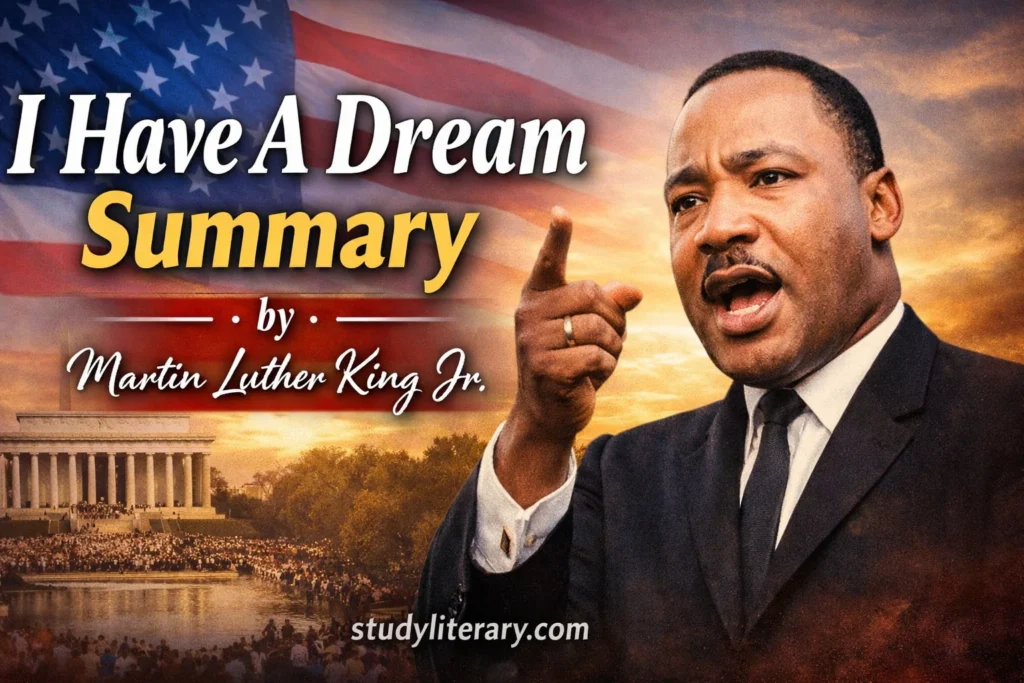
ToggleI Have a Dream Summary By Martin Luther King Jr.
Delivered at the March on Washington
1. Introduction: Purpose of the Gathering
Martin Luther King Jr. begins his speech by expressing his happiness to stand before a large crowd at what he calls the greatest demonstration for freedom in American history. He explains that the people gathered there are demanding justice, equality, and civil rights for Black Americans. The purpose of the speech is not only to inspire emotions but also to highlight the serious injustice faced by Black citizens. He makes it clear that this gathering is meant to draw national attention to racial discrimination and to demand immediate change in American society.
2. Reference to the Emancipation Proclamation
King refers to the historic moment one hundred years earlier when President Abraham Lincoln signed the Emancipation Proclamation, which officially ended slavery in America. He describes it as a great light of hope for millions of enslaved Black people. However, he strongly states that even after one hundred years, Black Americans are still not truly free. Although slavery has ended legally, racism, segregation, and discrimination still continue in many parts of the country. Therefore, the promise of freedom given a century ago has not been fully achieved.
3. Condition of Black Americans
King explains that Black Americans are still suffering from poverty, social injustice, and racial segregation. He uses powerful images to describe their condition, saying they live on a lonely island of poverty in the middle of a rich and prosperous nation. He says they feel like strangers or exiles in their own country. Because of unfair laws and social practices, they are denied equal opportunities in education, employment, housing, and public facilities. This painful reality is the reason why they have come to the nation’s capital—to show the world this shameful condition.
4. The “Bad Check” Metaphor
One of the most important parts of the speech is the metaphor of a “bad check.” King explains that when the founding fathers wrote the Constitution and the Declaration of Independence, they promised all Americans the rights of life, liberty, and the pursuit of happiness. This promise was like a promissory note guaranteeing equality to every citizen, including Black Americans. However, when Black citizens tried to claim these rights, America gave them a bad check marked “insufficient funds.” King says they have come to Washington to cash this check and demand that the nation fulfill its promise of justice and equality.
5. Non-Violence and Discipline
King advises that the struggle for civil rights must remain peaceful and dignified. He warns the people not to allow anger or frustration to turn into violence. According to him, their protest must stay on the high level of discipline and moral strength. He also emphasizes that not all white Americans are enemies, as many white citizens are supporting the civil rights movement. He stresses unity and cooperation, saying that the future of Black Americans is closely connected with the future of white Americans. Therefore, the movement must be guided by love, patience, and peaceful resistance.
6. “We Can Never Be Satisfied”
King clearly states that Black Americans cannot be satisfied as long as injustice continues. He gives several examples, such as police brutality, racial segregation in hotels and public places, poor living conditions, humiliation caused by “For Whites Only” signs, and the denial of voting rights in some states. He repeats the phrase “We can never be satisfied” to show strong determination. He declares that the struggle will continue until justice flows like water and righteousness like a powerful stream, meaning until true equality is achieved everywhere in America.
7. The Dream of Equality
In the most famous part of the speech, King shares his dream for the future of America. He says he dreams that one day the nation will truly believe that all men are created equal. He imagines a time when the sons of former slaves and the sons of former slave owners will sit together as brothers. He dreams that even the most racist states will become places of freedom and justice. He also dreams that his own children will be judged not by the color of their skin but by their character. This dream represents hope for racial harmony, equal rights, and peaceful coexistence among all people.
8. “Let Freedom Ring”
Towards the end of the speech, King uses patriotic language and repeats the phrase “Let freedom ring.” He mentions different mountains and states of America to show that freedom must spread everywhere in the country. He wants liberty and equality to reach every city, village, and community. According to him, when freedom rings from every corner of America, people of all races and religions will join hands and celebrate together as equals. This powerful ending fills the audience with hope and confidence.
9. Conclusion: Hope and Faith
King ends the speech with strong hope and faith in the future. He believes that if people remain united and continue their peaceful struggle, real freedom will come. He imagines a day when all Americans—Black and white, rich and poor—will celebrate together and proudly say that they are finally free. The speech closes with emotional power, leaving a lasting message that justice and equality will win in the end.
Life and Works of Martin Luther King Jr.
Martin Luther King Jr. was born on 15 January 1929 in Atlanta, Georgia, USA. He was born into a religious and educated family. His father was a Baptist minister, and his mother was a school teacher. From childhood, King experienced racial discrimination, which deeply affected him. He was a brilliant student and skipped two grades in school. At the age of 15, he entered Morehouse College. Later, he studied theology and earned a doctorate degree in systematic theology from Boston University. During his studies, he was influenced by the ideas of non-violence taught by Mahatma Gandhi. These ideas later became the foundation of his civil rights movement.
King became nationally famous during the Montgomery Bus Boycott in 1955. This protest began after Rosa Parks refused to give up her bus seat to a white passenger. King was chosen as the leader of the movement. The boycott lasted for more than a year and finally ended segregation in public buses. This success made King a major leader of the American Civil Rights Movement. He believed in peaceful protest and civil disobedience instead of violence
King led many peaceful movements to demand equal rights for Black Americans. In 1963, he led the historic March on Washington, where he delivered his famous “I Have a Dream” speech. In this speech, he demanded equality and justice for all races. His leadership played an important role in the passing of the Civil Rights Act of 1964, which ended segregation in public places, and the Voting Rights Act of 1965, which protected the voting rights of Black citizens. In 1964, he was awarded the Nobel Peace Prize for his non-violent struggle against racial injustice. He was the youngest person at that time to receive this award.
King strongly believed in non-violence, equality, and brotherhood. He was inspired by Christian teachings and Mahatma Gandhi’s philosophy of peaceful resistance. He believed that love and peace are more powerful than hatred and violence. According to him, injustice anywhere is a threat to justice everywhere. His speeches and writings encouraged people to fight against injustice with courage but without hatred.
Martin Luther King Jr. was assassinated on 4 April 1968 in Memphis, Tennessee. His death shocked the entire world. However, his ideas and mission did not die. Today, he is remembered as one of the greatest leaders in world history. His birthday is celebrated as a national holiday in the United States. His life and works continue to inspire people to fight for equality, human rights, and social justice.
Martin Luther King Jr. was not only a civil rights leader but also a symbol of peace and equality. Through his speeches, movements, and sacrifices, he changed American society and inspired the whole world. His life teaches us that peaceful struggle and strong determination can bring great social change.
Major themes of “I Have a Dream” by Martin Luther King Jr.
1. Racial Equality
The most important theme of the speech is racial equality. King says that Black people are not treated equally in America. Even after slavery ended, they still suffer from discrimination and segregation. He dreams of a country where all people, Black and white, are treated the same. He wants a society where skin color does not decide a person’s value.
2. Freedom
Freedom is another central theme. Although slavery was abolished long ago, true freedom has not been given to Black Americans. King demands complete freedom — social, political, and economic. When he says “Let freedom ring,” he means freedom should reach every part of America.
3. Justice
King repeatedly talks about justice. He says that America has failed to give justice to Black citizens. The famous line about justice rolling down like waters shows his strong desire for fairness. He believes justice must replace injustice in every area of life.
4. The Failure of American Promises
King explains that the Constitution and the Declaration of Independence promised equality to all citizens. However, this promise has not been fulfilled for Black Americans. Through the “bad check” metaphor, he shows that America has broken its promise. This theme highlights hypocrisy in American democracy.
5. Non-Violent Protest
King strongly supports peaceful protest. He warns people not to use violence in their struggle. According to him, the movement must be based on dignity, discipline, and moral strength. This theme shows his belief in non-violence as the best way to achieve change.
6. Unity and Brotherhood
Another important theme is unity between Black and white people. King does not promote hatred. Instead, he believes both races must work together. He dreams of a time when former slaves and former slave owners will sit together as brothers. Unity is necessary for national progress.
7. Hope and Optimism
Even though he describes many problems, the speech is full of hope. The repeated phrase “I have a dream” shows his positive vision for the future. He believes that change is possible and that equality will come one day.
8. Faith in America and God
King shows deep faith in American ideals and in God. He believes that America can correct its mistakes and become a truly great nation. His ending reflects spiritual faith and moral confidence that freedom will finally win.
Share
- Facebook
- Twitter
- Linkedin
- Whatsapp
- Pinterest
- Telegram