

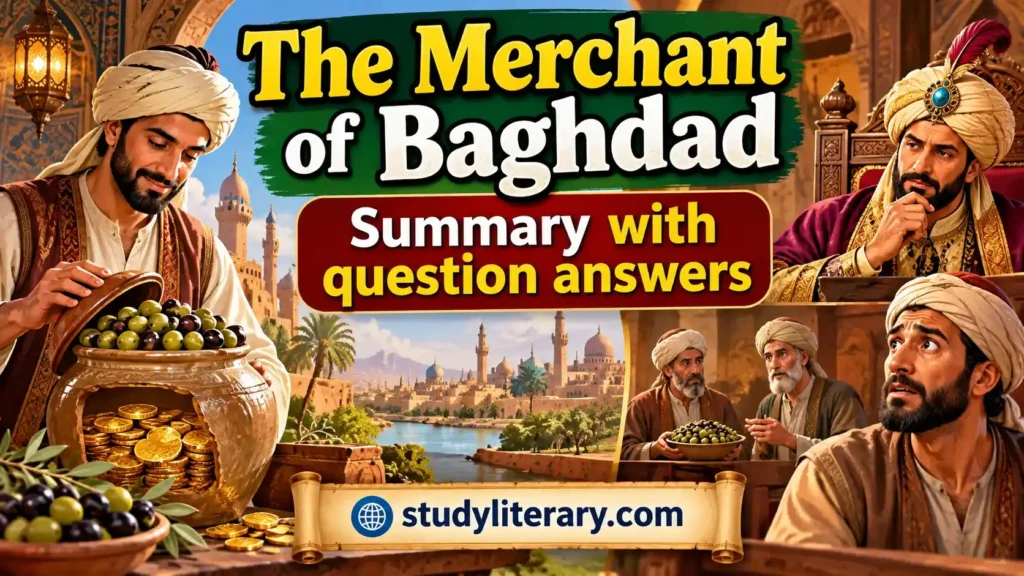
Summary of The Merchant of Baghdad
The Merchant of Baghdad is a story about trust, honesty, greed, and justice. Ali, a merchant in Baghdad, decides to travel to India. Before leaving, he sells most of his belongings and saves one thousand pieces of gold. He hides the gold under a layer of olives in a jar and asks his friend Sajid to keep the jar safely until he returns.
Ali is away for seven years. During this time, Sajid discovers the gold hidden beneath the olives. At first, he leaves it untouched because his wife, Noor, reminds him that he must respect the trust placed in him. However, when his business suffers, Sajid becomes greedy and secretly takes some of Ali’s gold, replacing it with fresh olives. Later, he decides not to return the money.
When Ali comes back, he discovers that the gold is missing. Sajid denies stealing it and claims that he never touched the jar. Since Ali has no witnesses or evidence, the judge cannot help him. Ali then appeals to Caliph Haroun al-Rashid, who agrees to hear the case.
The Caliph cleverly examines the olives and calls two olive merchants as experts. They explain that olives cannot remain fresh for seven years. Since the olives in Ali’s jar are fresh, the Caliph realizes that the jar must have been opened and its contents replaced. Sajid is exposed as a liar and confesses his crime. He is ordered to compensate Ali for the stolen gold.
The story teaches us that we should always be honest and faithful to the trust others place in us. Greed and dishonesty may remain hidden for a while, but the truth will eventually come to light. It also shows the wisdom of Caliph Haroun al-Rashid in discovering the truth through careful reasoning.
Moral: Honesty and trustworthiness are precious virtues, while greed and betrayal ultimately lead to punishment.
Summary of The Merchant of Baghdad in Hindi/Urdu
The Merchant of Baghdad ek kahani hai jo bharosa, imaandari, lalach aur insaaf ke baare mein hai. Ali Baghdad ka ek vyapari tha. Usne India jaane ka faisla kiya. Jaane se pehle usne apna zyada tar samaan bech diya aur ek hazaar sone ke sikke bacha liye. Usne sone ke sikkon ko ek bade jar mein rakha aur unke upar olives daal diye, taaki sikke chhupe rahein. Phir usne woh jar apne dost Sajid ko diya aur kaha ki uske wapas aane tak use surakshit rakhe.
Ali saat saal tak Baghdad se bahar raha. Is dauran Sajid ko olives ke neeche chhupe hue sone ke sikke mil gaye. Pehle usne sikkon ko nahi chhua, kyunki uski patni Noor ne use yaad dilaya ki Ali ne us par bharosa karke jar uske paas rakha hai. Lekin jab Sajid ka business kharab chalne laga, to woh lalach mein aa gaya. Usne chupke se Ali ke kuch sone ke sikke nikaal liye aur jar mein naye olives bhar diye. Baad mein usne paise wapas na karne ka faisla kar liya.
Jab Ali wapas aaya, to usne dekha ki jar mein sone ke sikke nahi the. Sajid ne sikke churaane se inkaar kar diya aur kaha ki usne jar ko kabhi nahi chhua. Ali ke paas koi gawah ya saboot nahi tha, isliye judge uski madad nahi kar saka. Tab Ali ne Caliph Haroun al-Rashid se insaaf maanga. Caliph uska case sunne ke liye taiyaar ho gaye.
Caliph ne bahut samajhdari se olives ki jaanch ki aur do olive vyapariyon ko bulaya. Unhone bataya ki olives saat saal tak taaze nahi reh sakte. Ali ke jar ke olives taaze the. Isse Caliph samajh gaye ki jar ko zaroor khola gaya tha aur purane olives ko naye olives se badla gaya tha. Is tarah Sajid ka jhooth pakda gaya. Sajid ne apna jurm maan liya aur use Ali ke churaaye hue sone ke sikkon ka muawza dena pada.
Yeh kahani humein sikhati hai ki humein hamesha imaandar rehna chahiye aur doosron ke bharose ko kabhi nahi todna chahiye. Lalach aur beimaani kuch samay tak chhup sakti hai, lekin aakhir mein sach saamne aa hi jaata hai. Yeh kahani Caliph Haroun al-Rashid ki samajhdari bhi dikhati hai, jinhone dhyaan se sochkar sach ka pata lagaya.
Moral: Imaandari aur bharosemand hona bahut achhi qualities hain. Lalach, beimaani aur kisi ka bharosa todne ka natija aakhir mein bura hi hota hai.
The Merchant of Baghdad Question and Answer
A. Answer the Following Questions
1. Why did Ali cover the gold coins with olives?
Ali covered the gold coins with olives to hide and protect his money while he was away on his journey to India.
2. Why did Sajid’s wife ask him not to open Ali’s jar?
Sajid’s wife, Noor, asked him not to open the jar because Ali had entrusted it to him, and opening it would be a betrayal of his friend’s trust. She also believed that the olives would have spoiled after seven years.
3. Why did Sajid take out some gold coins from the jar?
Sajid took out some gold coins because his business was not doing well and he needed money. He planned to return the money when his business improved, but later he became greedy and decided not to repay Ali.
4. What did Ali do when he realised that Sajid had lied to him?
When Ali realised that Sajid had lied to him, he asked Sajid to return his one thousand gold coins. When Sajid refused, Ali went to the judge for justice, and later appealed to Caliph Haroun al-Rashid when the judge could not settle the case.
5. Why did the Caliph call for the olive merchants?
The Caliph called for the olive merchants to find out whether the olives could remain fresh for seven years. Their expert knowledge would help him determine whether the jar had been opened and the olives replaced.
6. What was the observation that the olive merchants had about the olives in the jar?
The olive merchants observed that the olives were fresh and from the current year. They explained that olives could not remain fresh for seven years, so the jar must have been opened and the old olives replaced.
7. What happened to Sajid in the end?
In the end, the Caliph discovered that Sajid had stolen Ali’s gold. Sajid confessed his crime, and he was ordered to compensate Ali for the stolen money.