
Table of Contents
ToggleMain Characters
Santiago – an old, poor fisherman who hasn’t caught a fish in 84 days.
Manolin – a young boy who loves and learns fishing from Santiago.
The Marlin – a giant fish symbolizing Santiago’s greatest challenge.
The Sharks – enemies that test Santiago’s courage and strength.
The Old Man and The Sea Summary
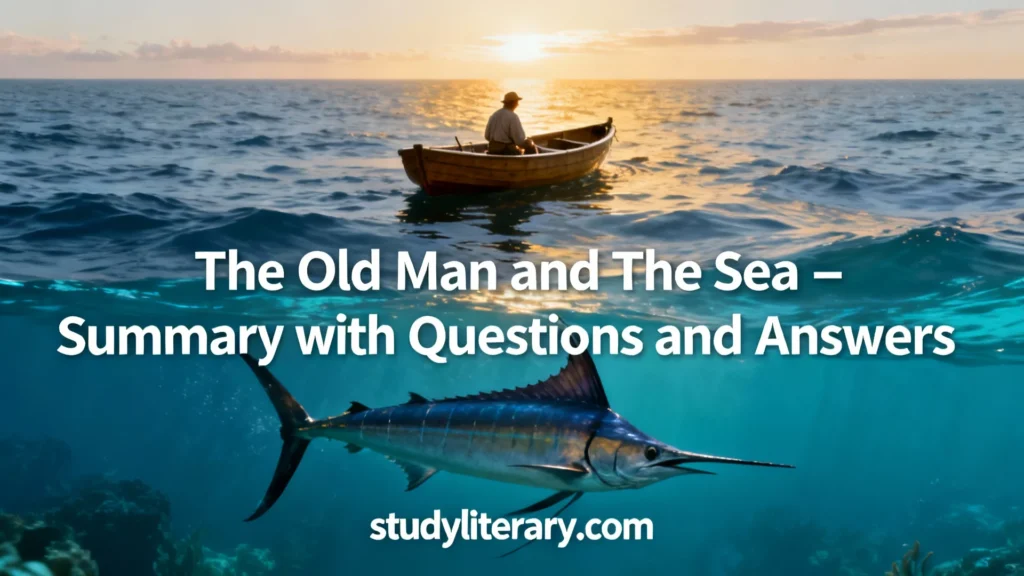
Santiago, an old fisherman in a Cuban village, has gone 84 days without catching any fish. People say he is “salao,” the unluckiest man alive.
A boy named Manolin used to fish with him but was forced by his parents to go with another, luckier boat. Despite that, the boy still loves and helps Santiago every day — bringing him food, bait, and hope.
At night, they talk about baseball, especially Santiago’s hero Joe DiMaggio, who plays even with pain — like Santiago, who never gives up.
The boy wishes to go fishing with him again, but Santiago says no; he doesn’t want to ruin the boy’s luck.
On the 85th day, Santiago goes alone, determined to prove his strength and luck.
He sails far into the deep Gulf Stream, farther than the other fishermen dare to go.
He feels the beauty of nature — the flying fish, the birds, the calm sea — and believes that the sea (“la mar”) is a woman who gives and takes life.
He carefully prepares his fishing lines at different depths, using small tuna as bait, waiting patiently.
Finally, a huge marlin (a type of swordfish) takes his bait deep in the water. Santiago feels its great power. The fish is so strong that it pulls his small boat far out into the sea.
For two full days and nights, Santiago holds the line with bleeding hands, his back and arms aching.
He talks to the fish, calling it his brother and admiring its strength and dignity.
He remembers his youth and prays for strength like DiMaggio, who played through pain.
Santiago fights the marlin in silence and pain.
Finally, after a long struggle, he kills it with his harpoon. The fish is the biggest he has ever seen — longer than his boat.
He ties it beside the skiff and begins the journey home, proud but exhausted.
But his victory doesn’t last. The marlin’s blood attracts sharks.
He fights them bravely — killing some with his harpoon, then using a knife, then a club — but more and more come.
They tear the marlin apart, leaving only its skeleton tied to the boat.
Santiago feels deep sadness, not anger. He says the sharks destroyed his dream but not his pride.
Santiago reaches the shore at night, completely worn out.
He carries his mast on his shoulder — like a cross, symbolizing his suffering and strength — and falls into bed, deeply asleep.
In the morning, the villagers see the huge skeleton tied to his boat and realize how great his catch was.
Manolin cries when he finds the old man hurt and promises to fish with him again.
The old man dreams again of lions playing on African beaches, a symbol of his youth, hope, and spirit that will never die.
Themes
Perseverance – Santiago never gives up, no matter how hopeless things seem.
Pride and Dignity – Even in defeat, Santiago remains noble.
Man vs. Nature – The story celebrates respect, not war, between man and nature.
Loneliness and Friendship – Santiago’s bond with Manolin gives him emotional strength.
Spiritual Strength – His pain and endurance show a Christ-like spirit.
Life and Works of Ernest Hemingway
Ernest Miller Hemingway (1899–1961) stands as one of the most influential writers of the twentieth century — a man whose life often seemed as dramatic and symbolic as his fiction. Soldier, journalist, sportsman, and artist, Hemingway forged a literary style and a moral vision that changed the shape of modern prose. His life and his art are inseparable: both express a deep fascination with courage, endurance, and the dignity of facing life’s brutal realities.
Early Life and Influences
Hemingway was born on July 21, 1899, in Oak Park, Illinois, into a conservative, upper-middle-class family. His father, a physician, taught him to hunt and fish, while his mother instilled in him a love of music and discipline. The duality of nature and culture — of masculinity and sensitivity — would later define his art.
After high school, Hemingway began his career as a journalist, working for The Kansas City Star, whose style guide emphasized short sentences, vigorous English, and understatement — principles that shaped his signature prose.
War and the Making of a Writer
In World War I, Hemingway served as an ambulance driver on the Italian front, where he was seriously wounded. The horror and disillusionment of war marked him profoundly. His first major novel, A Farewell to Arms (1929), drew directly from these experiences, blending romance and tragedy against the chaos of war. Like many writers of the “Lost Generation,” Hemingway struggled to find meaning in a fractured modern world.
After the war, he settled in Paris among other expatriate artists — Gertrude Stein, Ezra Pound, and F. Scott Fitzgerald. Stein famously called them “a lost generation,” a phrase that Hemingway immortalized in the epigraph to The Sun Also Rises (1926), his first great novel. Set against the backdrop of bullfighting and postwar aimlessness, it captured the spiritual exhaustion of the 1920s youth.
The Mature Works and the Code of Courage
Throughout his career, Hemingway sought to portray life stripped to its essentials — violence, love, endurance, and death — through an objective, almost sculptural style. His prose, spare and rhythmic, became known as the “iceberg theory”: only a fraction of meaning is visible on the surface, while the deeper emotions lie submerged.
Some of his finest works include:
The Sun Also Rises (1926) – explores moral dislocation and lost ideals after WWI.
A Farewell to Arms (1929) – a tragic love story and antiwar meditation.
For Whom the Bell Tolls (1940) – set in the Spanish Civil War, fusing political commitment with individual heroism.
The Old Man and the Sea (1952) – a parable of endurance and grace, earning him the Pulitzer Prize.
Men Without Women (1927) and The Snows of Kilimanjaro (1936) – short stories that distill his art to its purest emotional essence.
In each, Hemingway’s protagonists — soldiers, bullfighters, fishermen, hunters — live by a moral code defined not by victory, but by courage, self-control, and honor under pressure. His “code hero” endures suffering without complaint, measuring life not by success but by grace in defeat.
Later Years and Decline
Hemingway’s later years were marked by both fame and fragility. He reported on World War II, witnessed the liberation of Paris, and was celebrated as an international literary icon. In 1954, he received the Nobel Prize in Literature, honored for his “mastery of the art of narrative” and the influence of The Old Man and the Sea.
Yet behind the legend was a man haunted by illness, depression, and the ghosts of violence. His lifelong injuries, heavy drinking, and genetic predisposition to mental illness deepened his despair. On July 2, 1961, at his home in Ketchum, Idaho, Hemingway ended his life with a shotgun — a tragic conclusion that mirrored the fatalism of his fiction.
Style and Legacy
Hemingway’s style revolutionized modern prose. His sentences are short, declarative, and rhythmically precise — each word chosen for its weight. His understatement, what he called “the dignity of movement of an iceberg,” allows emotion to emerge through restraint.
Critically, he bridged realism and modernism, combining the clarity of journalism with the symbolic depth of myth. His heroes — stoic men confronting chaos — became archetypes of twentieth-century masculinity, yet his works also reveal profound tenderness and moral introspection.
His influence can be seen across generations — from Raymond Carver’s minimalism to Norman Mailer’s machismo, from Cormac McCarthy’s violence to Joan Didion’s clarity. Hemingway’s art endures because it expresses a truth that transcends style: that courage and authenticity define human worth.
Conclusion
Ernest Hemingway’s life was a paradox of strength and vulnerability — a man who hunted, fought, and loved fiercely, yet was also wounded, sensitive, and haunted by meaning. His fiction, distilled from experience, remains a testament to the dignity of endurance.
As Santiago says in The Old Man and the Sea, “A man can be destroyed but not defeated.” In many ways, Hemingway himself lived and died by that creed. Though destroyed by his own demons, he remains undefeated in literature — a writer whose art continues to illuminate the grandeur and tragedy of being human.
The Old Man and The Sea Questions and Answers
Q1. “The Old Man and the Sea” is about man’s archetypal battle with the forces of nature. Discuss.
Ernest Hemingway’s The Old Man and the Sea is not merely a tale of a fisherman’s struggle with a marlin. It is a timeless fable — almost mythic in simplicity and resonance — about humankind’s perpetual, dignified confrontation with the vast and indifferent forces of the natural world. Beneath its deceptively simple surface lies an elemental vision: man, stripped of everything but his will and faith, testing the boundaries of his endurance against nature’s inscrutable power.
At first glance, the novella reads like a classical contest — one man, one fish, and the sea. Yet what gives this story its lasting depth is Hemingway’s transformation of this physical battle into an archetypal one. Santiago’s ordeal is not personal misfortune; it is the distilled image of humankind’s eternal drama — the struggle to find meaning and dignity within a universe that offers no guarantees.
Nature: The Opponent and the Ally
Hemingway’s sea is not a mere setting; it is a living, feminine presence — “la mar,” as Santiago calls it, not el mar. In this subtle linguistic gesture, Hemingway draws a sharp contrast between the younger fishermen who see the sea as an enemy and Santiago, who regards it as a beloved woman — capricious, generous, and cruel by turns. Nature, for Santiago, is not a foe to be conquered but a partner in an ancient dance of respect and risk. His contest with the marlin thus carries an almost ritual purity — a sacrament of survival where both man and fish participate in a cycle older than history itself.
This respect elevates the battle beyond material struggle. Santiago does not hate the fish; he calls it brother. “You are killing me, fish,” he says, “but you have a right to.” Such words dissolve the simple boundary between hunter and prey. The marlin becomes a mirror to the old man — another embodiment of strength, nobility, and endurance. What Hemingway reveals is not the victory of man over nature, but the tragic beauty of man within nature — the brief flare of consciousness defying an indifferent sea.
The Archetype of Struggle
Santiago’s struggle echoes the ancient myths of Prometheus, Sisyphus, and Odysseus — figures who, like him, confront the vastness of fate with lonely courage. Yet Hemingway modernizes this archetype by removing the gods. The world of The Old Man and the Sea is not divine but elemental. The sea replaces Olympus, the marlin replaces the dragon, and the human spirit stands alone without divine protection. Hemingway’s philosophy of the “code hero” — the belief that true grace lies in enduring defeat without surrender — finds its purest expression here.
When Santiago kills the marlin, he achieves a kind of tragic triumph. But the sharks soon come, devouring the marlin until only its skeleton remains. It seems nature has reclaimed her own. Yet paradoxically, Santiago is not defeated. His physical loss becomes a moral victory: he has proved that “a man can be destroyed but not defeated.” This is the paradox at the heart of Hemingway’s art — defeat as the highest form of victory, because it reveals the spiritual endurance that defines humanity.
Nature’s Indifference and Man’s Meaning
Nature in Hemingway’s world has no pity and no malice; it simply is. The sea’s cruelty is not moral but existential. Santiago, who has lived his life at sea, knows this. He neither curses nor romanticizes it. He accepts the law of the natural order: “Everything kills everything else in some way.” Yet he also sees beauty in that inevitability. The marlin’s death, his own wounds, even the sharks’ feeding — all belong to one seamless rhythm of life and death.
In this, Hemingway approaches a form of stoic spirituality. Santiago’s endurance is not grounded in faith in God but in faith in human dignity. His prayers are half ritual, half superstition; what sustains him is not theology but will. Nature may destroy the body, but it cannot break the human spirit.
The Sea as the Soul’s Mirror
The sea mirrors Santiago’s inner condition. Its calm mornings and violent nights externalize the fluctuations of his own faith and fatigue. As he drifts, his solitude takes on cosmic significance. The narrative moves from realism to allegory: the skiff becomes the stage of human existence, the ocean a symbol of the unknown. When Santiago dreams of the lions on the African beaches — creatures of strength, youth, and freedom — we sense that nature is not merely his adversary but also the source of his most innocent and eternal longing.
Conclusion: The Eternal Contest
In the end, The Old Man and the Sea is not about a man winning or losing a fish; it is about the human spirit affirming its worth against the unfeeling vastness of existence. Santiago’s struggle with the marlin is every man’s struggle with fate, time, and mortality. Nature does not yield, yet it grants meaning through resistance. The old man’s wounds become the stigmata of endurance, his skiff a crucifix of solitude.
In this way, Hemingway’s novella transcends realism to become myth: a modern scripture of courage without illusion, faith without theology, and beauty without comfort. Santiago’s battle with nature is humanity’s ongoing dialogue with the infinite — fierce, futile, and yet profoundly sacred.
Q2. Comment on the relationship between Santiago and Manolin in The Old Man and the Sea.
At the heart of The Old Man and the Sea lies one of the most tender and understated relationships in modern fiction — the bond between the aged fisherman Santiago and the boy Manolin. Their relationship is not built on sentimentality, but on the quiet endurance of love that transcends generations, social status, and even words. It is a rare example of emotional purity — the kind that is not declared but lived, as natural as the tide that shapes their lives.
The Human Core of a Solitary Fable
Hemingway’s novella, often read as a parable of man’s isolation and endurance, would risk being unbearably bleak without the presence of the boy. Manolin anchors Santiago in the realm of human warmth. The old man’s days at sea are defined by struggle, but his evenings — shared with the boy — are filled with the small rituals of care: food, talk of baseball, and affectionate teasing. Their bond softens the existential austerity of the story. The boy’s devotion is the only unbroken current in Santiago’s life, the one thing that resists the erosion of age, poverty, and failure.
It is worth noting that Manolin is not Santiago’s son, yet their relationship radiates a quiet filial intimacy. The boy’s biological father forbids him to fish with Santiago, declaring the old man “salao” — unlucky — but Manolin’s spiritual loyalty cannot be commanded. “There are many good fishermen,” he tells the old man, “but there is only you.” In that simple sentence, Hemingway captures the essence of reverence that transcends mere admiration. The boy sees in Santiago not a failure but a figure of authenticity — the living embodiment of the fisherman’s ideal: courage, humility, and endurance.
Mentorship and Moral Continuity
Santiago has taught Manolin how to fish, but what he truly teaches is something deeper — a moral and existential code. Hemingway’s heroes rarely preach, yet they teach through the dignity of their bearing. The boy’s faith in the old man is not based on material success but on the integrity with which he faces failure. Even when Santiago insists that Manolin should remain with a “lucky boat,” the boy’s loyalty persists. This quiet obedience — mingled with unspoken resistance — marks the passage from apprenticeship to emotional maturity. Manolin’s devotion restores to the old man a sense of continuity, of life that will endure beyond his own frail body.
The relationship also functions symbolically. Santiago and Manolin represent two ends of the human cycle — age and youth, experience and promise. Their bond bridges mortality and renewal. Hemingway, who wrote the novella after years of personal and creative decline, may have seen in Manolin the embodiment of faith — faith not in success, but in the endurance of values. Santiago’s courage becomes a legacy that Manolin inherits; his physical defeat becomes the boy’s moral initiation.
A Love Beyond Dependency
What is striking about their relationship is its lack of sentimentality. Santiago does not weep or embrace the boy in melodramatic gestures. Their affection is expressed through service: the boy brings sardines, coffee, and newspapers; Santiago offers stories, memories, and trust. Their talk of baseball — especially of Joe DiMaggio — functions as a shared mythology, a secular form of prayer. Baseball becomes their language of hope, translating heroism into something familiar and repeatable. When Santiago compares his endurance to DiMaggio’s pain from a bone spur, he connects himself to the boy through the shared belief that true greatness lies in quiet perseverance.
Even the way they address each other — “old man,” “my son” — suggests both equality and affection. There is no hierarchy between them; their bond dissolves the traditional gap between age and youth. The old man accepts the boy’s help without pride, and the boy serves without pity. Their relationship thus transcends the ordinary pattern of dependence; it becomes a communion of spirits. In their simplicity, they embody what Hemingway admired most: loyalty without expectation, love without rhetoric.
Presence in Absence
Once Santiago goes to sea, the boy disappears from the narrative — but his absence is profoundly felt. The old man often speaks aloud to himself, as if addressing Manolin across the water. His imagined dialogues with the boy become a lifeline during his ordeal. “I wish I had the boy,” he repeats, not merely for help, but for companionship — for the presence of faith that the boy represents. In the vast solitude of the sea, Santiago’s thoughts of Manolin keep his humanity alive. The boy becomes an inward voice — the echo of love that keeps despair at bay.
In this sense, Manolin’s role parallels that of the marlin: both are reflections of Santiago’s soul. The marlin embodies his strength; the boy embodies his tenderness. Between them, they complete the image of the old man’s humanity — fierce and gentle, solitary and loved.
The Final Benediction
When Santiago returns, defeated yet spiritually triumphant, it is Manolin who restores the human circle. The boy finds him asleep, sees his wounded hands, and weeps — not for pity, but for reverence. His vow — “Now we fish together” — becomes a quiet consecration. The story that began with separation ends with reunion. In Manolin’s eyes, Santiago’s suffering has transformed him into something saintly. The old man’s body, scarred and sleeping, resembles a crucified Christ; the boy becomes the first disciple of a gospel written in endurance.
Conclusion: The Circle of Human Continuity
Their relationship, stripped to its essence, is about continuity through compassion. Santiago’s greatness lies not in his solitary victory but in the love he inspires. Through Manolin, his values will survive. Hemingway thus redeems the stark isolation of his world with the smallest but most luminous human bond: the faith between one old man and one boy.
In a work often described as an allegory of man’s loneliness, it is this relationship that keeps the novella human, warm, and redeeming. The sea may test Santiago’s strength, but the boy affirms his soul. And in that affirmation, the old fisherman’s endurance becomes something eternal — a legacy of love cast forward, like a line across the dark waters of time.
Q3. The Character of Santiago in The Old Man and the Sea
Santiago, the old fisherman at the center of Hemingway’s novella, is one of literature’s most haunting portraits of human endurance — a man both ordinary and mythic, frail and indestructible. At first, he seems a figure of simple realism: an aged Cuban fisherman who has gone eighty-four days without catching a fish. Yet as the story unfolds, he grows into something larger — a universal emblem of courage, faith, and the unyielding dignity of the human spirit. Hemingway, with his lean prose and emotional restraint, sculpts Santiago not as a saint or hero in the traditional sense, but as a man who transcends defeat through the sheer purity of his struggle.
1. The Code Hero Reimagined
Hemingway’s fiction often circles around the figure of the code hero — the individual who maintains grace under pressure, who lives by an internal code of honor even when the external world collapses. Santiago is perhaps the purest embodiment of that ideal. His code is simple yet absolute: to endure without complaint, to act with skill and humility, and to measure victory not by success but by integrity. “A man can be destroyed but not defeated,” he says — the quiet credo that defines his existence.
Santiago’s heroism is not that of conquest but of constancy. When the novel opens, he is already isolated, poor, mocked by the other fishermen. Yet he bears this humiliation with quiet composure. There is no self-pity in him. His pride is not arrogance but a kind of inward flame — what the Greeks called thumos, the life-force of courage. Even his poverty is carried with elegance. His patched sail “looked like the flag of permanent defeat,” yet he hoists it each morning with the same quiet ritual, as if participating in an ancient ceremony of renewal.
2. The Spiritual Solitude
Although The Old Man and the Sea is outwardly a story about fishing, its inner movement is spiritual. Santiago’s journey into the sea is, in essence, a pilgrimage — a movement away from the social world and into the deep waters of self-confrontation. Alone on his skiff, he faces not only the marlin but the vast silence of existence itself. The sea becomes the stage of his soul; its calm and cruelty mirror the oscillations of his own endurance.
Santiago prays, but his religion is instinctive rather than orthodox. He mutters Hail Marys as one might repeat a charm against chaos. His true faith is in skill — the hard-earned knowledge of his craft — and in the natural order that links man, fish, and sea. When he calls the marlin “brother,” it is not metaphor but revelation: he recognizes himself in the creature he must kill. Santiago’s spirituality thus arises not from piety but from a profound sense of kinship with all living things — a pantheistic reverence that borders on the tragic.
3. The Warrior and the Saint
Santiago is both warrior and saint — his strength physical, his endurance moral. His body, scarred and weathered, is the record of a lifetime of struggle. His hands are covered with “deep-creased scars from handling heavy fish,” like sacred stigmata earned through labor. When he battles the marlin, his suffering acquires the rhythm of a ritual ordeal: the torn palms, the bleeding back, the exhaustion that borders on transfiguration. Hemingway’s imagery evokes the Passion of Christ — the lonely suffering, the burden borne in silence, the final collapse beneath the mast that mirrors the carrying of the cross. Yet Santiago’s divinity is entirely human. His sainthood arises not from miracle but from persistence — from his refusal to betray the craft, the fish, or himself.
4. Santiago’s Relationship with Nature
Santiago’s greatness lies in his attitude toward nature — at once reverent and realistic. He sees the sea as la mar, the feminine sea, capable of generosity and cruelty. He neither curses nor conquers her; he participates in her cycles. His respect for the marlin is genuine, even tender: “I do not care who kills who,” he says. “To kill him with dignity will be enough.” This paradox — love interwoven with violence — is central to Santiago’s moral complexity. He kills not out of hatred but because to live, one must engage in the eternal contest. In doing so, he becomes both participant and victim of nature’s law.
His communion with the natural world extends to the smallest details: the birds, the stars, the turtles, even the jellyfish. Each is part of a larger harmony that Santiago senses intuitively. The sea, for him, is both mirror and measure. It reflects his own solitude but also his belonging; it tests his limits but also grants him meaning.
5. The Tragic Victor
Santiago’s defeat by the sharks — who devour his great marlin until only the skeleton remains — is not the negation of his heroism but its consummation. In the Hemingwayan ethic, what matters is not the outcome but the endurance. Santiago loses everything but his form — his capacity to suffer nobly. When he returns to the village, broken and asleep, he carries the mast on his shoulder like a cross; the villagers see only the bones of the fish, but the boy Manolin sees the invisible victory. Santiago’s struggle has elevated him beyond the ordinary world — he has become, in defeat, a myth.
Even his dream of the lions at the end is symbolic: the lions are not literal animals but emblems of youthful vigor, freedom, and eternity. They represent the cyclical triumph of life over decay, the soul’s capacity to imagine beyond suffering. The old man sleeps, but the dream continues — an image of renewal after ordeal.
6. Santiago as Everyman
Santiago is not just a fisherman; he is Everyman. His struggle embodies the human condition itself: the perpetual fight against time, decay, and futility. Hemingway strips away all social and historical markers until what remains is pure essence — man alone, face to face with the vastness of existence. Santiago’s humility, his respect for his adversaries, and his refusal to despair mark him as a kind of existential hero, akin to Camus’ Sisyphus — condemned to endless labor but redeemed by his consciousness of it. To live, for Santiago, is to strive; to strive, even without victory, is to affirm life itself.
Conclusion: The Dignity of Defeat
In the end, Santiago’s greatness lies not in what he achieves but in how he endures. His story is not of triumph but of transcendence. He embodies Hemingway’s deepest belief: that honor and meaning are forged not in success but in resistance. The old man may return with nothing but bones, yet his spirit remains luminous — undefeated, serene, and elemental.
In Santiago, Hemingway distilled the essence of human courage — a courage stripped of glory, purified of reward, radiant in its futility. He stands at the edge of the sea, old and solitary, yet he carries within him the fire of all mankind — the quiet, unyielding will to live beautifully in an indifferent world.
Q4. “A man can be destroyed but not defeated.” — Comment on the quotation from The Old Man and the Sea.
Few sentences in modern literature carry the weight of Hemingway’s entire philosophy as powerfully as Santiago’s quiet declaration:
“A man can be destroyed but not defeated.”
These words, uttered in the midst of excruciating struggle, are not merely a reflection of Santiago’s courage; they encapsulate Ernest Hemingway’s moral vision of life itself — a vision forged in war, loss, and the relentless testing of human endurance. Within this line lies the essence of Hemingway’s “code” — the belief that while external defeat is inevitable, internal defeat is a matter of choice. The body may fail, but the spirit must remain unbroken.
1. The Context of the Line
Santiago speaks this line near the climax of his ordeal, when the sharks have attacked and mutilated the magnificent marlin he caught after days of solitary struggle. The old man has spent his strength, his flesh is torn and bleeding, and his triumph — the marlin — is being devoured before his eyes. Yet at that very moment, when all visible evidence points to defeat, Santiago utters this paradoxical truth.
In the literal sense, he has lost everything: his catch, his energy, his pride in material success. But in another, deeper sense, he has gained something enduring — a moral victory that no external loss can undo. Santiago’s words transform what might have been a scene of despair into an act of affirmation. His destruction becomes his proof of dignity.
2. The Philosophy Behind the Words
This statement captures Hemingway’s lifelong moral code — what critics call the Hemingway hero or code hero. For Hemingway, life is an arena where defeat is inevitable, because mortality itself ensures that we will lose everything in the end. Yet within this doomed condition lies the possibility of grace. The measure of a person’s worth lies in how he conducts himself in the face of certain defeat. To endure pain, loss, and humiliation with courage and integrity is to achieve a kind of spiritual victory.
Santiago’s attitude echoes the stoicism of classical heroes and the existential courage of modern thought. Like the Greek warriors of Homer or the tragic figures of Sophocles, he knows that fate cannot be escaped, but it can be met with style. Hemingway admired such “grace under pressure” — the ability to face annihilation without complaint, without self-pity, and without surrendering to despair.
Thus, when Santiago says that a man can be destroyed but not defeated, he defines defeat not as failure, but as the loss of spirit. Destruction belongs to the body; defeat belongs to the soul. And the soul, for Santiago, is unconquerable.
3. The Paradox of Heroism
The line’s brilliance lies in its paradox. How can one be “destroyed” and yet “not defeated”? Hemingway answers this through Santiago’s character. The old man is stripped of everything: his youth, his strength, his success, even his fish. Yet he refuses to lose his sense of identity as a fisherman, as a man who acts according to his craft and his code. His endurance is his triumph.
In this, Santiago embodies a modern version of the tragic hero. Like Aeschylus’s Prometheus, who endures eternal punishment for bringing light to humanity, or Camus’s Sisyphus, who rolls his rock endlessly yet finds meaning in the act itself, Santiago asserts his humanity through the persistence of will. He cannot control the outcome of his struggle, but he can control his response. That inner control — that refusal to surrender one’s dignity — is the true measure of victory in Hemingway’s moral universe.
4. The Battle as Metaphor
Santiago’s battle with the marlin and later with the sharks is not simply a fisherman’s tale but a symbolic reenactment of humanity’s confrontation with the vast, indifferent forces of existence — time, nature, mortality. The sea, the marlin, the sharks — all represent the external powers that test and destroy the body. But within this indifferent universe, Santiago asserts the one thing that cannot be destroyed: his conscious will.
When he says, “But man is not made for defeat,” he is not boasting; he is articulating an ontological faith — a belief that the essence of being human lies in the capacity to resist. The fight itself, not the outcome, gives life its meaning. The struggle against inevitable loss becomes a form of self-definition. It is through resistance, not through success, that Santiago — and by extension all humankind — affirms worth.
5. Destruction as Transformation
At the story’s end, Santiago returns home exhausted, carrying his mast like a cross, and collapses into sleep. The villagers see him as a failure, but Manolin and the reader see otherwise. His body is broken, but his spirit has entered the realm of legend. The marlin’s skeleton beside the boat becomes a monument to his endurance — proof that even what is destroyed can bear witness to indestructible will.
Here, Hemingway transforms physical destruction into moral resurrection. Santiago’s loss purifies him; he becomes, paradoxically, greater through failure. His ordeal has burned away all vanity, leaving only essence — courage, humility, and grace. This is Hemingway’s modern version of tragic redemption: not salvation through divine grace, but through human endurance.
6. The Universality of the Quotation
Hemingway’s line extends far beyond the context of a fisherman’s life. It speaks to the universal human condition — to soldiers in war, to artists facing despair, to anyone who confronts the limits of the self. The world may destroy our creations, our bodies, our hopes, but it cannot defeat the will that endures meaningfully in the face of destruction. In that sense, Santiago stands as the archetype of the human spirit: frail in form, infinite in defiance.
This moral outlook aligns Hemingway with the existential humanists of his century. Like Albert Camus’ “absurd hero,” Santiago finds dignity not in escaping defeat but in embracing it with awareness. His courage is not blind optimism but lucid acceptance. “It is better to be lucky,” he says early in the story, “but I would rather be exact.” That precision — the discipline of doing one’s best even when luck is gone — is the ethic of a man who cannot be defeated.
Conclusion: The Indestructible Spirit
“A man can be destroyed but not defeated” is both Santiago’s credo and Hemingway’s testament. It expresses a faith stripped of illusions — a faith not in God or destiny, but in the moral power of endurance. The old man’s destruction reveals the invincibility of his soul. He returns empty-handed, yet richer than any victor, because he has lived the full measure of what it means to be human: to fight on, to suffer nobly, and to preserve grace amid ruin.
In the end, Santiago’s life affirms what Hemingway believed most deeply — that courage is not the denial of defeat, but the art of facing it beautifully. And in that art lies the immortal, undefeated heart of man.
Q5. Comment on the Symbols Used in The Old Man and the Sea.
Ernest Hemingway’s The Old Man and the Sea is a story of stunning simplicity, yet beneath its quiet surface lies a world woven with powerful symbols — each object, image, and gesture charged with moral and spiritual resonance. Hemingway, who once claimed that a writer should create prose like an iceberg — showing only one-eighth above water — crafts this novella as a living embodiment of that idea. Beneath its plain sentences lie deep symbolic meanings that transform the story of a fisherman’s struggle into a myth of human endurance and transcendence.
1. The Sea – Nature, Life, and the Feminine Universe
The sea is the novel’s most complex and omnipresent symbol. It is not merely the setting of the story but its living soul — a mirror in which every human truth is reflected. To Santiago, the sea is “la mar,” a feminine being — both mother and lover — capable of nurturing and destroying. This gendered perception is crucial: while younger fishermen view the sea as an adversary (el mar), Santiago perceives her as a companion, unpredictable yet beloved.
Thus, the sea symbolizes the totality of existence — beautiful, cruel, and beyond control. It is the stage upon which man’s courage is tested, the force that both grants and withdraws meaning. Just as the sea sustains Santiago’s life, it also threatens it, embodying the dual nature of reality itself: creative and destructive, tender and indifferent. When Santiago sails far into her depths, he is not simply seeking a fish but entering into the very heart of life’s mystery.
2. The Marlin – The Ideal and the Double
The giant marlin is perhaps the most radiant symbol in the novella — at once the embodiment of Santiago’s dream, his adversary, and his mirror. Hemingway’s descriptions elevate the fish beyond mere prey: “He is wonderful and strange and who knows how old he is.” The marlin symbolizes the ideal of perfection — that which is pure, noble, and worthy of a man’s full strength.
When Santiago hooks the marlin, their three-day struggle becomes more than a contest between hunter and hunted; it becomes a ritual of equality. Santiago calls the fish “brother,” acknowledging that both are driven by the same will to live and the same acceptance of fate. In killing the marlin, Santiago paradoxically affirms the kinship between man and nature. His victory is inseparable from his loss — for in destroying what he loves, he realizes the tragic cost of aspiration.
Thus, the marlin stands for the unattainable ideal, the beauty that inspires man to strive beyond his limits, even when striving leads to ruin. It is art, glory, truth — whatever form of perfection one seeks — radiant yet perishable.
3. The Sharks – Destruction, Reality, and the World’s Cruelty
If the marlin represents beauty and aspiration, the sharks symbolize the forces of destruction that inevitably follow achievement. They are the brutal realism that devours idealism. Once Santiago catches the great fish, the sharks come — not out of evil, but out of nature’s law. They strip away the marlin’s flesh just as time and circumstance erode all human creations.
Hemingway does not moralize their attack; he presents it as inevitable. Yet for Santiago, fighting them is an act of moral defiance. Though he knows he cannot win, he refuses to surrender: “A man can be destroyed but not defeated.” In this sense, the sharks symbolize the world’s indifference — the way every triumph is eventually consumed by decay. But they also reveal Santiago’s greatness, for it is in resisting them, even hopelessly, that he transcends defeat. They are not only destroyers but the instruments of revelation: through them, Santiago’s spirit is purified.
4. The Lions – Youth, Innocence, and Eternal Renewal
Among all symbols in the novella, the lions are the most tender and mysterious. They appear in Santiago’s dreams — playful cubs running on African beaches — and they carry deep psychological and spiritual meaning. They belong to the memory of his youth, when he sailed ships to Africa and was strong, fearless, and free.
But the lions are not merely nostalgic; they are symbols of eternal vitality, of the primal life-force that continues beyond age and defeat. They represent an instinctive joy that contrasts with the suffering of the waking world. When Santiago dreams of the lions after his ordeal, we sense that he has returned — spiritually — to the innocence of his beginnings. The lions thus symbolize both rebirth and transcendence: the child within the old man, the eternal within the mortal. Their reappearance at the end signals that Santiago’s spirit, though broken in body, has achieved inner immortality.
5. The Mast and the Skiff – The Cross and the Burden
The mast of Santiago’s skiff takes on unmistakable religious symbolism. As he carries it up the hill after his return, he stumbles and falls under its weight — an image unmistakably echoing Christ carrying the cross. The mast becomes a symbol of suffering willingly borne, of redemptive struggle. Santiago’s journey is a kind of passion narrative: his wounds, his solitude, his endurance — all evoke a spiritual ordeal that leads not to worldly victory but to moral illumination.
The skiff, too, functions symbolically as both vessel and world. Isolated upon the sea, it becomes the fragile raft of human existence — a microcosm of life itself, where man, alone and exposed, faces the vastness of creation. The boat holds the old man’s tools, his faith, his memories — it is the extension of his body and the symbol of his independence. Together, the mast and the skiff embody the cross and the soul — suffering and endurance, destruction and transcendence.
6. The Joe DiMaggio Motif – The Human Idol as Symbol of Perseverance
Santiago’s devotion to baseball and particularly to Joe DiMaggio — who plays despite a painful bone spur — may seem a simple detail, yet it carries symbolic weight. DiMaggio represents the ideal of heroic perseverance in the modern world, a secular saint for ordinary men. For Santiago, he is proof that greatness resides in endurance rather than victory. When the old man suffers, he thinks of DiMaggio, reminding himself that courage lies not in strength but in grace under pain. Through this motif, Hemingway links the mythic struggle of Santiago with the everyday struggles of modern life. DiMaggio symbolizes faith in human resilience — the spark of inspiration that keeps Santiago’s spirit alive.
7. The Marlin’s Skeleton – The Remains of Glory
When Santiago returns, the marlin’s flesh has been devoured, but its immense skeleton remains — “beautiful and white and shining in the moonlight.” This haunting image crystallizes the novel’s tragic grandeur. The skeleton symbolizes the permanence of spirit amid the impermanence of matter. The body may decay, but the form — the essence of greatness — endures. For the villagers, it is proof of the old man’s achievement; for us, it becomes a metaphor for art itself — beauty surviving in ruin.
Hemingway thus turns defeat into monument. The bones of the marlin gleam like the bones of an idea that will not die — the skeleton of human nobility exposed to the world.
Conclusion: The Web of Meaning
In The Old Man and the Sea, Hemingway transforms the simplest materials — a sea, a boat, a fish, a dream — into a network of symbols that express the full paradox of human existence. The novel’s power lies in its duality: it is at once literal and metaphysical, realistic and allegorical. Through these symbols, Hemingway reveals that man’s life, however small in scale, participates in a cosmic drama of striving, suffering, and spiritual endurance.
Santiago’s sea is the universe; his fish, the ideal; his sharks, the inevitable decay; his lions, the eternal dream. And at the center of it all stands the old man himself — frail yet indomitable, carrying his cross toward a kind of silent resurrection.
Thus, Hemingway’s symbols do not decorate the story; they are its heartbeat. Through them, The Old Man and the Sea becomes not just a fisherman’s tale, but a timeless meditation on the dignity of the human soul.
Q6. Discuss the Christian Imagery in The Old Man and the Sea.
Ernest Hemingway’s The Old Man and the Sea may seem, at first glance, to be a secular tale — a fisherman’s lonely struggle with the sea. Yet beneath its lean surface lies a profoundly spiritual undercurrent. Santiago’s journey is suffused with Christian imagery — of faith, endurance, sacrifice, and resurrection. Hemingway, though not an orthodox believer, reshapes the language of Christian symbolism into a modern parable of redemption without dogma, grace without miracles. The novel becomes a Passion narrative retold in the idiom of the sea.
1. Santiago as a Christ Figure
From the opening pages, Santiago’s life carries the quiet resonance of sainthood. His humility, his poverty, and his patience evoke biblical simplicity. He lives in a shack with bare essentials; his hands are scarred from years of labor; he endures mockery without complaint. These outward signs mark him as a man of suffering and faith. Yet his holiness is not institutional but existential — a faith grounded in endurance rather than theology. Like Christ, Santiago accepts suffering as the natural condition of the good and refuses to curse his fate.
During his struggle with the marlin, Santiago’s suffering takes on unmistakably Christ-like dimensions. His hands are cut and bleeding, his back torn by strain, and he carries his pain with the same silent dignity as the crucified Christ. Hemingway’s imagery subtly parallels the Passion: Santiago’s three-day ordeal at sea mirrors the three days between Christ’s death and resurrection. The repetition of threes — three days, three pulls, three dreams — structures the narrative as a symbolic reenactment of the cycle of death, suffering, and renewal.
2. The Mast as the Cross
When Santiago returns after his battle, utterly exhausted, he shoulders the mast of his skiff and carries it up the hill to his shack. The image is unmistakable: it recalls Christ bearing the cross on the way to Calvary. He stumbles and falls under its weight, yet continues on, alone and in silence. Hemingway never labors the comparison, but the imagery speaks for itself — the mast becomes the burden of life, the emblem of human suffering carried with dignity.
This moment transforms the fisherman’s physical exhaustion into spiritual grace. The mast, a mere tool of his trade, becomes a symbol of redemptive endurance — a reminder that even in failure, one can bear one’s cross with faith. Santiago’s journey from the sea back to his home thus becomes a Via Dolorosa — a solitary walk from struggle to rest, from action to transcendence.
3. The Wounds and the Hands
Santiago’s bleeding hands are among the most direct symbols of Christ’s Passion. His left hand cramps, his right hand bleeds from the fishing line, and both become “raw” from the friction of the struggle. Yet he never complains. These hands, scarred and trembling, are his instruments of both suffering and creation. Like Christ’s wounded hands, they symbolize sacrifice — the body broken for a greater purpose.
The parallel extends beyond imagery: both Christ and Santiago accept suffering willingly, as an inevitable part of fulfilling their purpose. Santiago’s endurance sanctifies his labor. Fishing, for him, is not merely livelihood; it is vocation — a calling through which he discovers meaning in pain.
4. The Three Stages of Passion: Trial, Crucifixion, Resurrection
Hemingway structures the novella around a triptych of spiritual experience that mirrors the Christian Passion.
The Trial: Santiago sets out to sea with hope and humility. He faces mockery, isolation, and doubt — tests of faith.
The Crucifixion: The struggle with the marlin and the sharks represents the agony of the cross — a prolonged suffering through which the body is destroyed but the spirit sanctified.
The Resurrection: His return to the shore and his final dream of the lions form the symbolic resurrection. Though physically broken, he has attained inner peace and renewal. His dream — of young lions on golden beaches — signifies not death but rebirth, the persistence of innocence beyond pain.
In this way, Hemingway converts the Christian pattern of redemption into a secular yet deeply spiritual affirmation: that true resurrection is not bodily but moral — the rebirth of the spirit through endurance.
5. The Boy as a Disciple
Manolin, the boy, functions as a kind of disciple — a figure of faith and continuity. His devotion to Santiago parallels the loyalty of Christ’s followers. When he finds the old man asleep, scarred and bleeding, he weeps as one might at the tomb of a saint. His promise — “Now we fish together” — carries the tone of a vow, a passing of spiritual legacy. The boy’s compassion and faith transform Santiago’s personal ordeal into communal redemption. Through Manolin, Santiago’s values — humility, courage, love — are resurrected in the world.
6. The Sleep and the Dream – The Final Transfiguration
The final image of Santiago sleeping, with his palms up and his body stretched out, evokes the cruciform posture of Christ in death. Yet this death-like rest is not defeat; it is peace. In his dreams, Santiago sees the lions — symbols of youthful vitality and eternal life. The imagery here fuses Christian and natural symbolism: the lions become emblems of resurrection, the eternal spirit reborn through nature rather than dogma. Hemingway thus replaces divine salvation with human grace — redemption through acceptance and endurance.
7. A Gospel of Human Dignity
Hemingway’s Christian imagery is not meant to convert but to illuminate. He transposes religious myth into existential truth. Santiago’s crucifixion is not theological but human; his resurrection is not miraculous but moral. Through him, Hemingway rewrites the Gospel in the language of human endurance: man can be destroyed but not defeated.
In this sense, The Old Man and the Sea becomes Hemingway’s secular scripture — a meditation on the holiness of work, the dignity of suffering, and the redemption found in persistence. The sea replaces Golgotha, the marlin replaces the cross, and the old fisherman replaces the Christ — each standing as a testament to the sacred within the ordinary.
Conclusion
The Christian imagery in The Old Man and the Sea elevates a simple tale into a universal allegory of faith and endurance. Santiago’s wounds, his burden, his solitude, and his final peace all echo the Passion of Christ, yet they remain profoundly human. Hemingway, who sought to find moral truth in the absence of metaphysics, transforms Christianity’s symbols into emblems of existential courage.
In the end, Santiago’s cross is every man’s burden; his suffering is every man’s trial; and his dream of the lions is every soul’s resurrection — the promise that within destruction lies the seed of renewal, and within defeat, the grace of the undefeated spirit.
Q7. Significance of the Lions in Santiago’s Dream.
The lions in Santiago’s dream form one of the most beautiful and enigmatic symbols in The Old Man and the Sea. They appear at both the beginning and end of the novella, framing the story like a soft, luminous echo of Santiago’s inner life. To understand their meaning is to understand the old man’s soul.
The lions recall Santiago’s youth, when he sailed to Africa and saw them “playing like young cats” on the beaches. They embody vitality, freedom, and fearlessness — qualities the old man once possessed. In his present age and solitude, these dreams offer a return to innocence, a reconciliation with the life-force that still glows beneath his frail exterior. The lions are not ferocious but playful, suggesting that Santiago’s idea of strength is not domination but harmony — a natural grace that coexists with the world rather than conquers it.
Psychologically, the lions represent the eternal youth of the spirit. Santiago’s body grows weak, his hands bleed, his eyes tire, but in his dreams he remains young and whole. They are his soul’s memory of courage that no defeat can erase.
At the novella’s end, after his exhausting struggle, Santiago sleeps and dreams once more of the lions. This closing image signifies spiritual renewal. Though physically broken, he has reconnected with the most vital part of himself — his enduring, childlike faith in life. The lions thus become symbols of resurrection: the return of strength after suffering, purity after struggle.
In a world of decay and loss, the lions shine as Hemingway’s quiet assurance that the human spirit, however weathered, retains an untamed core of innocence and hope — the eternal roar within silence.
Share
- Facebook
- Twitter
- Linkedin
- Whatsapp
- Pinterest
- Telegram