

Table of Contents
ToggleAbout the Author: Katherine Mansfield
Early Life and Background
Katherine Mansfield was born in 1888 in Wellington, New Zealand. She later moved to England, where she became one of the most important modern short story writers. Her real name was Kathleen Mansfield Beauchamp. She lived during a time of great social and political change, including World War I, which deeply influenced her writing. Her life was full of personal struggles, including illness and loneliness, and these experiences shaped her sensitive and emotional stories.
Literary Style and Contribution
Mansfield is famous for her modernist style of writing. She focused on small moments in life and explored deep human emotions like grief, loneliness, and memory. Instead of long plots, she used simple situations to show complex psychological feelings. Her stories often include symbolism and indirect meaning, which require careful interpretation. According to critics, her works are rich in themes such as trauma, memory, and the effects of war on human life (Shen, 2013; Edwards, 2017).
Themes in Her Works
Many of Mansfield’s stories deal with:
The impact of war
Human suffering and death
Emotional isolation
The passage of time
Scholars note that her stories often show how people struggle to express their feelings and how time changes human emotions (Glotova, 2014; Smith, 2011).
Importance in Literature
Katherine Mansfield is considered one of the greatest short story writers in English literature. Her works influenced many other writers, including Virginia Woolf. Even though she died young in 1923, her stories remain important for their deep psychological insight and modern narrative techniques (Garlington, 1956; Van Gunsteren, 2024).
About the Short Story: The Fly
Basic Introduction
“The Fly” is a short story written by Katherine Mansfield and published in 1922. It is set after World War I and focuses on a businessman called the boss, who has lost his only son in the war. The story explores how he deals with grief and how time affects his emotions.
Plot Overview
The story begins with a visit from an old man, Mr. Woodifield, who reminds the boss about his son’s grave. After the visitor leaves, the boss tries to feel sad and cry for his son but fails. Then he notices a fly struggling in ink. He first helps the fly but then repeatedly drops ink on it, watching it struggle until it dies. At the end, he forgets what he was thinking about, showing emotional emptiness.
The Fly Summary of Katherine Mansfield
Overall Idea of the Story
“The Fly” by Katherine Mansfield is a story about grief, time, memory, and human cruelty. It shows how a man deals with the death of his son and how his emotions change over time. The story also uses the image of a small fly to represent human struggle and suffering, especially in the context of war.
Beginning: The Visit of Mr. Woodifield
The story begins in the office of a businessman called the boss. One day, his old friend Mr. Woodifield visits him. Woodifield is weak and sick after a stroke, and his family only allows him to go out once a week. He admires the boss’s office, which is comfortable and newly decorated. The boss feels proud and enjoys showing his success. This part shows the contrast between the two men—one is weak and dependent, while the other appears strong and in control.
The Whisky and Memory
The boss offers Woodifield some whisky, which he is not allowed to drink at home. After drinking, Woodifield remembers something important. He tells the boss that his daughters recently visited Belgium and saw the graves of soldiers. They also saw the grave of the boss’s son, which is near Woodifield’s son’s grave. This suddenly brings back painful memories of the war and the death of their sons.
The Mention of the Dead Sons
When Woodifield talks about the graves, the boss becomes quiet and disturbed. His son died in the war six years ago, but he has never visited the grave. Even though he does not show strong emotion in front of Woodifield, the memory deeply affects him. Woodifield soon changes the topic and talks about something unimportant, like the high price of jam, showing how people often avoid serious emotions.
The Boss Tries to Feel Grief
After Woodifield leaves, the boss sits alone and decides to think about his son and cry. He remembers how his son was his only child and how he had built his entire business for him. In the past, he used to cry deeply whenever he thought about his son. However, now he finds that he cannot cry. This confuses him because he believes his grief should still be strong. This shows that time has reduced his emotional intensity.
Realization of Emotional Change
The boss realizes something is wrong—he is no longer able to feel the same deep sadness. Although he tries to remember his son clearly, even the photograph does not satisfy him. This moment reveals an important idea: time does not always heal pain but can weaken or erase emotions.
The Fly and Its Struggle
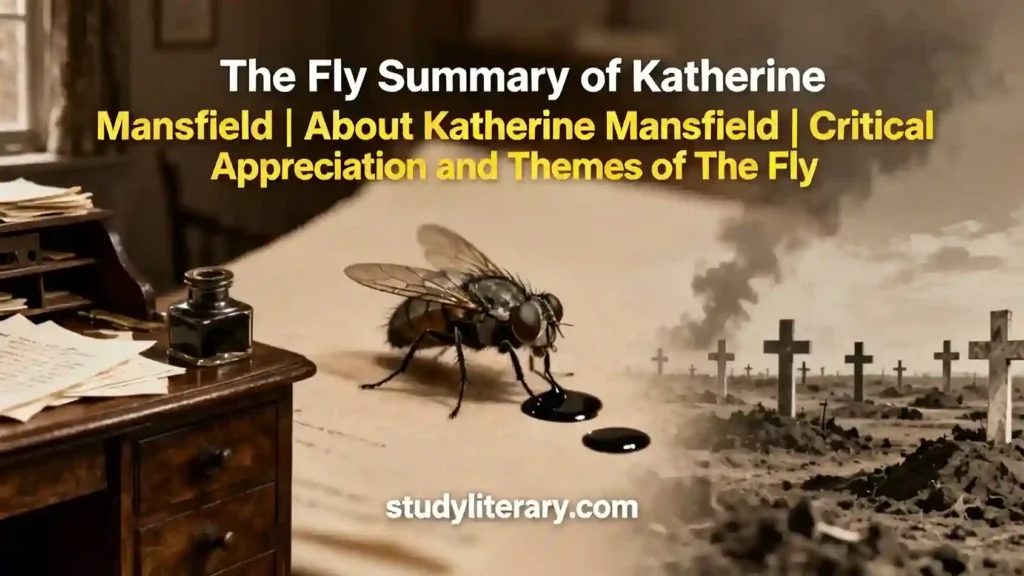
While sitting at his desk, the boss notices a fly that has fallen into his inkpot. The fly struggles hard to get out. The boss helps it by lifting it onto a piece of paper. The fly begins to clean itself and slowly recovers. The boss watches it closely and admires its effort and courage. The fly represents life, struggle, and survival, similar to soldiers fighting in war.
The Boss’s Cruel Experiment
Suddenly, the boss drops ink on the fly again. The fly struggles once more to clean itself. The boss repeats this action several times, each time testing the fly’s strength. Although he seems interested in the fly’s bravery, his actions are actually cruel. This shows his desire for control and power, similar to how fate or war controls human lives.
Death of the Fly
After repeated suffering, the fly becomes too weak and dies. The boss tries to make it move again, but it does not respond. He throws the dead fly into the wastepaper basket. This moment symbolizes how life can be destroyed after continuous suffering, just like soldiers in war.
Ending: Forgetfulness and Emptiness
After killing the fly, the boss feels uneasy and disturbed. He tries to remember what he was thinking about before, but he cannot. He even forgets about his son. This shows that his emotions have become empty and weak. The story ends with a powerful message about the loss of memory and feeling.
Critical Analysis of The Fly
Psychological Depth and Inner Conflict
“The Fly” is a psychological story that focuses more on the inner mind of the boss than on external events. Mansfield shows how the boss struggles with his emotions after the death of his son. He wants to feel grief, but he cannot cry. This shows emotional numbness, which is a common effect of trauma. Critics describe this as a modernist exploration of the human mind, where feelings are confused, controlled, or even lost (Shen, 2013; Parui, 2018). The story reveals that the boss is not emotionally strong, but rather deeply disturbed inside.
Representation of Post-War Trauma
The story is set after World War I, and the boss’s son died in the war. His behavior reflects the trauma experienced by many people after the war. Scholars explain that the boss’s inability to express grief shows how war damages human emotions and mental health (Edwards, 2017; Gupta, 2022). The repeated suffering of the fly is often interpreted as a symbol of soldiers who struggled again and again before dying.
Power, Control, and Cruelty
One of the most important aspects of the story is the boss’s cruelty towards the fly. At first, he saves the fly, but then he starts torturing it by dropping ink on it repeatedly. This shows his desire to control life and death. Critics argue that this reflects human nature—people may become cruel when they have power over weaker beings (Sen, 2025). The boss behaves like fate or war itself, deciding who lives and who dies.
Symbolism and Modernist Technique
Mansfield uses strong symbolism in this story. The fly is not just an insect; it represents human life, struggle, and suffering. The ink symbolizes pain, destruction, and fate. The boss represents authority and control. According to scholars, Mansfield uses simple objects to express complex ideas, which is a key feature of modernist literature (Glotova, 2014; Feklistova, 2020). The story does not directly explain meanings but leaves readers to interpret them.
Open Ending and Ambiguity
The ending of the story is unclear and disturbing. The boss forgets what he was thinking about, including his son. This creates ambiguity and forces the reader to think deeply. Critics say this open ending is typical of Mansfield’s style, where meaning is not directly stated but suggested (Hindricks, 2018). It shows emotional emptiness and loss of memory.
Major Themes in The Fly
Theme of Time and Fading Grief
One of the central themes is how time affects human emotions. At the beginning, the boss believes his grief is permanent. However, after six years, he cannot even cry. This shows that time does not always heal; instead, it may weaken or erase feelings. Scholars describe this as the “conquest of time over grief” (Feklistova, 2020).
Theme of Grief and Loss
The story deeply explores the pain of losing a loved one. The boss’s son was his only child, and his death destroyed his hopes. However, the story also shows that grief is not always expressed openly. Sometimes, it becomes hidden or suppressed, leading to emotional emptiness.
Theme of War and Suffering
World War I forms the background of the story. The deaths of the sons represent the loss experienced by many families. The suffering of the fly symbolizes the repeated struggles of soldiers in war. Critics highlight that Mansfield uses this small incident to reflect the large-scale tragedy of war (Edwards, 2017).
Theme of Cruelty and Power
The boss’s actions show how power can lead to cruelty. He controls the life of the fly and enjoys testing its strength. This reflects how people in powerful positions may act without compassion. The story suggests that humans can be as cruel as the forces that control them.
Theme of Memory and Forgetfulness
Memory plays an important role in the story. At first, the boss remembers his son clearly, but by the end, he cannot remember anything. This shows how memory fades over time. It also suggests that forgetting may be a way to escape pain.
Theme of Life as Struggle
The fly’s repeated attempts to survive show that life is a continuous struggle. Even when the fly escapes danger, it is forced to face new challenges. This reflects human life, where people face repeated hardships without control over their fate.
Theme of Isolation
The boss is emotionally isolated. Even though he has wealth and power, he cannot share his grief with anyone. His loneliness increases his inner suffering.
Important Links
Not active yet
Share or Save This Post
- Facebook
- Twitter
- Linkedin
- Whatsapp
- Pinterest
- Telegram