Table of Contents
ToggleAbout the Drama - Riders to the Sea by J.M. Synge
Setting
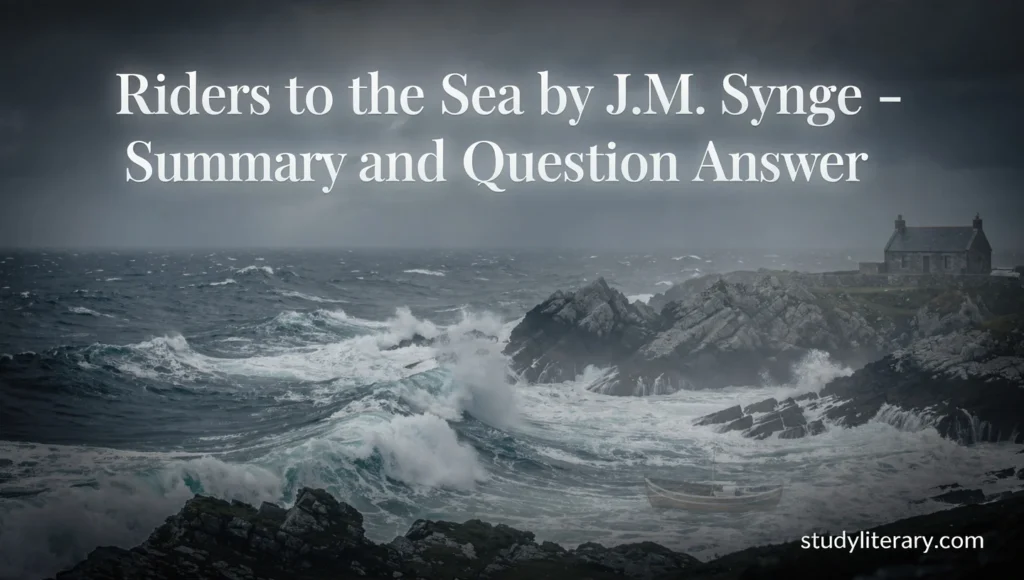
The play takes place in a small, poor cottage on one of the Aran Islands, off the west coast of Ireland. The family lives beside the rough Atlantic Ocean, which both feeds them and takes the lives of their men. The sound of the sea and wind is always present — symbolizing danger and fate.
Main Characters
Maurya – An old mother who has lost many family members to the sea.
Cathleen – Her elder daughter, practical and responsible.
Nora – Her younger daughter, emotional and innocent.
Bartley – Maurya’s last living son, determined to go to the Galway fair to sell horses.
Michael – Maurya’s son, recently drowned; his body has not been recovered yet when the play begins.
Riders to the Sea Summary of the Act
1. The Daughters’ Fear
The play opens in Maurya’s cottage.
Cathleen is baking bread while Nora secretly enters with a bundle given to her by a young priest. Inside the bundle are a shirt and stocking found on a drowned man in Donegal. The priest believes the clothes might belong to Michael, their missing brother. He tells the girls to check quietly — if the clothes are Michael’s, they should tell Maurya he had a proper burial; if not, say nothing, because it might break her heart.
The sea outside is rough and dangerous, and the sisters fear for both Michael (lost) and Bartley (planning to go to sea today).
2. Bartley’s Decision to Leave
Maurya enters, sad and worried. She hopes Bartley will stay home because of the rising wind. But when Bartley comes in, he says he must go to Galway to sell the horses — there’s only one boat leaving for weeks, and they need the money. He takes a rope to make a halter for his horse.
Maurya begs him not to go, saying she has already lost six sons and a husband to the sea. She even says she needs the rope to make a coffin if Michael’s body washes up. But Bartley does not listen. He tells Cathleen to look after the animals while he’s away.
Maurya cries that if Bartley goes, she’ll lose her last son too. Still, he leaves, riding the red mare with the gray pony following behind.
Maurya doesn’t give him her blessing — she’s too upset. The daughters scold her for sending him away with harsh words.
They realize Bartley forgot his lunch, so Cathleen urges Maurya to take the bread to him, give him her blessing, and break the “bad luck.”
3. The Daughters Confirm Michael’s Death
After Maurya leaves, the girls open the bundle from Donegal.
They compare the shirt and stocking to Michael’s clothes. At first, they are unsure, but soon Nora counts the stitches on the stocking — exactly the same number she knitted for Michael. The truth hits them: Michael is dead.
They cry bitterly but decide not to tell their mother until Bartley returns safely.
4. Maurya’s Terrifying Vision
Maurya returns, pale and shaken, still holding the bread. She didn’t give it to Bartley. When the girls ask what happened, she says she saw a terrible vision: Bartley riding on the red mare, and behind him, Michael riding the gray pony, dressed in fine clothes — as if alive but ghostly.
The daughters realize this is a sign of death. Maurya feels sure Bartley will die too.
She recalls all her losses — her husband, father-in-law, and six sons — all drowned. The sea has taken everything from her. Just as she says this, the girls hear cries from outside. Neighbors enter, carrying Bartley’s dead body. The gray pony knocked him into the sea.
5. The Final Acceptance
Bartley’s body is laid on the table. Maurya kneels beside him, heartbroken but strangely calm. She sprinkles holy water and places Michael’s clothes across Bartley’s feet. She says now the sea can take no more from her — her suffering is complete, and peace has come at last.
She prays quietly:
“They’re all together now, and the end is come.
Michael has a clean burial in the far north.
Bartley will have a fine coffin from the white boards.
No man can live forever, and we must be satisfied.”
The curtain falls with Maurya’s quiet acceptance of fate.
Her tragedy is total — but her pain has turned into peace.
Q1. Do you agree with the view that Maurya is a tragic character who refuses to accept defeat? Give reasons for your answer.
Maurya as a Tragic Character Who Refuses to Accept Defeat
J.M. Synge’s Riders to the Sea (1904) is one of the most profound short tragedies in modern drama — a lyrical and stark representation of human endurance against the indifferent forces of nature. Set on the desolate Aran Islands off the west coast of Ireland, it distills life to its elemental struggle between man and the sea. At the heart of this tragic vision stands Maurya, an old peasant woman who has lost her husband and all her sons to the merciless ocean. She is both the suffering mother and the spiritual centre of the play — a figure through whom Synge explores not merely grief, but the tragic dignity of acceptance.
The question whether Maurya is a tragic figure who refuses to accept defeat touches the very essence of Synge’s art. On the surface, she appears to be a woman crushed by loss, defeated by destiny. Yet beneath her sorrow lies a deeper resistance — not the futile defiance of rebellion, but the stoic defiance of endurance. She is defeated in the material sense, but spiritually, she transcends defeat.
1. Maurya’s Situation: The Human Against the Elemental
The tragedy of Riders to the Sea is rooted in the harsh reality of life on the Aran Islands, where survival itself is a battle against the sea. The islanders live by fishing and herding, their existence constantly threatened by storms and drowning. For Maurya, the sea is not merely a natural force; it is a living presence — vast, pitiless, and omnipotent.
At the beginning of the play, Maurya has already lost her husband, father-in-law, and four of her six sons to the sea. Another son, Michael, has recently disappeared, and his body is feared drowned. Her youngest and last surviving son, Bartley, insists on sailing to the mainland to sell horses, despite the stormy weather. Maurya pleads with him not to go, haunted by premonitions of death, but he refuses. Her words, half-plea and half-prophecy, echo with tragic inevitability:
“He’s gone now, and when the black night is coming I’ll have no son left me in the world.”
Here, Synge establishes the atmosphere of inexorable fate. Maurya’s world is one where nature dictates life and death, where human will is dwarfed by cosmic forces. Yet in confronting this inevitability, Maurya’s tragedy acquires moral grandeur.
2. The Tragic Vision: Fate, Suffering, and Endurance
Synge’s play, though rooted in Irish peasant life, has the universal resonance of Greek tragedy. Maurya, like Hecuba or Niobe, is the archetypal mother bereaved by destiny. The structure of the play resembles a ritual of suffering: she moves from anxiety to despair, from despair to revelation, and finally to calm resignation.
Her tragedy is not of rebellion but of endurance. She does not curse God, nor does she deny the inevitability of fate. When Bartley’s death is revealed — drowned by the very sea that took his brothers — she does not scream or rage. Instead, she speaks words that are both heart-rending and ennobling:
“They’re all gone now, and there isn’t anything more the sea can do to me.”
In this line lies the essence of her tragic heroism. It is not the heroism of resistance but the heroism of ultimate acceptance. Maurya refuses to be spiritually defeated, even when all is lost. She has reached the point beyond fear, beyond struggle — a state of tragic serenity where suffering itself becomes illumination.
3. Maurya’s Tragic Heroism
In classical terms, the tragic hero is one who confronts forces greater than themselves — fate, the gods, or nature — and attains moral elevation through suffering. Maurya, though a poor old peasant woman, fulfills this definition more profoundly than any king or warrior.
Her greatness lies not in defiance but in the moral strength of submission. She cannot change her destiny, but she can face it without despair. Her final act of sprinkling holy water on the dead bodies and uttering a prayer of peace reflects her acceptance of human limitation. She has moved from personal grief to universal understanding:
“No man at all can be living forever, and we must be satisfied.”
This is not resignation born of weakness; it is the triumph of wisdom. Maurya has transcended individual sorrow to perceive the eternal law of life and death. In this moment, she embodies what Synge himself called “the tragic joy” — the sense of spiritual elevation that arises when one confronts suffering with dignity and insight.
4. Religion, Ritual, and the Strength of Faith
Maurya’s strength is also sustained by her deep religious faith, which transforms tragedy into transcendence. Her references to God, the Holy Water, and the priest reveal a consciousness rooted in the rhythms of Catholic spirituality. Yet Synge, though not a religious moralist, uses these symbols to express something more elemental — the human need to find meaning amid chaos.
When Maurya blesses Bartley before his fatal journey, her words echo like a benediction and a lament:
“God bless you, and spare you, if it’s His will.”
Her faith does not protect her from suffering, but it gives her the courage to endure it. Religion, in Riders to the Sea, is not an escape but a mode of acceptance — a ritual through which human sorrow finds order and dignity. Maurya’s faith becomes a spiritual weapon; it prevents despair from corroding her soul.
5. The Symbolism of the Sea
To understand Maurya’s tragedy, one must grasp the symbolism of the sea, which functions almost as a character in the play. The sea is both giver and taker — it sustains life and destroys it. For Maurya, it is the eternal adversary, the embodiment of fate.
Yet by the end of the play, her relationship with the sea changes. Having lost everything, she no longer fears it. The sea, in its vastness, becomes a symbol of the cosmic order in which individual life and death are insignificant moments. Maurya’s final acceptance — “They’re all gone now” — signifies her reconciliation with this larger rhythm. The sea can no longer defeat her, for she has recognized that defeat is the condition of life itself.
6. The Dramatic Function of Maurya’s Silence and Speech
Synge’s artistry lies in the economy of expression. Maurya speaks little, but every word carries immense emotional weight. Her silences are as eloquent as her speech. In the opening scenes, her silence expresses fear; in the final moments, it embodies peace.
When she blesses the dead and declares that no one can live forever, she achieves a tone of tragic universality. The simplicity of her language — drawn from the idioms of Irish peasantry — gives her speech a Biblical resonance. She speaks not merely for herself, but for all humanity caught in the web of suffering. In this way, Maurya transcends her individual identity and becomes a symbolic figure — the voice of all mothers who have endured loss and yet continued to live.
7. The Refusal to Accept Defeat
Does Maurya refuse to accept defeat? On the surface, she seems utterly defeated — bereaved, impoverished, alone. But Synge’s tragedy is not about victory in worldly terms. Maurya’s refusal lies in her spiritual endurance. She does not allow grief to annihilate her will. Her acceptance is an act of quiet defiance — the defiance of one who will not be broken by suffering.
Her calm at the end is not passivity; it is a form of victory. She has faced the worst that life can offer and found a stillness that transcends pain. She does not collapse into madness or despair, as a lesser soul might. Instead, she blesses her dead and accepts the eternal law of mortality. In that acceptance, she asserts the indestructibility of the human spirit.
8. Conclusion: Maurya’s Tragic Greatness
In Riders to the Sea, Maurya embodies the essence of tragic greatness — the dignity of endurance, the wisdom of acceptance, and the courage to face annihilation without losing faith. Her tragedy is universal because it reveals the eternal human condition: the struggle to find meaning in a world governed by suffering and death.
She is defeated materially but not morally; destroyed by fate but ennobled by her response to it. In her final serenity, she achieves the tragic victory of the spirit over circumstance. Synge’s art lies in showing that true heroism does not reside in battlefields or crowns, but in the hearts of ordinary people who face suffering with quiet strength.
Thus, Maurya is indeed a tragic figure — not because she resists fate, but because she learns to live with it. Her acceptance is her triumph. She refuses defeat not by overcoming death, but by embracing it with the calm of understanding. In her final words, simple yet majestic, Synge gives voice to the eternal wisdom of humanity:
“No man at all can be living forever, and we must be satisfied.”
In that line — poised between despair and transcendence — Maurya ceases to be a mere character and becomes an image of eternal endurance.
Q2. Comment on Synge’s use of symbols in Riders to the Sea.
Synge’s Use of Symbols in Riders to the Sea
J.M. Synge’s Riders to the Sea (1904) is one of the most powerful short tragedies in modern drama — a work of haunting simplicity and elemental grandeur. Though the play is set in a humble Irish cottage on the Aran Islands, it reverberates with universal meanings about life, death, and human endurance. What gives the play its depth and resonance is Synge’s masterly use of symbolism. Beneath its plain realism lies a rich symbolic structure that transforms a domestic tragedy into a timeless meditation on fate and faith.
In Riders to the Sea, every object, gesture, and natural element carries a symbolic weight. The sea, the white boards, the spinning wheel, the clothes, the horses, even the bread and the water — all are woven into a pattern of meaning that expresses Synge’s tragic vision of humanity’s struggle against the forces of nature and destiny.
1. Symbolism as the Soul of Synge’s Tragic Vision
Synge’s art is characterized by a profound fusion of realism and symbolism. Having lived among the peasants of the Aran Islands, he observed the physical hardships and spiritual resilience of their lives. Yet he transformed this realism into poetry by imbuing ordinary objects with spiritual significance. In Riders to the Sea, Synge does not impose symbolism artificially; it grows organically out of the life and language of the islanders.
The play, though written in prose, has the rhythm and depth of myth. Through symbols, Synge raises the story of one poor Irish family to the level of universal tragedy. The symbols are not decorative but essential — they express the hidden emotional and metaphysical dimensions of experience.
2. The Sea: The Central and Omnipresent Symbol
The most dominant symbol in the play is, of course, the sea. It is at once the literal setting and the metaphysical force that governs the characters’ lives. For the islanders, the sea is the source of livelihood — it feeds them through fishing and trade — but it is also their greatest enemy, claiming life after life in its cold embrace.
To Maurya, the central character, the sea is not a mere natural element but a living, almost divine power — capricious, indifferent, and omnipotent. She speaks of it as if it had consciousness:
“In the big world, the old people do be leaving things after them for their sons and children, but in this place it is the sea that is taking them.”
Here, the sea symbolizes fate itself — an uncontrollable, impersonal force that dictates human destiny. Its rhythm of giving and taking mirrors the eternal cycle of birth and death. When Bartley sets out to sea despite the storm, the audience senses that he is not merely sailing to the mainland but moving toward the inevitable fulfilment of destiny.
At the end of the play, Maurya’s acceptance of her sons’ deaths is also an acceptance of the sea’s power — and thus of life’s tragic law. The sea becomes both destroyer and purifier: it takes life, but through loss it also grants insight and peace.
In this way, Synge uses the sea as a cosmic symbol — representing not only nature’s might but also the eternal forces that govern human existence.
3. The White Boards: The Symbol of Death and Continuity
Another haunting symbol in the play is the white boards, the planks intended for making a coffin. Early in the play, Cathleen tells Nora that the boards are being stored in the loft for Michael’s burial when his body is found. These boards are never used for Michael; instead, they are brought down later for Bartley’s coffin.
Thus, the white boards become a symbol of the unending presence of death in Maurya’s life — a physical reminder of mortality’s inevitability. Their whiteness, paradoxically, carries a double meaning: it suggests both death and peace, loss and purification. The boards link the deaths of the sons, creating a visual cycle of sorrow that binds the past, present, and future.
In the final scene, when Maurya accepts her fate and sprinkles holy water over the bodies, the boards no longer represent terror but release. Death is no longer the enemy but part of the eternal rhythm of life and sea. The boards, therefore, symbolize both the end and the reconciliation that follow suffering.
4. The Spinning Wheel and the Hearth: The Symbol of Domestic Continuity
While the sea symbolizes destruction and fate, the spinning wheel and the hearth symbolize endurance and life’s continuity. The play opens with Cathleen spinning, a quiet domestic image that contrasts with the violence of the sea outside. This juxtaposition of the female world of patience with the male world of danger defines the play’s emotional structure.
The spinning wheel symbolizes the cyclical rhythm of life — repetitive yet sustaining. It suggests the persistence of human labor, tradition, and faith amid suffering. The hearth, too, is central: it represents home, warmth, and the continuity of generations. While men are taken by the sea, women keep the hearth burning, ensuring the survival of memory and community.
Thus, Synge uses these domestic symbols to celebrate the quiet heroism of women like Maurya, whose endurance is as eternal as the sea’s power.
5. The Clothes and the Bundle: The Symbol of Identity and Loss
When Nora and Cathleen receive the bundle of clothes from the priest — garments recovered from a drowned man believed to be Michael — the play’s symbolism deepens into the realm of recognition and mourning. The clothes become a token of absence, a substitute for the body lost to the sea.
Their act of examining the clothes in secret reflects the human need to find meaning and closure amid uncertainty. When Maurya later recognizes Michael’s clothes, her unspoken grief merges personal loss with universal sorrow. The clothes thus symbolize the fragile boundary between life and death, presence and absence.
For Synge, objects like these are never trivial. They carry the weight of the sacred. The simple act of identifying clothing becomes a ritual of mourning — transforming material relics into spiritual symbols.
6. The Horses: The Irony of Life and Death
The horses that Bartley takes to the mainland serve as another potent symbol. On the surface, they are merely property — the means of livelihood. Yet, in the tragic structure of the play, they become the agents of destiny. Bartley, riding the red mare and leading the grey pony, is carried to his death.
In Maurya’s vision, she sees Bartley riding the red mare, with Michael on the grey pony behind him — a vision that fuses the living and the dead. The horses thus symbolize the inescapable cycle of life and death, the continuity of fate across generations.
Moreover, they embody irony: the very animals that Bartley tends for survival become the instruments of his destruction. Synge’s use of this symbol underlines the paradox of human existence — that what sustains us also destroys us.
7. The Holy Water and the Religious Symbols
Religious imagery pervades the play, blending with the natural symbolism to create a spiritual dimension. The holy water, used by Maurya to bless her sons’ bodies, symbolizes purification, faith, and reconciliation. It connects the Christian ritual of peace with the older, pagan acceptance of fate that underlies the islanders’ worldview.
When Maurya sprinkles the water and says, “They’re all gone now, and there isn’t anything more the sea can do to me,” her act becomes both a Christian benediction and a pagan rite of release. The cross, the prayers, and the holy water transform the raw suffering of loss into sacred endurance. Through these symbols, Synge suggests that human beings, though powerless before nature, can achieve spiritual victory through acceptance and ritual.
8. The Seaweed, the Bread, and Everyday Objects
Even the most ordinary objects in Riders to the Sea carry symbolic resonance. The seaweed that covers Michael’s body when it is found connects the human and natural worlds — a reminder that death is not an ending but a return to nature. The bread, which Maurya carries to give Bartley, symbolizes nourishment and care; when she loses the bread on her way to bless him, it becomes a tragic foreshadowing — an unintentional renunciation of life’s sustenance.
Through such simple symbols, Synge reveals the sacramental quality of ordinary life — every gesture, every object is charged with spiritual significance.
9. The Synthesis of Symbolism: From Realism to Universality
The greatness of Synge’s symbolism lies in its fusion with realism. The play never abandons its concrete setting or its peasant idiom; yet, every word and object points beyond the immediate to the eternal. The sea stands for fate, the boards for death, the hearth for life, and the holy water for faith. Together, they form a symbolic architecture that transforms a local tragedy into a universal human parable.
Maurya’s final acceptance — “No man at all can be living forever, and we must be satisfied” — is both literal and symbolic. It expresses the eternal law of mortality that the sea enacts and that the human spirit must embrace. Through symbols, Synge turns the sufferings of one woman into a vision of humanity’s tragic wisdom.
10. Conclusion: Symbolism as the Language of the Soul
In Riders to the Sea, Synge achieves what few dramatists have — a perfect balance between simplicity of form and depth of meaning. His symbols emerge naturally from the life of the people; they are not abstract emblems but living presences. Through them, he elevates the particular to the universal, the local to the eternal.
The sea, the boards, the horses, the holy water — all unite to form a tragic symphony of symbols that expresses the cycle of life, death, and spiritual reconciliation. Maurya’s world, small and remote, becomes a mirror of the human condition itself.
Synge’s use of symbolism thus transforms Riders to the Sea from a tale of Irish peasantry into a modern sacred drama — a meditation on fate, suffering, and the enduring strength of the human soul.
Q3. “Then Bartley came along, and he riding on the red mare with the gray pony behind him.” Explain the significance of the above lines.
This line occurs in J.M. Synge’s Riders to the Sea (1904) and is spoken by Maurya, the tragic mother, in one of the play’s most visionary moments. It occurs after she has gone to bless her son Bartley, who insists on sailing to the mainland despite storm warnings. When she returns home, shaken, she recounts a vision she has seen on the path: Bartley riding the red mare, followed by Michael — her dead son — riding the gray pony.
On the literal level, Maurya’s vision seems like a hallucination born of exhaustion and fear. But symbolically, it is the central prophetic image of the play — the moment where the realms of life and death merge. The red mare, representing Bartley’s living vitality, and the gray pony, associated with the drowned Michael, together signify the continuity of fate. Bartley is alive, yet already shadowed by death. The two riders embody Synge’s central theme: that no man can escape the cycle of mortality decreed by the sea.
The vision’s color symbolism is crucial. The red mare, vibrant and fiery, stands for youth, passion, and life’s energy. The gray pony — pale and spectral — evokes death, the sea, and the afterlife. When Maurya sees them together, she perceives that life and death ride side by side, inseparable and inevitable. The moment fuses realism with mysticism, turning a mother’s premonition into a cosmic revelation.
Thematically, this line marks Maurya’s spiritual awakening. Until this point, she struggles to resist fate, pleading with Bartley not to go. But the vision reveals to her that resistance is futile — that the sea’s claim over her sons is final. After Bartley’s death, Maurya’s acceptance of fate derives from this moment of clairvoyance. When she later says, “They’re all gone now, and there isn’t anything more the sea can do to me,” her peace stems from having already foreseen Bartley’s doom in this symbolic vision.
Stylistically, Synge compresses enormous meaning into a single, plain sentence. Its simplicity mirrors the language of the Aran peasantry, but beneath it lies the grandeur of tragedy. The sentence unites the play’s two realms — the domestic and the mythic, the real and the eternal.
Thus, this line is not merely a mother’s hallucination but the play’s symbolic climax — where death ceases to be terror and becomes revelation. In Maurya’s vision of the red mare and the gray pony, Synge expresses his tragic philosophy: life and death are not opposites but riders on the same road, journeying toward the same sea.
Important Links
Share
- Facebook
- Twitter
- Linkedin
- Whatsapp
- Pinterest
- Telegram