
Table of Contents
ToggleOut of Business Summary
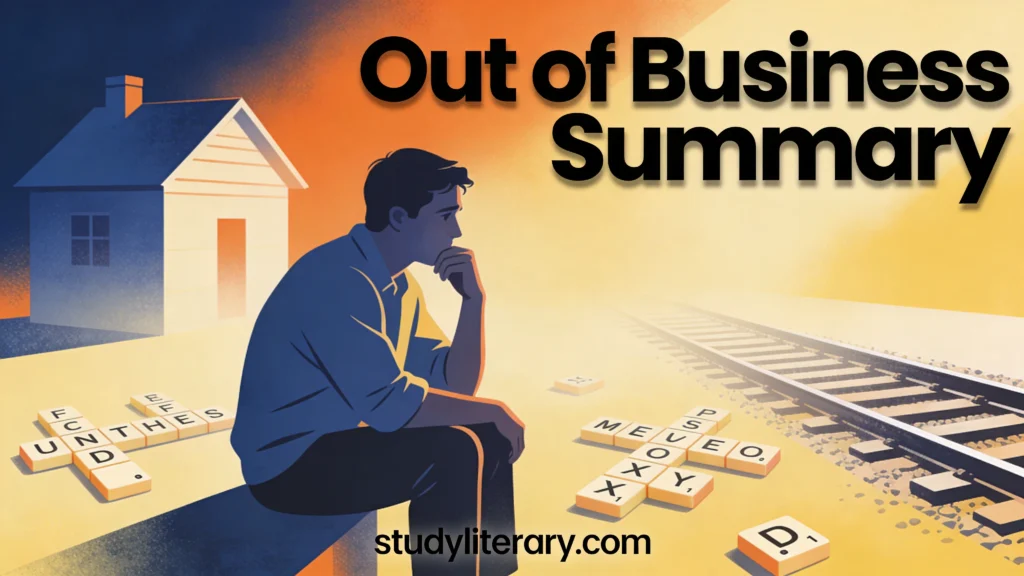
“Out of Business” by R.K. Narayan tells the story of Rama Rao, a middle-aged man living in Malgudi, whose life changes suddenly from comfort to hardship. Rama Rao was the local agent of a gramophone company and had invested all his inherited money in the business as security. For five years, he earned enough to support his wife and children comfortably. He built a small bungalow in a respectable area called the Extension and even dreamed of buying a car. However, one day his life collapses unexpectedly when the gramophone company shuts down. The closure happens due to a chain of distant financial events—a bank crash in Lahore caused by the death of a Bombay financier. Because of this, Rama Rao loses his business, his investment, and almost all his savings. At first, he does not fully understand the seriousness of the situation, but gradually his money runs out and he realizes that he is truly ruined.
As their financial condition worsens, his wife begins making sacrifices. She dismisses the cook and servant, withdraws the children from an expensive school, rents out their bungalow, and moves the family to a small house behind the Market. Their standard of living drops sharply. The children lose their friends and playground, their clothes become worn out, and the cheerful atmosphere of their earlier life disappears. Every evening, his wife and children wait anxiously at the door, hoping he will return with good news of employment. Rama Rao tries hard to find a job, sending many applications and visiting offices daily, but at his age and after being independent for years, it is humiliating and difficult to seek work. Everywhere he goes, he is politely refused. The repeated disappointments deeply hurt him, and he feels ashamed that he cannot provide for his family.
In this state of frustration, Rama Rao discovers a magazine called “The Captain,” which contains only crossword puzzles and offers large cash prizes. The possibility of winning easy money excites him and gives him hope. He begins spending small amounts of money each week to send his answers, dreaming that he will win thousands of rupees and restore his former life. However, week after week he fails. The cycle of hope and disappointment affects his mental balance. He becomes silent, withdrawn, and irritable at home. He even quarrels with his gentle wife to get money for the puzzle entries, though it reduces their household expenses. When the magazine announces a special prize of eight thousand rupees, he asks his wife for five rupees—almost a week’s food expense—to send multiple entries. Though he briefly feels guilty, he quickly returns to his dreams of success.
On the day the results are published, he discovers that his answers are wrong and that he has no chance of winning anything. This final disappointment breaks him completely. Feeling like a failure and believing that life is no longer worth living, he walks to the railway tracks at night and lies down across them, planning to end his life under an approaching train. He feels strangely calm and thinks death will free him from suffering. However, the train does not arrive because a goods train has derailed and all trains are delayed. Realizing this unexpected delay, he feels that God has shown him mercy and given him another chance. He returns home, where his wife is waiting anxiously. She shares surprising news: their tenants want to buy the bungalow for a good price. She suggests selling it. Rama Rao immediately agrees and decides to take some money to go to Madras in search of honest work. When his wife quietly asks whether he will use the money again for crossword puzzles, he firmly promises that he will never repeat that mistake. The story ends on a hopeful note, suggesting that life always offers another chance if one chooses courage over despair.
About R. K. Narayan
R.K. Narayan (1906–2001) was one of the most famous and respected Indian writers in English. Although he is not a poet but a novelist and short story writer, his writing style is so simple and expressive that many readers feel a poetic quality in his prose. He was born in Madras (now Chennai), South India, and spent most of his life there. Much of his writing is set in the fictional town of Malgudi, which he created. Malgudi represents a typical small Indian town and reflects Indian middle-class life, traditions, struggles, and emotions.
Narayan’s writing is known for its simplicity, humor, realism, and deep understanding of human nature. He focused mainly on ordinary people and their everyday problems. Instead of writing about kings or great heroes, he wrote about common men—teachers, businessmen, students, housewives—who face simple but meaningful life challenges. His language is clear, natural, and easy to understand, which makes his works popular among students and general readers.
Some of his most famous works include Swami and Friends, The Guide, The Bachelor of Arts, The English Teacher, and many short stories such as Out of Business. His novel The Guide won the Sahitya Akademi Award in 1960 and was later made into a successful film. Narayan’s works often explore themes like middle-class life, financial struggles, fate, family relationships, tradition versus modernity, and human weakness.
In “Out of Business,” Narayan shows his skill in portraying the psychological struggles of an ordinary man who faces unemployment and despair. His gentle humor, irony, and realistic storytelling make serious themes easy to understand. He does not criticize harshly but presents situations naturally, allowing readers to think and learn from them.
R.K. Narayan is considered one of the pioneers of Indian English literature, along with Mulk Raj Anand and Raja Rao. His contribution helped Indian writing in English gain recognition worldwide.
Characters Analysis
Rama Rao (Main Character)
Rama Rao is the central character of the story. He is a middle-class, educated man of about forty years old. At the beginning of the story, he is a successful and respectable businessman. He works as the Malgudi agent of a gramophone company and earns enough to give his family a comfortable life. He builds a bungalow, lives in a good locality, and dreams of buying a car. This shows that he is hardworking and ambitious.
However, when his business suddenly collapses, his personality begins to change. He becomes anxious, depressed, and emotionally weak. He tries hard to find a job but faces repeated rejection. Being nearly forty, he feels ashamed to ask others for employment after having been independent. His pride and self-respect suffer greatly.
As his financial condition worsens, Rama Rao loses confidence. Instead of facing reality practically, he escapes into dreams of winning crossword puzzle prizes. The crossword becomes his obsession. He spends money on it even when his family is struggling for food. This shows his weakness and his desire for quick success without steady effort. He becomes silent, irritable, and emotionally distant from his family.
At his lowest point, after failing again in the puzzle competition, he decides to commit suicide by lying on the railway track. This shows how deeply he feels like a failure. However, when the train is delayed and he survives, he realizes that life has given him another chance. At the end, he promises never to waste money on crossword puzzles again. This shows that he learns from his mistake and regains some strength and determination.
In short, Rama Rao represents the struggles of the middle-class man who cannot easily accept failure. He is loving but weak, hopeful but impractical, and finally wiser after his near-death experience.
Rama Rao’s Wife
Rama Rao’s wife is a very important but silent character in the story. She represents patience, sacrifice, and emotional strength. When their financial condition declines, she calmly takes practical steps. She sends away servants, shifts the children to a cheaper school, rents out their bungalow, and adjusts to a smaller house without complaining.
Unlike Rama Rao, she does not escape into dreams. She faces reality bravely. Even when he quarrels with her for money to send crossword entries, she does not fight back strongly. She quietly sacrifices household needs to give him the money. This shows her love and loyalty.
She also waits for him every evening with hope and worry. On the night he tries to commit suicide, she feels restless without knowing why. This shows her emotional connection with him. At the end, she suggests selling the bungalow, showing her practical and sensible nature. When she gently asks whether he will again waste money on puzzles, it shows her wisdom and awareness.
In short, She is emotionally stronger than Rama Rao. She symbolizes stability, patience, and silent suffering.
The Children
The children are minor characters, but they help show the family’s suffering. Earlier, they lived happily in the bungalow, had friends, and wore new clothes. After their father loses his business, their life changes. They move to a small house, lose their friends, and their clothes become torn. They wait for their father every evening with hope.
They do not complain, but their silent disappointment increases Rama Rao’s guilt. They represent innocence and the impact of economic hardship on a family.
Themes in Out of Business
Unemployment and Economic Insecurity
One of the central themes of the story is sudden unemployment and financial insecurity. Rama Rao loses his gramophone agency due to events completely beyond his control. The collapse of a bank and the death of a financier in another part of the country destroy his stable business. This shows how fragile middle-class security can be. A man who was living comfortably suddenly finds himself without income, savings, or stability. Narayan highlights how economic systems and distant events can deeply affect ordinary individuals.
Middle-Class Struggle
The story presents a realistic picture of middle-class life. Rama Rao’s family depends entirely on his earnings. When the income stops, their social position falls immediately. They move from a respectable bungalow in the Extension to a small house behind the Market. The children lose their friends and good schooling, and their clothes become worn out. The family constantly fears losing even the small rent they receive. Through this, Narayan shows the anxiety, dignity, and vulnerability of middle-class existence.
False Hope and Escapism
Another important theme is false hope and escapism. Instead of facing reality practically, Rama Rao becomes obsessed with crossword puzzles that offer prize money. He believes he can win large amounts and restore his lost status. Even when the family struggles for basic needs, he continues to spend money on entries. The crossword puzzle symbolizes unrealistic dreams and dependence on luck rather than hard work. It represents a form of mental escape from painful reality.
Psychological Breakdown
The story also explores the psychological effects of failure and disappointment. Repeated rejection in job hunting damages Rama Rao’s confidence. His mind swings between hope and despair every week as he waits for puzzle results. Gradually, he becomes silent, irritable, and withdrawn. His mental balance weakens, and he loses emotional connection with his family. Narayan sensitively portrays how economic failure can lead to mental suffering.
Family Sacrifice and Silent Strength
Rama Rao’s wife represents patience, sacrifice, and emotional strength. She quietly reduces household expenses, sends away servants, and adjusts to a simpler life. She rarely argues and supports her husband despite his unreasonable demands for puzzle money. While Rama Rao becomes emotionally unstable, she remains practical and steady. Her silent endurance highlights the strength often found within family structures during times of crisis.
Pride and Masculine Ego
Rama Rao’s suffering is also connected to his wounded pride. As a former independent businessman, he finds it humiliating to beg for employment. His self-respect makes rejection more painful. His ego prevents him from accepting his situation calmly. This theme shows how pride can deepen personal suffering during difficult times.
Fate and Chance
Chance and fate play significant roles in the story. Rama Rao’s business collapses due to accidental events, and his life is saved because a train is delayed by a derailment. The delayed train acts as a symbol of divine intervention or destiny. Narayan suggests that life can change suddenly, both for the worse and for the better. Human beings are often powerless before larger forces.
Suicide and Second Chance
When Rama Rao lies on the railway track, he believes death is the only solution. However, the train’s delay gives him a second chance. This moment represents hope and renewal. The story clearly suggests that suicide is not the answer to life’s problems. Even in the darkest moments, life may offer unexpected opportunities.
Reality versus Illusion
Throughout the story, there is a contrast between illusion and reality. The crossword puzzle represents illusion and easy success, while practical decisions like selling the bungalow represent reality. At the end, Rama Rao chooses reality over fantasy. He decides to go to Madras and search for honest work instead of depending on luck. This shift marks his personal growth.
Hope and Renewal
Although the story contains suffering and despair, it ends on a hopeful note. The possibility of selling the bungalow provides financial relief, and Rama Rao promises never to depend on crossword puzzles again. The ending suggests that life always offers opportunities for new beginnings. With courage and practical thinking, one can rebuild life after failure.
Share
- Facebook
- Twitter
- Linkedin
- Whatsapp
- Pinterest
- Telegram