

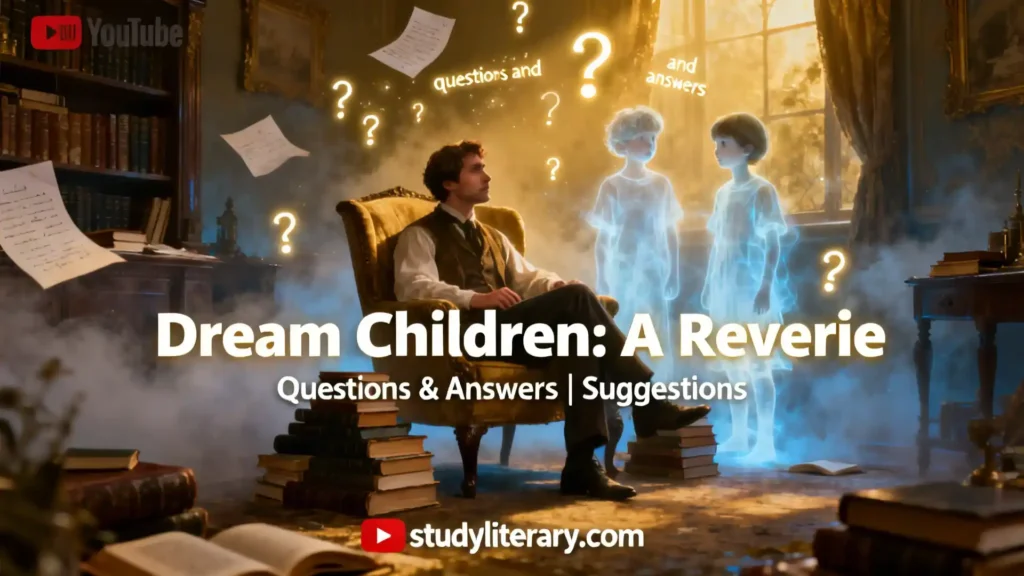
Dream Children: A Reverie Questions and Answers
Table of Contents
ToggleQ1. Discuss “Dream Children: A Reverie” as an autobiographical essay. How far is it based on Lamb’s real life?
Dream Children: A Reverie as an Autobiographical Essay
Charles Lamb’s Dream Children: A Reverie is one of those rare essays where life and imagination intertwine so delicately that it becomes impossible to separate one from the other. At first, it appears to be a simple domestic scene a father narrating stories to his children on a quiet evening. Yet, as the narrative deepens, the reader gradually realizes that this is not a record of lived reality but a reconstruction of a life shaped by memory, longing, and loss. It is autobiographical not because it strictly follows facts, but because it reveals the emotional truth of Lamb’s life with remarkable intimacy.
The essay unfolds through the persona of Elia, Lamb’s familiar literary self. Elia is not merely a mask but a softened version of Lamb himself, allowing him to speak with both candour and artistic distance. Through this voice, Lamb revisits his childhood, recounting memories that are at once vivid and tender. The presence of the children, Alice and John, initially gives the essay a sense of warmth and continuity, as though the past naturally flows into the present. However, this continuity is gradually revealed to be an illusion.
The autobiographical basis of the essay becomes evident when we consider the figures that populate it. The description of great grandmother Field clearly draws from Lamb’s own grandmother, a woman remembered for her dignity, piety, and quiet authority. The grand house in Norfolk, with its vast empty rooms and lingering sense of antiquity, reflects Lamb’s childhood experiences and his deep sensitivity to places filled with historical memory. These recollections are not mere decorative details; they form the emotional foundation of the essay, suggesting how profoundly the past shaped Lamb’s inner life.
Equally significant is the portrayal of John L, who represents Lamb’s real brother. The affection with which he is described, combined with the later note of regret, gives the essay a deeply personal resonance. Lamb’s confession that he did not always show enough patience towards his brother introduces a note of self reproach, making the narrative feel honest and unguarded. This is autobiography at its most human, where memory does not idealize but reflects upon its own imperfections.
Perhaps the most poignant autobiographical element is the figure of Alice W n, who corresponds to the woman Lamb loved but never married. The essay delicately alludes to this lost relationship, presenting it not as a dramatic tragedy but as a quiet, enduring absence. The love story remains incomplete, suspended in time, much like the dream itself. Through Alice, Lamb does not merely recall a person; he evokes an entire unrealized life.
It is in the final movement of the essay that its autobiographical nature becomes most striking. The children, who seemed so real and responsive, slowly fade away and reveal themselves to be nothing more than projections of desire. Their haunting declaration that they are only what might have been transforms the entire narrative. In that moment, the essay shifts from reminiscence to revelation. Lamb is no longer recounting his past; he is confronting the emptiness of a future that never came to be.
This is where the essay transcends conventional autobiography. It is not simply about what Lamb experienced, but about what he was denied. The dream children symbolize a life of domestic happiness that remained forever out of reach. The quiet image of Lamb waking up alone in his chair, with only his sister beside him, underscores the reality of his existence a life shaped by responsibility, sacrifice, and solitude.
The role of memory in the essay further deepens its autobiographical quality. Lamb’s recollections are rich with sensory detail and emotional nuance. The old house, the garden, the silent rooms, and the small pleasures of childhood are not described as distant events but as living presences. Memory, in this essay, is not passive; it is creative, almost restorative. It allows Lamb to inhabit moments that are otherwise lost, even as it reminds him of their irretrievability.
Stylistically, the essay mirrors the movement of thought itself. It flows gently from one recollection to another, without rigid structure, creating the impression of a mind wandering through its own past. The tone shifts subtly from warmth to melancholy, from narrative ease to philosophical depth. This fluidity enhances the autobiographical effect, making the essay feel less like a constructed piece of writing and more like an intimate confession.
In considering how far the essay is based on Lamb’s real life, one must recognize that its truth lies not in literal accuracy but in emotional authenticity. The events and characters are drawn directly from his experiences, yet they are reshaped through imagination into something more profound. The essay does not aim to document life as it was, but to express life as it was felt and remembered.
Ultimately, Dream Children: A Reverie stands as a deeply personal work that transforms private sorrow into universal reflection. It reveals how memory and imagination can collaborate to create a form of autobiography that is both truthful and transcendent. Lamb does not simply tell his story; he allows us to feel the quiet ache of a life marked by love, loss, and unfulfilled possibility.
2. Examine the blend of dream and reality in the essay.
The Blend of Dream and Reality in Dream Children: A Reverie
Charles Lamb’s Dream Children: A Reverie is not merely an essay that contains a dream; it is an essay that moves like a dream, gradually dissolving the solid ground of reality beneath the reader’s feet. What makes it extraordinary is not the final revelation that everything was a dream, but the subtle, almost imperceptible way in which dream and reality are interwoven from the very beginning. The essay does not abruptly shift from one state to another; instead, it inhabits a delicate twilight zone where memory, imagination, and lived experience coexist.
At the outset, the scene appears convincingly real. A father sits with his two children, Alice and John, narrating stories about their ancestors. The domestic setting is quiet and intimate, filled with warmth and familiarity. Nothing in these opening moments suggests unreality. The children respond naturally with gestures, expressions, and small movements that give them a vivid presence. This realism is essential because it grounds the reader, creating a sense of trust before gently leading them into the realm of reverie.
Yet even within this apparent realism, there are faint signals that something is not entirely stable. The narrative tone carries a softness, as though it is slightly removed from the immediate present. The children’s responses, though lifelike, seem unusually attuned to the emotional undercurrents of the story. They do not interrupt or question in the spontaneous way real children might; instead, they react almost symbolically, embodying tenderness, curiosity, or sorrow at precisely the right moments. This subtle stylization hints that they belong as much to imagination as to reality.
The dream element deepens as Lamb begins to recount his childhood memories. The descriptions of the great house, the gardens, and his grandmother are richly detailed, yet they possess a heightened quality, as though memory itself has polished them into something more beautiful than they originally were. The house becomes less a physical structure and more a landscape of the mind, filled with “vast empty rooms” and silent presences. It is not simply remembered; it is re-experienced through a dreamlike lens.
This blending of dream and memory is characteristic of Romantic imagination, where the past is not fixed but fluid, capable of being reshaped by feeling. In Lamb’s essay, memory does not anchor reality; it begins to loosen it. The more vividly he recalls, the further he moves away from the present moment. The act of storytelling becomes an act of dreaming.
A particularly striking aspect of this blend is the way emotional truth overrides factual certainty. The narrative about his brother John, for instance, carries deep affection and regret. The feelings are undeniably real, yet their expression within this scene with the children creates a curious layering. The children listen to a story about a man who, in reality, belonged to the narrator’s past, but within the dream they seem to inherit him as part of their own lineage. Time collapses, and generational boundaries blur. This is not how reality functions, but it is precisely how dreams operate.
The figure of Alice W n intensifies this fusion further. Her presence is both remembered and imagined. She exists as a real person from Lamb’s life, yet in the dream she is transformed into the mother of these children who never existed. Here, the dream does not simply distort reality; it completes it. It creates a version of life that fulfills emotional desires left unmet in reality. The essay thus becomes a space where loss is temporarily undone, where the unreal can feel more true than the real.
What is remarkable is that Lamb never marks a clear boundary between these two realms. There is no explicit transition where the reader is told that the narrative has entered a dream. Instead, the dream grows organically out of reality, just as in actual human consciousness. This seamless blending reflects the nature of reverie, a state in which one is neither fully awake nor fully asleep. It is a condition where the mind drifts, and imagination gently overlays the real world.
The climax of the essay brings this delicate structure into sudden focus. The children begin to fade, and their final words reveal their insubstantial nature. The effect is both startling and inevitable. By this point, the reader senses that the reality presented earlier cannot fully hold. When the children declare that they are only what might have been, the dream collapses, and reality reasserts itself with quiet force.
This return to reality is not dramatic but deeply poignant. Lamb awakens to find himself alone, seated in his chair, with his sister beside him. The contrast between the rich emotional world of the dream and the simplicity of the real scene is striking. Reality appears diminished, almost bare, in comparison to the fullness of the dream. Yet it is also undeniable and inescapable.
The essay thus does not merely contrast dream and reality; it reveals their interdependence. The dream arises from reality, drawing its materials from memory and experience, but it reshapes them into something more fulfilling. At the same time, the return to reality gives the dream its emotional weight. Without the final awakening, the dream would remain a pleasant illusion; with it, the essay becomes a meditation on loss and longing.
In a deeper sense, Lamb suggests that human life itself exists in a similar tension. We live in reality, bound by its limitations, yet we are constantly haunted by dreams of what might have been. These dreams are not false in any trivial sense; they express truths about our desires, regrets, and inner lives that reality cannot fully accommodate.
Ultimately, the blend of dream and reality in Dream Children: A Reverie is so seamless that it resists simple classification. It is not a story framed by a dream, nor a dream interrupted by reality. It is a continuous flow in which the two states merge and separate with the quiet inevitability of thought itself. Lamb transforms a simple reverie into a profound exploration of memory, imagination, and the fragile boundary between what is lived and what is longed for.
Q3. Interpret the ending of the essay. Why is it so powerful?
The Ending of Dream Children: A Reverie and Its Emotional Power
The ending of Charles Lamb’s Dream Children: A Reverie is one of the most quietly devastating conclusions in English prose. It does not rely on dramatic action or elaborate revelation; instead, it unfolds with a soft inevitability, like the fading of twilight into night. What makes it so powerful is not merely the discovery that the children are imaginary, but the way in which this realization redefines everything that has come before. The ending does not close the essay; it opens a deeper emotional understanding of it.
Throughout the essay, Lamb carefully constructs a scene that feels stable and real. The children listen attentively, respond with tenderness, and seem fully present. By the time we reach the conclusion, we have accepted them as part of the narrative’s reality. It is precisely this sense of familiarity that makes the ending so striking. When the children begin to fade and declare that they are “nothing… but dreams,” the effect is not just surprise but a kind of emotional dislocation. The reader is forced to recognize that what seemed solid was always fragile.
This moment is powerful because it is not presented as a sudden shock, but as a gentle unveiling. The children do not vanish abruptly; they recede, as if withdrawing into the very imagination that created them. Their final words carry a strange calmness, almost a resignation, as though they themselves are aware of their unreal nature. This quiet tone intensifies the pathos. There is no resistance, no protest, only an acceptance of non existence.
At a deeper level, the ending reveals that the entire scene was not simply a dream, but a wish fulfilled in imagination. The children represent a life Lamb never lived a life of marriage, fatherhood, and domestic happiness. When they disappear, it is not merely the end of a dream; it is the collapse of an entire alternative existence. The emotional force of the ending lies in this realization that the dream was compensatory, an attempt to momentarily inhabit a life denied by reality.
The transition back to reality is equally significant. Lamb awakens not to a bustling household, but to solitude. The only real presence beside him is his sister. This return is understated, yet profoundly moving. The contrast between the richness of the dream and the simplicity of reality creates a sense of loss that is almost physical. Reality appears stripped down, reduced to its bare essentials, while the dream lingers as something fuller and more emotionally satisfying.
This contrast is central to the power of the ending. Lamb does not explicitly lament his condition; he does not indulge in overt self pity. Instead, he allows the reader to feel the absence through juxtaposition. The dream is warm, animated, and filled with emotional connections. Reality is quiet, still, and solitary. The difference between the two is not explained; it is experienced.
Another reason the ending is so powerful lies in its universal resonance. While the details are specific to Lamb’s life, the emotional structure is widely recognizable. Everyone carries within them some version of “dream children” unrealized possibilities, imagined futures, or lost alternatives. The essay’s conclusion gives form to this universal experience. It suggests that human life is shaped not only by what happens, but also by what does not happen, by the invisible weight of unrealized desires.
There is also a philosophical depth to the ending that elevates it beyond personal confession. The essay subtly raises questions about the nature of reality itself. If the dream feels so vivid, so emotionally true, in what sense is it less real than the waking world? Lamb does not offer an answer, but the ending leaves us suspended between these two states. The dream may be illusory in a factual sense, yet it reveals truths about longing and memory that reality cannot fully express.
Stylistically, the ending achieves its effect through restraint. Lamb avoids rhetorical excess, allowing the language to remain simple and controlled. This simplicity creates space for emotion to emerge naturally. The rhythm of the prose slows, mirroring the fading of the dream. The final image of Lamb sitting quietly, awakened from his reverie, carries a stillness that lingers long after the essay ends.
Importantly, the ending also reshapes our understanding of the essay’s beginning. What initially seemed like a straightforward domestic narrative is revealed to be a carefully constructed illusion. The entire essay becomes a single extended moment of reverie, framed by reality but not confined to it. This retrospective transformation adds to the ending’s power, as it forces the reader to reinterpret the narrative in light of its conclusion.
The emotional impact of the ending is therefore cumulative. It arises not only from the final lines, but from the way they resonate with everything that precedes them. The memories of childhood, the affection for family, the quiet hints of regret all converge in this final moment of revelation. The dream gathers these elements, intensifies them, and then releases them, leaving behind a sense of emptiness that is both painful and beautiful.
Ultimately, the ending of Dream Children: A Reverie is powerful because it captures a fundamental aspect of human experience the tension between desire and reality. It shows how the imagination can create worlds that feel more complete than the one we inhabit, and how the return to reality can be both inevitable and heartbreaking. Lamb does not dramatize this tension; he renders it with such subtlety that it feels almost like a personal memory rather than a literary construction.
In this way, the essay’s conclusion achieves something rare. It does not simply end the narrative; it deepens it, leaving the reader with a lingering awareness of life’s quiet incompleteness. The dream fades, but its emotional truth remains, echoing long after the final sentence.
Q4. Comment on Charles Lamb’s prose style in “Dream Children.”
Charles Lamb’s Prose Style in Dream Children: A Reverie
To speak of Charles Lamb’s prose style in Dream Children: A Reverie is to enter a space where language itself seems to breathe with memory. His style cannot be reduced to ornament or simplicity alone; it is a living texture woven out of intimacy, nostalgia, irony, and quiet sorrow. Lamb belongs to the tradition of the familiar essay, yet he transforms that form into something more delicate and inward, where prose becomes almost lyrical without ever ceasing to be conversational.
One of the most striking features of Lamb’s prose is its intimacy. The essay reads less like a formal composition and more like a private conversation overheard. From the very first line, he draws the reader into a shared space, as though we are sitting beside him, listening along with the children. This conversational ease is carefully crafted. It gives the illusion of spontaneity, yet beneath it lies a subtle control of tone and rhythm. The sentences flow naturally, often unfolding in gentle curves rather than abrupt stops, mirroring the movement of thought itself.
Closely connected to this intimacy is Lamb’s use of the personal voice. Writing as Elia, he creates a persona that is both himself and slightly removed from himself. This allows him to speak with emotional openness while maintaining a certain artistic distance. The voice is reflective, tender, occasionally playful, and quietly self aware. It does not assert; it suggests. It does not argue; it remembers. In this way, Lamb’s prose becomes a medium for self revelation without ever becoming confessional in a crude or direct sense.
Another defining quality of his style is its fusion of simplicity and richness. At the surface level, his language appears plain, almost deceptively so. He avoids grandiloquence and heavy abstraction. Yet within this simplicity lies a remarkable depth. A single phrase can carry layers of meaning, emotional as well as visual. When he describes the old house or the silent rooms, the language is unadorned, but the effect is haunting. The simplicity allows the reader’s imagination to enter fully into the scene, while the underlying richness gives it emotional resonance.
Lamb’s prose is also deeply rhythmic. Though written in prose, it often carries the cadence of poetry. His sentences expand and contract with a natural musicality, moving between longer, reflective passages and shorter, more immediate expressions. This rhythm is particularly evident in the transitions between memory and present narration. The flow is never mechanical; it feels organic, like the drifting of thought in a quiet moment. The essay’s final movement, where the dream begins to dissolve, is marked by a slowing of rhythm, as though the language itself is fading along with the vision.
A distinctive feature of Lamb’s style is his use of nostalgia, not as mere sentimentality, but as a shaping force of perception. His descriptions of childhood and the past are not objective records; they are colored by affection and longing. This gives his prose a soft, almost luminous quality. The past appears both vivid and distant, real and slightly idealized. Yet Lamb avoids excessive sentiment by introducing subtle notes of irony and self reflection. He is aware that memory beautifies, and this awareness adds complexity to his style.
Equally important is his ability to blend humour with pathos. Even in an essay as melancholic as Dream Children, there are touches of gentle humour. These moments are never intrusive; they arise naturally, softening the emotional intensity without diminishing it. This interplay between lightness and sadness is one of Lamb’s greatest stylistic achievements. It reflects a deeply human sensibility, where joy and sorrow are not opposites but companions.
Lamb’s prose also reveals a strong imaginative quality. The boundary between description and vision is often blurred. Objects and places seem to carry emotional significance beyond their physical presence. The old house, for instance, is not just a building; it becomes a symbol of childhood wonder and loss. This imaginative depth is what allows the essay to move so seamlessly into the realm of dream. The style itself prepares the reader for this transition, making the final revelation feel both surprising and inevitable.
Another subtle aspect of his style is his control of tone. Lamb moves effortlessly from warmth to melancholy, from narrative ease to philosophical reflection. These shifts are never abrupt; they occur gradually, almost imperceptibly. This tonal fluidity mirrors the essay’s thematic concern with memory and reverie. Just as the mind drifts between past and present, so the prose shifts between emotional registers.
Finally, what gives Lamb’s style its enduring charm is its human quality. There is nothing mechanical or artificial in his writing. It carries the marks of a living mind thinking, remembering, and feeling. The reader is not merely informed but gently drawn into an emotional experience. The prose does not impose meaning; it invites participation.
In Dream Children: A Reverie, style is not separate from content; it is the very medium through which meaning is created. The softness of the language, the fluidity of the sentences, the delicate balance between clarity and suggestion all contribute to the essay’s dreamlike atmosphere. When the illusion finally breaks, it is not only the narrative that changes, but the tone itself, leaving behind a quiet stillness.
Thus, Lamb’s prose style can be described as intimate, reflective, and deeply evocative. It transforms the familiar essay into a form capable of expressing the most delicate shades of human experience. In his hands, prose becomes not just a vehicle of thought, but a space where memory and imagination meet, and where the ordinary is touched by something almost poetic.
Q5. Discuss the major themes in “Dream Children: A Reverie.”
Major Themes in Dream Children: A Reverie
Charles Lamb’s Dream Children: A Reverie is a deceptively simple essay that unfolds into a profound meditation on human experience. Beneath its quiet domestic surface lies a rich network of themes that explore memory, loss, imagination, time, and the fragile nature of happiness. These themes do not appear as abstract ideas imposed upon the text; rather, they emerge organically through Lamb’s reflective voice, giving the essay its emotional depth and enduring resonance.
One of the most central themes is the interplay between memory and the present. The essay is structured as a recollection, yet memory here is not merely a record of past events. It is a living force that reshapes reality. Lamb revisits his childhood, his grandmother, and his ancestral home with a tenderness that suggests memory has preserved and even beautified these experiences. The past appears fuller, warmer, and more meaningful than the present. However, this act of remembering is not entirely comforting. It carries within it a quiet awareness that what is recalled can never be recovered. Memory becomes both a refuge and a reminder of loss.
Closely connected to memory is the theme of nostalgia. Lamb’s nostalgia is not superficial longing; it is deeply reflective. The old house, with its “silent rooms” and expansive spaces, is not just a physical setting but a symbol of a lost world. Through these descriptions, Lamb evokes a sense of time that has slipped away, leaving behind only traces in the mind. Yet this nostalgia is not entirely reliable. It softens harsh realities and lends an almost dreamlike glow to the past. In doing so, Lamb subtly suggests that nostalgia is as much an act of imagination as of recollection.
Another powerful theme is loss and unfulfilled desire. This theme reaches its most poignant expression in the imagined children themselves. Alice and John represent a life Lamb never lived a life of marriage, family, and domestic continuity. Their presence is tender and convincing, yet ultimately fragile. When they vanish, the reader is confronted with the depth of Lamb’s loss. This is not simply the loss of specific people, but the loss of possibilities. The essay captures the quiet sorrow of unrealized futures, reminding us that human life is shaped as much by what does not happen as by what does.
The theme of dream versus reality runs through the entire essay, binding its elements together. The narrative begins in what appears to be a realistic setting, but gradually shifts into the realm of dream. This transition is so subtle that the reader hardly notices it until the final revelation. The dream allows Lamb to construct an alternative reality, one that fulfills his emotional desires. Yet, when the dream dissolves, reality returns with a sense of starkness. This contrast highlights the limitations of real life, while also affirming its inevitability. The essay suggests that while dreams may offer temporary solace, they cannot replace the truth of lived experience.
Another significant theme is the passage of time and its effects. Time in the essay is fluid rather than linear. Past and present intermingle, and the boundaries between generations blur. Lamb speaks of his grandmother as though she is still vividly present, while his brother appears both as he was and as he became. This fluidity reflects the way human consciousness experiences time not as a sequence, but as a layering of moments. At the same time, there is an underlying awareness of time’s irreversible movement. The fading of the dream children becomes a symbolic representation of how all things, whether real or imagined, are subject to disappearance.
The essay also explores the theme of solitude and companionship. On the surface, the presence of the children suggests warmth and connection. Yet, by the end, Lamb is revealed to be alone, except for his sister. This contrast emphasizes the quiet solitude that defines his life. However, this solitude is not portrayed as entirely bleak. There is a sense of acceptance, even dignity, in Lamb’s condition. The companionship he shares with his sister, though understated, carries a depth that contrasts with the imagined relationships of the dream.
Another subtle yet important theme is the role of imagination as both creative and compensatory. Imagination in the essay does not merely embellish reality; it actively reconstructs it. Through imagination, Lamb creates a world where his desires are fulfilled. Yet this creative power is also a response to absence. The dream children exist because real children do not. Thus, imagination becomes a means of coping with loss, offering temporary relief while also deepening the awareness of what is missing.
Finally, the essay touches upon the theme of human vulnerability. Beneath its gentle tone lies an acknowledgment of life’s uncertainties and disappointments. Lamb does not dramatize his suffering; instead, he presents it with quiet restraint. This subtlety makes the emotional impact more profound. The essay suggests that vulnerability is an inherent part of being human, and that it is through this vulnerability that we experience both our deepest sorrows and our most meaningful reflections.
In conclusion, Dream Children: A Reverie weaves together multiple themes into a seamless emotional tapestry. Memory, nostalgia, loss, imagination, time, and solitude are not treated as separate ideas but as interconnected aspects of human experience. Lamb’s genius lies in his ability to express these themes with simplicity and grace, allowing them to emerge naturally from the flow of his prose. The essay ultimately becomes more than a personal reflection; it is a universal meditation on the delicate balance between what we live, what we remember, and what we dream.
Suggestion of Most Important 15-Mark Questions
A. Critical & Analytical Questions (Very Important)
Critically analyze “Dream Children: A Reverie” as a personal essay.
Discuss “Dream Children: A Reverie” as an autobiographical essay. How far is it based on Lamb’s real life?
Examine the blend of dream and reality in the essay.
Discuss the element of pathos (deep emotion) in the essay.
Analyze the narrative technique and structure of the essay.
Discuss Lamb’s art of characterization in “Dream Children.”
B. Theme-Based Questions (High Probability)
Discuss the major themes in “Dream Children: A Reverie.”
Explain the theme of nostalgia in the essay.
Discuss the theme of loss and regret in the essay.
How does Lamb present the idea of unfulfilled desires?
Examine the theme of loneliness in the essay.
Discuss the role of imagination in the essay.
C. Character-Based Questions
Write a character sketch of Great-Grandmother Field.
Describe the character of John (Lamb’s brother) and its significance.
Discuss the symbolic role of Alice in the essay.
D. Style & Technique Questions
Comment on Charles Lamb’s prose style in “Dream Children.”
Discuss the use of humour and pathos in the essay.
Analyze Lamb’s use of imagery and descriptive technique.
E. Symbolism & Interpretation Questions (Very Scoring)
Discuss the symbolic significance of the dream children.
“The essay is a reverie of what might have been.” — Explain.
Interpret the ending of the essay. Why is it so powerful?
F. Long Analytical Questions (Very Likely in Exams)
“Dream Children is a study of memory, loss, and imagination.” — Discuss.
How does Lamb transform personal sorrow into literary art?
Discuss the significance of childhood memories in the essay.
Evaluate “Dream Children” as a Romantic essay.
Preparation Tip (Important)
If you are preparing for Calcutta University, focus especially on:
Dream vs Reality
Autobiographical elements
Themes (loss, nostalgia, loneliness)
Ending interpretation
Style of Charles Lamb
These are most frequently repeated areas.
Important Links
Share or Save This Post
- Facebook
- Twitter
- Linkedin
- Whatsapp
- Pinterest
- Telegram