

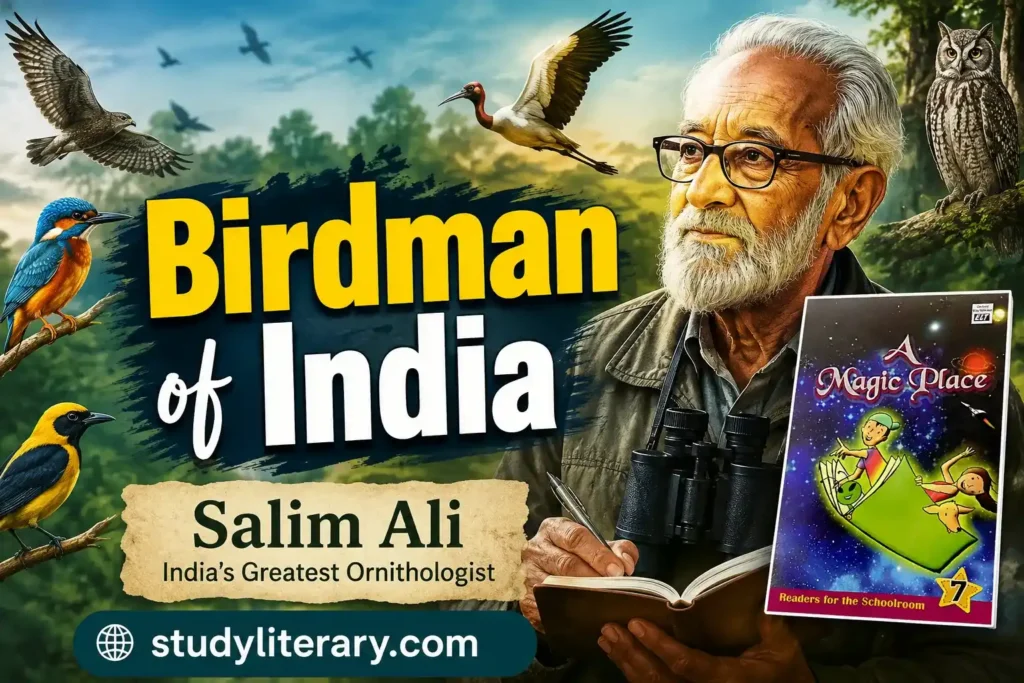
Birdman of India Questions and Answers
A. Answer these questions.
1. What was the incident that made Salim Ali a devoted student of birds?
When Salim Ali was ten years old, his uncle gave him a Daisy air gun. One day, he shot a strange sparrow with a yellow line below its neck. Since his uncle could not identify the bird, he took it to the Bombay Natural History Society (BNHS). The secretary of the society identified it as a yellow-throated sparrow and showed Salim Ali the collection of stuffed birds. This incident greatly fascinated him and made him a devoted student of birds.
2. What advice did Tehmina give Salim Ali?
Tehmina advised Salim Ali not to take a job if he could not enjoy it. She encouraged him to follow his interest in birds and nature instead of doing work that did not make him happy.
3. What did Salim Ali do between 1930 and 1950?
Between 1930 and 1950, Salim Ali travelled throughout the Indian subcontinent conducting ornithological surveys. He studied birds in different regions such as Kutch, Sikkim, Kerala, and Afghanistan. During this period, he carefully observed birds and their habitats and made valuable contributions to the study of ornithology in India.
4. What was Salim Ali’s contribution to the Silent Valley?
Salim Ali played an important role in saving Kerala’s Silent Valley from being destroyed for a hydroelectric project. Through his powerful letters and efforts, he created awareness about the importance of protecting the environment and wildlife. His contribution helped in preserving the Silent Valley.
5. What was Salim Ali’s last book? What was it about?
Salim Ali’s last book was “The Fall of a Sparrow”. It was his autobiography in which he wrote about his life, experiences, expeditions, struggles, and achievements as an ornithologist.
B. Read these lines and answer the questions with reference to the context.
1. “He took up ornithology as a very serious hobby at a time when the subject in India was just an Englishman’s pastime.”
a. Why was Salim Ali’s interest in birds of importance at the time?
Salim Ali’s interest in birds was important because, at that time, very few Indians studied birds seriously. He conducted scientific studies on Indian birds and helped develop ornithology in India. His work increased knowledge about birds and inspired people to take an interest in nature and wildlife conservation.
b. Why was it called an ‘Englishman’s pastime’?
It was called an “Englishman’s pastime” because, during British rule in India, the study of birds was mainly pursued by English people as a hobby or leisure activity. Most Indians were not involved in ornithology at that time.
2. “Finishing school,” Salim Ali once remarked, “did not finish her completely.”
a. Who does Salim Ali refer to? Why does he say this?
Salim Ali refers to his wife, Tehmina. She had studied in a finishing school in England, but despite her fashionable education and wealthy background, she remained simple, warm, lively, and interested in nature and adventure. Salim Ali says this because she did not become overly formal or artificial after attending the finishing school.
b. The remark is indeed humorous. What makes it humorous?
The remark is humorous because the expression “finishing school” usually means a school that trains young women in polite social behaviour and refined manners. Salim Ali jokingly says that the school did not “finish” Tehmina completely, meaning that it could not change her natural personality and adventurous spirit. The play on the word “finish” creates the humour.