

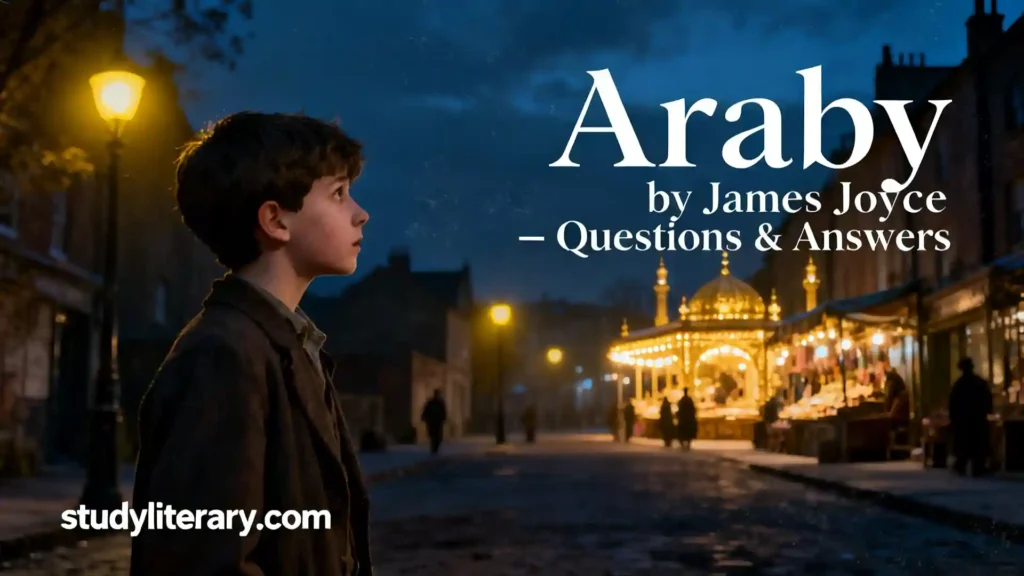
Araby Questions and Answers of James Joyce
Table of Contents
ToggleQ1. Discuss the theme of “illusion vs reality” in Araby. How does Joyce present it?
To read “Araby” attentively is to watch a mind constructing a dream—and then to witness, almost painfully, the moment when that dream collapses under the weight of reality. Joyce does not merely present the theme of illusion versus reality; he stages it as an inward drama, where perception itself becomes unreliable, and where the ordinary world is transformed—briefly, intensely—by the alchemy of desire before returning, cold and unchanged.
Illusion as a Mode of Seeing
From the very opening, Joyce quietly prepares the ground for illusion by presenting a world steeped in stagnation and dullness. North Richmond Street is “blind”—a word that carries more than spatial meaning. It is not merely a cul-de-sac; it is a psychological and spiritual condition. The boy lives in a space where life appears static, repetitive, almost suffocating. Critics have often linked this atmosphere to Joyce’s broader theme of paralysis in Dubliners .
Against this backdrop of monotony, illusion becomes not an error but a necessity. The boy’s imagination begins to re-enchant his surroundings. Mangan’s sister is not simply a girl; she is transformed into an almost sacred figure. Notice how Joyce’s language shifts subtly into a register of devotion—the boy carries his “chalice” through the marketplace, and her name becomes part of “strange prayers.” This is not accidental. The illusion here is deeply shaped by Catholic symbolism: romantic desire borrows the language of religious worship.
Thus, illusion is not just personal fantasy—it is culturally conditioned. The boy has inherited a symbolic vocabulary that elevates desire into something sacred, almost mystical. As Coleman observes, imagination in Araby often transforms ordinary experience into visionary illusion .
The Bazaar as Oriental Fantasy
The illusion reaches its most concentrated form in the idea of “Araby” itself. The very word acts like a spell. It conjures an imagined East—a place of mystery, luxury, and romance. This is not the real East, but an Orientalist fantasy, filtered through colonial imagination.
What is remarkable is that Joyce never directly describes this imagined Araby. Instead, he allows the word to resonate within the boy’s consciousness. The syllables themselves “cast an Eastern enchantment.” Here, illusion operates linguistically—the sound of a word generates a world.
This reflects a broader modernist insight: reality is not simply what exists externally, but what is perceived and constructed internally. The boy’s illusion is not false in a trivial sense; it is emotionally real, even if factually unfounded.
Delay, Frustration, and the Erosion of Illusion
Yet Joyce does not shatter illusion abruptly. Instead, he lets it decay gradually through time, delay, and frustration.
The uncle’s lateness is crucial. It introduces a note of mundane reality—forgetfulness, trivial conversation, domestic inertia. These are not dramatic forces; they are ordinary. And that is precisely Joyce’s point: illusion is not destroyed by catastrophe but by banality.
By the time the boy reaches the bazaar, it is already closing. The delay has drained the experience of its anticipated magic. Critics note that such structural delay intensifies the eventual epiphany, making the contrast between expectation and reality more devastating.
Reality Revealed: The Anti-Climax of Araby
The bazaar itself is the most powerful embodiment of reality. Instead of exotic splendour, the boy finds darkness, silence, and trivial commerce. The stalls are nearly closed; the atmosphere resembles “a church after a service”—a striking image that reverses the earlier religious imagery. What was once sacred is now empty.
Even more telling is the conversation he overhears: banal, flirtatious, distinctly English. The exotic East collapses into the ordinary West. The illusion of difference dissolves into sameness.
This moment is not merely disappointing—it is disorienting. The boy cannot immediately articulate what has happened, but he senses the gap between his imagined world and the actual one. As Kong notes, the clash between fantasy and reality is central to the boy’s awakening .
Epiphany: The Violent Recognition of Reality
The final lines of the story deliver what Joyce famously called an epiphany—a sudden revelation of truth. But this truth is not comforting. It is harsh, even humiliating.
“Gazing up into the darkness I saw myself as a creature driven and derided by vanity.”
This is not merely the collapse of illusion; it is the exposure of the self that created the illusion. The boy recognises his desire as vanity—something foolish, self-deceiving. The illumination is inward and painful.
Scholars consistently emphasize that the epiphany in Araby arises from the recognition of illusion’s absurdity . Yet what is often overlooked is its emotional texture: the boy is not simply enlightened; he is wounded. Reality here is not neutral—it is experienced as loss.
Beyond Illusion vs Reality: A Subtler Tension
To reduce the story to a simple opposition between illusion (bad) and reality (good) would be misleading. Joyce’s treatment is far more nuanced.
Illusion, after all, gives the boy intensity, purpose, and a sense of transcendence. Without it, his world is grey and lifeless. Reality, on the other hand, appears flat, commercial, and spiritually empty.
Thus, the story leaves us with an unsettling question: is reality truly superior to illusion, or merely less beautiful?
Some critics suggest that Joyce’s epiphanies do not resolve tension but deepen it, revealing the complexity of perception itself . The boy’s awakening is not a triumphant arrival at truth but an entry into ambiguity—a recognition that both illusion and reality are incomplete.
Conclusion: Illusion as Necessary, Reality as Inevitable
Joyce presents illusion not as a simple mistake but as a vital, if fragile, mode of human experience. It is born out of emotional need, cultural inheritance, and imaginative power. Reality, however, intrudes—quietly, persistently—until the illusion can no longer sustain itself.
What makes Araby unforgettable is the way this transition is rendered: not as an abstract idea, but as a lived moment of disillusionment. The boy’s journey to the bazaar becomes, in effect, a journey from enchantment to self-awareness.
And yet, even in that final moment of clarity, there is something lingering—an afterglow of the illusion that once was. Joyce leaves us not with certainty, but with a dim, flickering awareness that the human mind will always oscillate between dreaming and seeing.
Q2. What is epiphany? Discuss the epiphany in Araby.
What is Epiphany? Joyce’s Reimagining of the Concept
The term “epiphany” originally belongs to theology, referring to a divine manifestation—God revealing Himself to the human world. Joyce borrows this sacred idea and quietly transforms it. In his early notes (particularly Stephen Hero), he defines epiphany as a sudden spiritual manifestation, whether in the “vulgarity of speech” or in a trivial gesture.
This shift is crucial. Joyce relocates the divine from heaven to the everyday. The extraordinary is no longer distant—it flickers within the ordinary, waiting to be perceived.
Modern critics describe Joyce’s epiphany as a “sudden moment of illumination” in which the deeper truth of a situation becomes visible, often without logical explanation . Yet this illumination is rarely triumphant. As Narula notes, Joycean epiphanies are often “evanescent moments,” fleeting flashes that resist full intellectual grasp .
Thus, epiphany is not simply knowledge—it is awareness, charged with emotion, ambiguity, and sometimes disillusionment.
Epiphany as Structure in Dubliners
In Dubliners, epiphany is not an isolated device but an organizing principle. Each story moves—almost invisibly—towards a moment of realization. But unlike traditional narratives, these moments do not resolve the plot; instead, they expose a deeper paralysis or truth.
Scholars emphasize that Joyce uses epiphany to reveal the hidden stagnation of Dublin life, turning ordinary experiences into sites of sudden insight . The characters do not escape their condition; they merely see it.
In this sense, epiphany is double-edged: it illuminates, but it does not liberate.
The Epiphany in Araby: A Gradual Awakening
In Araby, the epiphany does not arrive abruptly—it gathers slowly, like dusk thickening into night.
At first, the boy lives within a carefully constructed illusion. His love for Mangan’s sister is infused with religious imagery; his journey to the bazaar becomes a quest. Everything is heightened, symbolic, almost sacred.
But beneath this illusion, reality begins to press in—through small, seemingly insignificant details: the uncle’s forgetfulness, the banal chatter at the dinner table, the lateness of the hour. These moments do not yet constitute the epiphany, but they prepare it. As Kong observes, the boy’s realization is “gradually formed” through the tension between expectation and experience .
The epiphany, then, is not a lightning strike—it is the final crystallization of a long, invisible process.
The Climactic Moment: Vision in Darkness
The actual epiphany occurs in the closing lines:
“Gazing up into the darkness I saw myself as a creature driven and derided by vanity.”
This moment is deceptively simple. Nothing external happens—no dramatic event, no revelation from another character. The transformation is entirely internal.
Yet what changes is profound. The boy suddenly perceives himself—not as a romantic hero, but as a figure of folly. His quest, once imbued with sacred meaning, is exposed as vanity. The illusion collapses, and in its place emerges a stark self-awareness.
Critics consistently identify this as a classic Joycean epiphany: a recognition of the “absurdity” of one’s previous beliefs or actions . But what deserves emphasis is the tone of this realization. It is not calm or reflective; it is charged with “anguish and anger.” The epiphany wounds even as it enlightens.
The Nature of This Epiphany: Self-Recognition, Not World-Discovery
It is tempting to say that the boy discovers the reality of the bazaar—that it is ordinary, disappointing, commercial. But this would be too superficial.
The deeper epiphany is not about Araby; it is about himself. The bazaar merely provides the occasion. What he truly sees is the gap between his imagined self and his actual condition.
In this sense, the epiphany is psychological rather than external. As Bowen suggests, Joyce’s epiphanies often reveal an internal truth that had been obscured by illusion .
The boy’s realization is thus a moment of self-exposure. He becomes aware of his own susceptibility to illusion—his capacity to project meaning where none exists.
Is the Epiphany Transformative?
A crucial question arises: does this epiphany change the boy?
Joyce offers no explicit answer. The story ends at the moment of realization, leaving us suspended in ambiguity. Some critics argue that epiphany in Dubliners leads to awareness without action—a recognition that does not necessarily result in transformation .
In Araby, this ambiguity is particularly striking. The boy sees clearly—but what will he do with this clarity? Will it harden into cynicism, or deepen into maturity? Joyce refuses to say.
This refusal is itself meaningful. It suggests that epiphany is not an endpoint but a beginning—a moment that opens possibilities without resolving them.
The Paradox of Epiphany: Illumination and Loss
Perhaps the most haunting aspect of the epiphany in Araby is its paradoxical nature. It brings knowledge, but at the cost of enchantment.
Before the epiphany, the boy’s world is charged with meaning, even if that meaning is illusory. After the epiphany, the illusion is gone—but so is the intensity. What remains is a clearer, but colder, vision of reality.
In this sense, Joyce’s epiphany is not purely positive. It resembles what modern critics describe as a “loss of meaning” accompanying insight . The boy gains awareness, but loses wonder.
Conclusion: Epiphany as the Quiet Drama of Consciousness
In Araby, Joyce transforms a simple narrative into a profound exploration of perception. The epiphany is not an external event but an inward turning—a moment when the mind sees itself with sudden clarity.
What makes this moment so powerful is its restraint. Joyce does not dramatize the revelation; he lets it emerge quietly, almost inevitably, from the texture of experience.
And yet, in that quietness lies its force. The boy’s final vision—of himself as “driven and derided by vanity”—lingers far beyond the story, reminding us that epiphany is not always a moment of triumph. Sometimes, it is the recognition that what we believed most deeply was, after all, a beautiful illusion.
Q3. Explain “Araby” as a story of loss of innocence.
Innocence as Imagination: The Child’s Enchanted World
At the beginning of the story, the boy inhabits a distinctly innocent consciousness—not because he is naïve in a simple sense, but because his perception is intensely imaginative. The world is not yet divided into the real and the symbolic; everything glows with meaning.
The ordinary Dublin street becomes a stage for adventure. The dark, quiet houses are not merely dull—they are mysterious. Even his games in the street carry a sense of ritual. Critics often note that the boy’s early perception reflects a stage “from innocence to experience,” characteristic of Joyce’s childhood narratives .
Most strikingly, his feelings for Mangan’s sister reveal how innocence operates: he does not understand desire as physical or social, but transforms it into something sacred. His love is expressed in religious metaphors—he carries his “chalice,” whispers her name like a prayer. In this fusion of romance and religion, we see a mind that does not yet distinguish between emotional intensity and spiritual truth.
Innocence, then, is not ignorance—it is imaginative absolutism. Everything is heightened, unified, and meaningful.
The First Disturbance: Desire as Awakening
Yet within this innocence lies the seed of its own undoing. The boy’s attraction to Mangan’s sister marks the beginning of change. Desire introduces tension—between body and spirit, reality and imagination.
What is important is that the boy cannot yet process this feeling in mature terms. Instead, he elevates it, almost desperately, into a romantic quest. The journey to the bazaar becomes a mission, as if buying a trivial gift could justify or consummate his emotion.
Scholars have pointed out that this moment reflects early adolescent awakening, where emotional and sexual impulses are filtered through fantasy rather than understood directly . In this sense, innocence is already unstable. It cannot accommodate the complexity of desire without transforming it into illusion.
The World Intrudes: Reality as Friction
The movement from innocence to experience does not occur through a single dramatic event; it emerges through friction with reality.
The uncle’s forgetfulness, the lateness of the hour, the mundane conversations—these are not extraordinary obstacles, but precisely the opposite. They represent the dull persistence of adult life, indifferent to the boy’s inner drama.
Here Joyce is remarkably subtle. Innocence is not destroyed by tragedy; it is eroded by banality. The boy begins to sense, though not yet fully understand, that the world does not respond to his emotions. His intense inner life meets an external world that is slow, careless, and unromantic.
This contrast is central to the theme. As Bhandari observes, Joyce often uses such experiences to depict the painful transition of young protagonists into awareness .
The Bazaar: The Collapse of Illusion
The decisive moment comes at the bazaar itself. “Araby,” which had shimmered in the boy’s imagination as a place of wonder, appears instead as dim, nearly closed, and disappointingly ordinary.
The disillusionment operates on multiple levels:
Spatially: The bazaar is small, dark, and quiet—not expansive or magical.
Socially: The people there are indifferent, engaged in trivial flirtation.
Symbolically: The exotic East collapses into a commercial space governed by money and routine.
This is the moment where innocence cannot sustain itself. The boy’s imagination, which once transformed reality, now fails to do so. The world resists enchantment.
Critics frequently interpret this scene as the culmination of a journey from idealism to disillusionment, where the boy confronts the gap between expectation and actuality .
The Final Recognition: Loss as Self-Awareness
The loss of innocence is sealed in the final epiphany:
“I saw myself as a creature driven and derided by vanity.”
This line is devastating not because of what the boy learns about the world, but because of what he learns about himself. He recognises that his feelings—once experienced as noble and sacred—were shaped by vanity, illusion, and self-deception.
This is the true loss of innocence: the loss of self-trust. The boy can no longer believe in the purity or authenticity of his own emotions.
Moreover, the language of the passage—“anguish,” “anger,” “darkness”—suggests that this recognition is not liberating. It is painful, even humiliating. Innocence is not gently outgrown; it is abruptly exposed as fragile and inadequate.
Innocence and Experience: Not a Simple Opposition
Yet Joyce complicates the idea of loss. Innocence, for all its illusion, is also what gives the boy’s world its richness. His imagination transforms dull surroundings into something luminous. Without it, reality appears flat and lifeless.
Thus, the movement from innocence to experience is not purely progressive. It is also a form of diminishment. As some critics suggest, Joycean characters often gain awareness at the cost of emotional vitality .
The boy’s final state is not one of maturity in any triumphant sense. It is a state of awareness tinged with loss—a recognition that the world is less meaningful than he had believed.
A Broader Context: Childhood in Dubliners
Within the larger structure of Dubliners, Araby belongs to the “childhood” section, where Joyce explores early encounters with reality. These stories collectively depict the gradual shaping of consciousness, where innocence gives way to the constraints of social, cultural, and psychological forces.
The boy in Araby becomes representative of a broader human experience: the inevitable confrontation between inner desire and external limitation. His loss of innocence is not unique—it is, in a sense, universal.
Conclusion: Innocence as a Beautiful Illusion
Araby presents the loss of innocence not as a dramatic fall, but as a quiet awakening. The boy begins with a world charged with meaning, shaped by imagination, desire, and cultural symbolism. By the end, that world has dimmed.
Yet what lingers is not simply disillusionment, but a deeper awareness—of self, of reality, and of the fragile boundary between them.
Joyce’s genius lies in capturing this transition with extraordinary delicacy. Innocence is not mocked; it is rendered with tenderness. And its loss is not celebrated, but felt—as a moment where something luminous slips away, leaving behind a clearer, but colder, vision of the world.
Q4. Discuss the use of symbolism in Araby.
Symbolism as a Language of Consciousness
Joyce’s symbolism in Araby does not function in a decorative or allegorical way, as in earlier Victorian fiction. Instead, it emerges organically from perception. The symbols are not imposed; they are felt.
Modern critics emphasize that the imagery of the story operates on an “internal plane,” reflecting the boy’s psychological quest rather than a fixed moral scheme . In this sense, symbolism becomes a language through which consciousness expresses itself—fluid, unstable, and deeply subjective.
The “Blind” Street: Paralysis and Spiritual Stagnation
The story opens with North Richmond Street, described as “blind.” This is one of Joyce’s most quietly powerful symbols.
On the surface, it is simply a dead-end street. But symbolically, it represents a condition of incompleteness and confinement. The street does not lead anywhere—it circles back into itself. This spatial limitation mirrors the broader paralysis of Dublin life, a theme central to Dubliners.
The houses, with their “brown imperturbable faces,” suggest lifelessness, as if the environment itself has hardened into inertia. Critics often interpret this setting as symbolic of a society trapped in routine and spiritual stagnation .
Thus, from the very beginning, the boy’s world is symbolically closed—an environment that cannot easily sustain growth or transformation.
Light and Darkness: A Shifting Symbolic Contrast
Perhaps the most pervasive symbolic pattern in Araby is the interplay of light and darkness.
Darkness dominates the setting: dark streets, dim rooms, shadowy corners. It symbolizes ignorance, paralysis, and the oppressive weight of reality.
Light, on the other hand, appears fleetingly—often associated with Mangan’s sister.
When the boy watches her, she is “defined by the light,” almost illuminated against the surrounding gloom. Critics note that she functions as a symbolic “light” within a dark environment, embodying hope and desire .
Yet this light is unstable. It does not illuminate the world; it merely highlights the boy’s longing. By the end of the story, even the bazaar’s lights are extinguished, leaving the boy literally and metaphorically in darkness.
Thus, the movement of the story can be read as a journey from imagined illumination to actual darkness—a symbolic trajectory from illusion to disillusionment.
Mangan’s Sister: The Idealised Image
Mangan’s sister is perhaps the most complex symbol in the story—not because she does much, but because she is seen in a particular way.
She is not developed as a realistic character; instead, she exists primarily within the boy’s imagination. He elevates her into an almost sacred figure, blending romantic and religious imagery. As some critics suggest, she becomes a symbolic fusion of the “beloved” and the “holy,” reflecting the boy’s emotional and cultural conditioning .
Her very anonymity—she is never given a proper name—reinforces her symbolic status. She is less a person than a projection.
In this sense, she represents:
Desire transformed into ideal
The human tendency to mythologise the ordinary
The illusion of transcendence within a mundane world
The Bazaar “Araby”: Oriental Dream and Commercial Reality
The central symbol of the story is, of course, the bazaar itself.
“Araby” functions on multiple symbolic levels:
1. The Exotic Ideal
To the boy, the word evokes an “Eastern enchantment.” It represents escape, romance, and possibility. Scholars have linked this to Orientalist imagination, where the East becomes a symbolic space of fantasy and desire .
2. The Spiritual Quest
The boy’s journey to Araby resembles a pilgrimage. He imagines himself as a knight undertaking a sacred mission. This gives the bazaar a quasi-religious significance.
3. The Collapse into Reality
When he finally arrives, the bazaar is nearly closed, dimly lit, and disappointingly ordinary. The exotic dissolves into the commercial. As Stone notes, the “splendid bazaar” becomes a site of anti-climax, exposing the gap between imagination and reality .
Thus, Araby symbolizes not just illusion, but the failure of illusion—the moment when imagined meaning confronts actual experience.
Money and Commerce: The Symbol of Material Reality
A quieter but equally important symbol is money.
The boy’s quest ultimately depends on a trivial economic transaction—he needs money to buy a gift. This introduces a stark contrast between the elevated world of imagination and the mundane world of commerce.
At the bazaar, the presence of shopkeepers, prices, and casual conversation reduces his romantic quest to an ordinary act of buying and selling. Critics have interpreted this as a symbolic “transaction,” where emotional desire is confronted by material reality .
In this sense, money becomes a symbol of limitation—a reminder that even the most idealistic impulses must operate within practical constraints.
Time and Delay: The Symbolism of Waiting
Time itself functions symbolically in the story. The repeated delays—the uncle’s lateness, the slow passage of evening—gradually erode the boy’s anticipation.
This temporal stretching creates a symbolic tension between expectation and fulfillment. By the time he reaches the bazaar, the moment has already passed.
Thus, time becomes a quiet antagonist—a force that transforms possibility into disappointment.
The Final Darkness: Symbol of Self-Realisation
The closing image of darkness is perhaps the most powerful symbol in the story.
When the boy gazes “into the darkness,” it is not merely the physical absence of light. It represents:
The collapse of illusion
The exposure of self-deception
The entry into a more complex, less enchanted understanding of reality
Critics frequently note that darkness in Araby carries deep symbolic value, marking the boy’s transition into self-awareness .
Conclusion: Symbolism as the Soul of the Story
In Araby, symbolism is not an added layer—it is the very fabric of the narrative. The street, the girl, the light, the bazaar—all are charged with meanings that shift as the boy’s perception changes.
What makes Joyce’s symbolism remarkable is its fluidity. No symbol remains fixed. Light becomes darkness; the sacred becomes trivial; the ideal becomes the ordinary.
In the end, the story itself becomes a symbolic journey—from enchantment to awareness, from projection to perception. And like all true symbols, it resists final interpretation, leaving us with a lingering sense that meaning, like the boy’s vision, is always both revealed and withdrawn.
Q5. Analyze the character of the boy as a symbol of youth and imagination.
Youth as a Double Vision: Between World and Dream
The boy exists in what one critic calls a “dual consciousness”—a life divided between the real and the imagined. Outwardly, he inhabits a dull, constricted Dublin street; inwardly, he moves through a world of heightened meaning and emotional intensity. This doubleness is the essence of youth. The child does not passively accept reality; he reinterprets it. The boy’s games in the street are not just play—they are charged with drama, danger, and excitement, while even the dark houses seem to conceal mystery. In this sense, the boy represents youth not merely as innocence, but as creative perception. He does not see the world as it is; he sees it as it might become under the pressure of imagination.
The Imaginative Transformation of Reality
What distinguishes the boy most strikingly is his capacity to transform the ordinary into the extraordinary. Mangan’s sister, for instance, is not described in elaborate detail, yet in the boy’s mind she becomes radiant, almost sacred. He watches her in silence, elevating her presence into something akin to a religious experience. His imagination reveals itself through symbolic gestures: he imagines himself carrying a “chalice” through hostile streets, and her name becomes part of his “prayers.” Scholars note that this fusion of religious symbolism and romantic longing creates a coherent imaginative structure that elevates everyday experience. This is not mere exaggeration but the imaginative logic of youth itself—the boy cannot yet separate emotion from meaning; to feel intensely is to believe deeply.
The Heroic Self: Youth as Romantic Projection
Closely tied to imagination is the boy’s tendency to construct himself as a hero. His journey to the bazaar is not, in his mind, a simple errand; it becomes a quest. He imagines himself as a knight venturing into a hostile world to retrieve a symbolic object. Such self-fashioning reflects the youthful impulse to dramatize experience, transforming ordinary actions into meaningful adventures. This heroic projection gives shape to his emotions, transforms passivity into action, and elevates the mundane into the meaningful. Yet it also reveals a limitation: the boy does not yet see himself clearly. He is both the creator and the subject of his own illusion.
Imagination as Escape from Paralysis
The boy’s imagination is not only creative—it is also compensatory. It arises in response to the lifelessness of his environment. Dublin, in Araby, is marked by routine, darkness, and stagnation; adults appear distracted, indifferent, or confined by habit. Against this backdrop, imagination becomes a form of resistance. Critics suggest that the boy’s imaginative space offers a temporary escape from the paralysis of his surroundings. Through fantasy, he creates a world that feels alive, purposeful, and emotionally charged. In this sense, the boy symbolizes youth not merely as a biological stage, but as a counterforce to social inertia. His imagination challenges the deadness around him, even if only briefly.
The Fragility of Youthful Imagination
Yet Joyce does not romanticise this imaginative power without qualification. The boy’s vision, for all its intensity, is fragile. It depends on conditions that cannot be sustained: time must align with expectation, the external world must cooperate with inner desire, and imagined meaning must find some confirmation in reality. As soon as these conditions fail—as they do through delay, indifference, and banality—the imaginative structure begins to collapse. Scholars frequently emphasise that the boy’s disillusionment reflects the psychological vulnerability of adolescence, where expectations are heightened but understanding remains incomplete. Thus, the boy embodies not only the richness of youth, but also its instability.
The Crisis: Imagination Confronts Reality
The visit to the bazaar marks the turning point where imagination encounters resistance. Everything the boy had imagined—exotic beauty, romantic fulfilment, symbolic triumph—is quietly undermined. The bazaar is nearly closed, the atmosphere is dull and commercial, and the people are indifferent. In this moment, the boy’s imaginative world is exposed as projection. The external world does not confirm his vision; it contradicts it. What makes this crisis profound is that it is not imposed from outside—it arises from the mismatch between inner expectation and outer reality.
The Epiphany: Youth Becomes Self-Aware
The boy’s final realization—seeing himself as “driven and derided by vanity”—marks the transformation of youth. He does not simply lose his illusion; he becomes aware of how he created it. This is a crucial shift. Imagination, once unconscious and immersive, becomes visible and questionable. Critics interpret this as a movement from imaginative immersion to reflective consciousness—a hallmark of maturation. Yet this awareness is painful. The boy recognises that his emotions were shaped by illusion and that his heroic self-image was unfounded. In becoming self-aware, he loses the immediacy that once defined his youthful experience.
The Boy as Universal Symbol
Because the boy remains unnamed and psychologically fluid, he transcends his specific context. He becomes a symbol of the imaginative intensity of youth, the tendency to idealise and project meaning, the inevitable confrontation with reality, and the painful emergence of self-awareness. His journey is not limited to Dublin or to a particular historical moment; it reflects a universal human passage—from dreaming to knowing.
Conclusion: Youth as Radiance and Risk
Joyce’s portrayal of the boy is remarkable for its balance. He neither mocks youthful imagination nor glorifies it uncritically. Instead, he presents it as both a source of beauty, intensity, and meaning, and a fragile construct vulnerable to collapse. The boy’s imagination illuminates a dark world, but it cannot ultimately transform it. When reality asserts itself, the light dims, giving way to a more complex, less enchanted awareness. Yet one might still ask whether this is entirely a loss, or whether the memory of that imaginative radiance continues to shape the self. Joyce leaves us with this ambiguity: a boy standing in darkness—no longer dreaming as before, yet perhaps not finished dreaming altogether.
Q6. Explain the significance of the title “Araby”.
The Title as Enchantment: A Word that Creates a World
The first and most immediate significance of the title lies in its sound and suggestion. “Araby” is not an ordinary word in the boy’s Dublin environment; it carries a sense of distance, mystery, and exotic beauty. Joyce never defines it explicitly. Instead, he allows the word to resonate within the boy’s imagination, where it becomes charged with what critics describe as an “Oriental enchantment,” evoking a fantasy of the East shaped by Western imagination. In this sense, the title functions almost like poetry: it does not describe—it evokes. For the boy, “Araby” is less a place than a dream, a projection of desire onto an unknown world.
Orientalism and the Exotic Imagination
To deepen this understanding, one must consider the cultural context. The “Araby Bazaar” was a real event in Dublin, inspired by Victorian fascination with the Orient. Such exhibitions presented the East as a space of luxury, sensuality, and mystery. Joyce deliberately draws on this Orientalist tradition, where the East is not represented realistically but imagined as an exotic “other.” The title thus reflects a broader cultural phenomenon—the Western tendency to romanticise and mythologise distant places. For the boy, this cultural fantasy becomes intensely personal: “Araby” represents an escape from the dullness of Dublin, a realm of beauty and possibility, and a stage upon which his desires might be fulfilled. Thus, the title is not merely geographical; it is deeply psychological.
The Title as a Symbol of Desire
At a deeper level, “Araby” becomes inseparable from the boy’s feelings for Mangan’s sister. When she mentions the bazaar, the word acquires emotional urgency. It is no longer just a place—it becomes a mission. The boy invests the title with symbolic meaning: it becomes the destination of his quest, represents the possibility of expressing his love, and transforms a trivial errand into a sacred act. In this way, “Araby” is internalised, becoming part of the boy’s imaginative structure—a focal point where desire, fantasy, and identity converge.
The Title as Anticipation: A Promise Deferred
Another crucial aspect of the title is its temporal function. “Araby” represents something yet to come—a future moment of fulfilment. The boy’s entire experience is oriented toward this anticipated event. The delays he encounters—the uncle’s lateness and the slow passage of time—intensify the significance of the title, turning it into a symbol of hope deferred. This anticipation is essential, for without it the final disillusionment would lack its emotional force. The title builds expectation only so that Joyce may later dismantle it.
The Title as Irony: From Splendour to Emptiness
When the boy finally reaches the bazaar, the title undergoes a dramatic transformation. What had seemed exotic and magical is revealed as dimly lit, nearly closed, and commercial in nature. The grandeur suggested by the word “Araby” collapses into ordinary reality. This irony is central to the story: the title promises transcendence but delivers banality. It exposes the gap between language and experience, between imagination and reality.
The Title and the Reality of Commerce
An often overlooked dimension of the title is its connection to commerce. Despite its exotic connotations, “Araby” is, in reality, a market—a place of buying and selling. The boy’s quest, which he imagines as romantic and spiritual, is ultimately reduced to a financial transaction. At the bazaar, the presence of money, bargaining, and casual conversation strips the title of its imagined purity. Thus, the title reveals its dual nature: imagined as a realm of beauty and mystery, yet actualised as a commercial space governed by practical concerns.
The Title and the Epiphany
The full significance of the title is realised only in the final epiphany. When the boy recognises himself as “driven and derided by vanity,” the word “Araby” is retrospectively transformed. It is no longer a symbol of hope, but of illusion. The title becomes the object of disillusionment, standing for everything the boy believed in—and everything that has now been exposed as fragile or false. In this sense, the story can almost be read as an exploration of a single word: how it is imagined, pursued, and ultimately understood.
A Broader Interpretation: The Title as Modernist Insight
From a wider literary perspective, the title reflects a key modernist concern—the instability of meaning. “Araby” does not possess a fixed significance; rather, it shifts according to perception. At the beginning, it signifies enchantment; during the journey, expectation; at the bazaar, disappointment; and after the epiphany, self-awareness. This fluidity suggests that meaning is not inherent in things but constructed by consciousness. Joyce uses the title to dramatise this shifting process of interpretation.
Conclusion: A Word that Contains the Story
In “Araby,” the title is not an accessory—it is the story in miniature. It begins as a dream shaped by cultural fantasy and personal desire, gathers emotional intensity as the boy invests it with meaning, and finally collapses into irony, revealing the distance between imagination and reality. Its power lies in its simplicity: Joyce does not explain it, but allows it to unfold gradually. By the end, “Araby” lingers not as a place, but as a memory of illusion—a reminder that the human mind, especially in youth, can transform a single word into an entire world.
Q7. Discuss Joyce’s narrative technique in Araby.
A Fusion of Voices: The Retrospective First-Person Narrative
At first glance, Araby appears to be a simple first-person narrative, told by the boy using “I.” Yet this “I” is not singular—it is layered with complexity. There are, in effect, two selves speaking: the younger self, who experiences events with immediacy, intensity, and innocence, and the older self, who narrates them with reflective distance and understanding. This dual perspective creates a subtle irony. The boy’s youthful perceptions are presented with sincerity, yet the mature narrator quietly exposes their limitations. As Robinson observes, the story is framed within a “controlling viewpoint” that shapes interpretation. Through this technique, Joyce allows readers to inhabit illusion while simultaneously perceiving its fragility.
Interiorisation: The World Filtered Through Consciousness
Joyce’s realism is not rooted in external action but in internal perception. The events of Araby are minimal—there is no elaborate plot or dramatic conflict. What truly matters is how the boy experiences these events. Everything is filtered through his consciousness: the street appears mysterious because he feels it so, Mangan’s sister becomes radiant because he imagines her so, and the bazaar becomes disappointing because his expectations collapse. Critics often describe this as psychological realism, where inner experience takes precedence over outward action. In this sense, the story is less about what happens than about how it is felt.
Proto–Stream of Consciousness: The Flow of Thought
Although Araby is not a full example of stream-of-consciousness technique as seen in Ulysses, it clearly anticipates it. Joyce allows the boy’s thoughts to flow with immediacy and fluidity. Sentences shift naturally between observation and reflection, while external description blends seamlessly with inner emotion. Time, too, becomes subjective—shaped by anticipation, memory, and emotional intensity rather than strict chronology. Joyce’s early experimentation with interior narration gives the story a dreamlike quality, drawing the reader into the movement of the boy’s mind rather than positioning them outside it.
Imagistic Language: Narration as Sensory Experience
Another defining feature of Joyce’s narrative technique is his use of imagery, not merely as decoration but as a structural principle. The story unfolds through vivid sensory impressions—the “dark muddy lanes,” the “yellow glow” of light, the “musty” air of the house. These details do more than describe; they create atmosphere and emotional resonance. As Norris suggests, Joyce’s prose demonstrates an “aesthetic self-display,” where language itself becomes expressive. Importantly, these images often mirror the boy’s inner state. Darkness, for instance, is both literal and symbolic, reflecting confusion, longing, and eventual disillusionment.
Structural Economy: The Art of Compression
Joyce’s narrative technique is marked by remarkable restraint. The story is brief, almost deceptively simple, yet every element is carefully placed. There is a clear progression: the exposition introduces the boy’s environment and emotional world; rising expectation develops through his fascination with Mangan’s sister; delays heighten anticipation; the visit to the bazaar serves as the climax; and the epiphany provides resolution. This structure feels organic rather than mechanical, guiding the reader almost invisibly. Joyce’s ability to compress complex psychological development into such a concise form intensifies the story’s impact.
The Use of Epiphany as Narrative Closure
One of Joyce’s most distinctive narrative techniques is his use of epiphany. Traditional stories resolve conflict through action, but Joyce resolves it through recognition. The climax of Araby is not an external event but an internal realization: “I saw myself as a creature driven and derided by vanity.” This moment reshapes the entire narrative, transforming earlier experiences into steps leading toward this insight. The story becomes fully meaningful only in retrospect, revealing Joyce’s fundamentally retrospective narrative design.
Minimal Plot, Maximum Suggestion
Joyce deliberately minimizes external action. The plot of Araby can be reduced to a simple statement: a boy goes to a bazaar and returns disappointed. Yet this simplicity conceals depth. Through narrative technique, Joyce expands this small घटना into a profound exploration of desire, imagination, and disillusionment. Critics often remark that in such stories, “nothing happens” externally, yet everything happens internally. This reflects a modernist shift in literature, where significance lies not in events but in perception.
Irony and Distance: The Quiet Undercurrent
A subtle but crucial element of Joyce’s technique is irony. The boy believes he is engaged in a meaningful, even heroic quest. However, the narrative voice gently reveals the fragility of this belief. This creates a quiet tension between what the boy perceives and what the reader understands. Importantly, this irony is never harsh or mocking. Joyce maintains a tone of sympathy, allowing the reader to recognise the gap between illusion and reality without diminishing the emotional truth of the boy’s experience.
Conclusion: Technique as Experience
Joyce’s narrative technique in Araby is not merely a set of formal strategies; it is a way of shaping lived experience. Through a layered first-person voice, interiorised perspective, imagistic language, and epiphanic structure, he transforms a simple घटना into a deeply psychological journey. What makes this technique extraordinary is its subtlety—it feels effortless, almost invisible, yet it is meticulously controlled. Joyce does not simply narrate the boy’s disillusionment; he enables the reader to experience it from within. In doing so, he redefines storytelling itself—not as the recounting of events, but as the revelation of consciousness.
Important 15-Mark Questions
Theme-Based Questions
Discuss the theme of “illusion vs reality” in Araby. How does Joyce present it?
Explain “Araby” as a story of loss of innocence.
Discuss the theme of disillusionment in the story.
Examine the role of “paralysis” in Dublin society as shown in Araby.
How does Joyce present the theme of first love and its failure?
Character-Based Questions
Analyze the character of the boy as a symbol of youth and imagination.
Discuss the role and symbolic importance of Mangan’s sister.
Examine the role of the uncle in shaping the boy’s disappointment.
Show how the boy’s character develops from innocence to experience.
Symbolism & Literary Technique
Discuss the use of symbolism in Araby.
Explain the significance of the title “Araby”.
Analyze the importance of setting in the story.
Discuss the use of light and darkness as symbols.
Epiphany & Modernism (Very Important)
What is epiphany? Discuss the epiphany in Araby.
Show how Araby is a modernist short story.
Discuss Joyce’s narrative technique in Araby.
Critical & Analytical Questions
“Araby is a journey from dream to reality.” Discuss.
“The story reflects the frustration and stagnation of Dublin life.” Explain.
Critically analyze Araby as a psychological story.
How does Joyce combine realism and symbolism in Araby?
Most Repeated / High Probability Questions
👉 If you are preparing for exams, focus especially on:
Epiphany in Araby
Illusion vs Reality
Loss of Innocence
Symbolism
Character of the Boy
Significance of the Title
Answers have been given above. Check the table of content.
Important Links
Share or Save This Post
- Facebook
- Twitter
- Linkedin
- Whatsapp
- Pinterest
- Telegram