

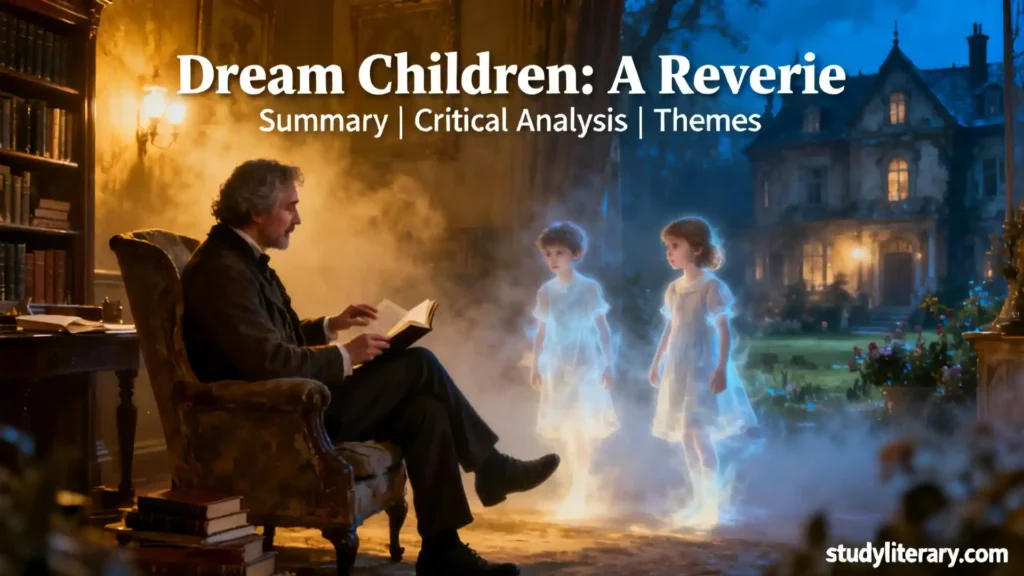
Dream Children: A Reverie Summary of Charles Lamb
Table of Contents
ToggleAbout the Author: Charles Lamb
Charles Lamb was a famous English essay writer of the early 19th century. He was born in 1775 in London and is best known for his personal and emotional essays. He wrote many of his essays under the pen name “Elia.” His writing style is simple, gentle, and full of feelings, often based on his own life experiences.
Lamb’s life was full of sadness and struggles. His sister Mary suffered from mental illness, and Lamb devoted his life to taking care of her. He never married, even though he loved a woman deeply. These personal losses and sacrifices are clearly reflected in his writings. His essays, especially those in Essays of Elia, are admired for their honesty, nostalgia, and emotional depth.
About the Essay: “Dream Children: A Reverie”
“Dream Children: A Reverie” is one of the most famous essays written by Charles Lamb. It is a personal and imaginative essay in which the narrator dreams about having children and a happy family life. The story begins with Lamb telling stories to two children, John and Alice, about his past and his family.
As the essay progresses, he talks about his grandmother, his childhood memories, and his brother John, who later died. He also shares his love for a woman named Alice, whom he could not marry. These parts show that the essay is deeply connected to Lamb’s real life.
The most important part of the essay comes at the end, when the children suddenly disappear and reveal that they are not real. They are only dreams and represent the life that Lamb never had. He then wakes up and finds himself alone, realizing that his happy family life was only an imagination.
Nature and Style of the Essay
This essay is not a simple story but a mix of dream and reality. It is written in a soft, emotional, and reflective style. Lamb uses simple language but expresses deep feelings like love, regret, loneliness, and memory. The essay moves from happiness to sadness, making it very touching for the reader.
Dream Children: A Reverie Summary of Charles Lamb
Introduction: Children Listening to Stories
The essay begins with the narrator, Charles Lamb (also called Elia), sitting comfortably and telling stories to two children named John and Alice. Children naturally enjoy listening to stories about the past, especially about family members they have never seen. In the same way, these children gather around him and ask him to tell stories about their great-grandmother Field.
Great-Grandmother Field: A Noble and Religious Woman
The narrator describes great-grandmother Field as a very kind, religious, and respected woman. She lived in a very large and old house in Norfolk, though she was not its owner. She was given the responsibility to take care of it and maintained it with dignity as if it were her own. She was loved by everyone in the area, and many people attended her funeral to show respect. She had deep religious knowledge and could remember many parts of the Bible by heart.
The Old Mansion and Childhood Memories
The narrator then recalls his childhood visits to the grand old house. The house was full of history, with carved wooden stories and large empty rooms. He loved wandering alone through the rooms, looking at old statues, and exploring the peaceful gardens. He enjoyed simple activities like watching fish in the pond, lying on the grass, and walking among trees. Interestingly, he did not care much for fruits like peaches or oranges, even though they were available. These memories show that he valued imagination and quiet enjoyment more than material pleasures.
His Brother John: Love, Admiration, and Regret
The narrator speaks about his brother John, who was brave, energetic, and loved adventure. As a child, John would ride horses and explore freely. He was also very caring, especially toward the narrator, who was physically weak. However, later in life, John became ill and died. The narrator feels deep regret because he thinks he was not always kind and patient with his brother. After his death, he realizes how much he truly loved him and misses both his kindness and even their small quarrels.
Emotional Reaction of the Children
As the narrator talks about his brother’s death, the children become sad and begin to cry. They ask him to stop talking about their uncle and instead tell them stories about their mother. This moment shows the emotional innocence and sensitivity of children, as well as the deep emotional tone of the essay.
Alice: The Narrator’s Unfulfilled Love
The narrator then speaks about a woman named Alice, whom he loved deeply. He had loved her for many years and tried to win her affection, sometimes with hope and sometimes with despair. However, their love did not succeed, and they never married. This part reflects the narrator’s personal loss and emotional pain due to unfulfilled love.
The Sudden Twist: Children Disappear
Suddenly, a strange and emotional change occurs. The children begin to fade away slowly. They reveal that they are not real and never existed. They say they are only dreams and represent what could have happened in life but never did. This moment shocks the narrator and changes the entire meaning of the story.
Ending: Return to Reality
In the end, the narrator wakes up from his dream. He finds himself sitting alone in his chair, with his sister Bridget beside him. He realizes that his brother is gone forever, he never married Alice, and he has no children. The happy family he imagined was only a dream. This creates a strong emotional impact, showing the contrast between imagination and reality.
Critical Analysis of the Essay
“Dream Children: A Reverie” is one of the finest personal essays by Charles Lamb. It is a beautiful mixture of autobiography, imagination, and emotion. The essay appears simple at first, as it shows a father telling stories to his children, but gradually it reveals deep sadness and truth about life.
One of the most striking features of the essay is its dream-like structure. The narration moves smoothly from reality to imagination without any clear break. At the beginning, the children seem real, but in the end, we understand that they are only part of a dream. This sudden shift creates a strong emotional effect on the reader.
The essay is highly autobiographical. The characters in the essay represent real people from Lamb’s life. His brother John represents his real brother, and Alice represents the woman he loved but could not marry. Through this, Lamb expresses his personal regrets, loneliness, and emotional pain in a subtle and artistic way.
Another important aspect is Lamb’s use of pathos (deep emotion). The essay starts with warmth and happiness but slowly moves towards sorrow. The death of his brother, his lost love, and finally the disappearance of the dream children create a deep sense of loss. The ending is especially powerful, as the narrator wakes up to reality and realizes that his happy family life never existed.
The language and style are simple, graceful, and conversational, yet very expressive. Lamb uses gentle humor, vivid descriptions, and emotional reflections. His style makes the essay easy to read but deeply meaningful.
Overall, the essay is a perfect example of how personal pain can be transformed into artistic beauty. It shows Lamb’s mastery in blending reality with imagination and creating a touching emotional experience.
Themes of the Essay:
1. Dream vs Reality
The central theme of the essay is the contrast between dream and reality. The children, John and Alice, appear real at first but are later revealed to be only dreams. This shows how human beings often imagine a happy life that they do not actually have. The essay ends with the harsh truth of reality, where the narrator is alone.
2. Nostalgia (Love for the Past)
The essay is full of memories of the past. Lamb remembers his childhood, his grandmother, and the old mansion with great affection. These memories are sweet but also painful because they cannot be relived. This creates a feeling of nostalgia throughout the essay.
3. Loss and Regret
Loss is a major theme in the essay. The narrator loses his brother and his beloved Alice. He also regrets not being kind enough to his brother when he was alive. This shows how people often realize the value of relationships only after losing them.
4. Unfulfilled Desires
The dream children represent the narrator’s unfulfilled wishes. He wanted a happy married life and children, but he never achieved it. The essay shows how people carry such unfulfilled desires throughout their lives.
5. Loneliness
At the end of the essay, the narrator wakes up and finds himself alone. This highlights the theme of loneliness. Despite his rich memories and imagination, his real life is empty and silent.
6. Power of Imagination
The essay shows how imagination can create a complete world of happiness. For a short time, the narrator experiences joy through his dream. However, imagination cannot replace reality permanently.
7. Love and Family Bonds
The essay also highlights the importance of love and family. The narrator’s affection for his grandmother, brother, and beloved Alice shows deep emotional connections. Even the imagined children reflect his desire for family love.