

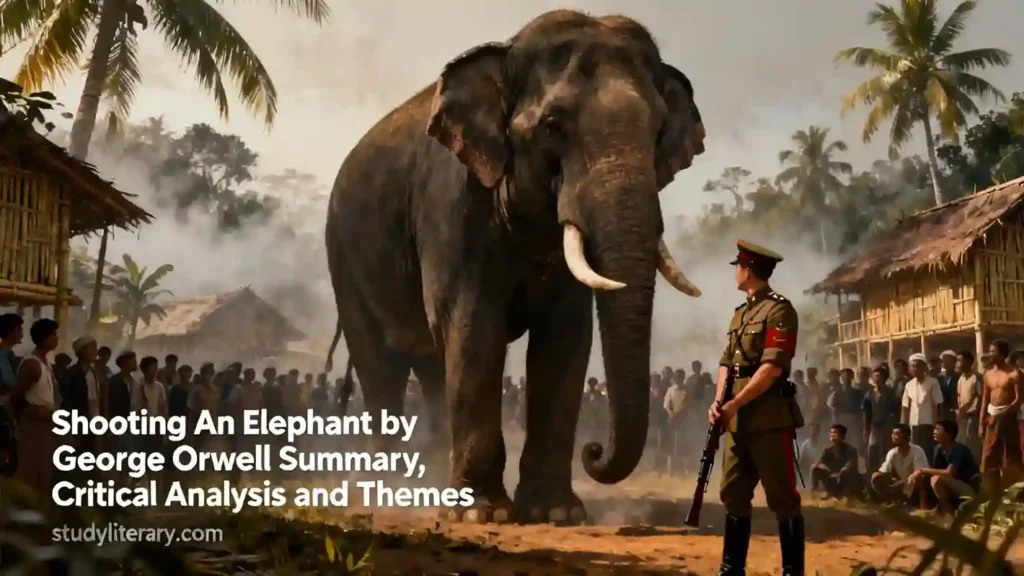
Shooting An Elephant Summary of George Orwell
Table of Contents
ToggleAbout the Author: George Orwell
George Orwell (1903–1950) was a famous English writer, journalist, and critic. His real name was Eric Arthur Blair. He is best known for his strong opinions against injustice, dictatorship, and imperialism. Orwell’s writings are simple, clear, and powerful, which makes them very useful for students and competitive exams.
Orwell was born in British India and later served in the Indian Imperial Police in Burma (Myanmar). This experience had a deep impact on him and shaped his views about British imperialism. He saw the cruelty and injustice of colonial rule from close quarters, which made him dislike imperialism strongly.
Some of his most famous works include Animal Farm and 1984, both of which criticize political systems and misuse of power. Orwell is known for presenting deep ideas in a simple way, and his works often focus on truth, morality, and human freedom.
About the Essay: Shooting an Elephant
Shooting an Elephant is a famous autobiographical essay written by George Orwell. It is based on his real-life experience as a police officer in Burma during British rule. The essay shows the harsh realities of imperialism and the psychological pressure faced by those who are part of the system.
In the essay, Orwell describes an incident where he is forced to shoot an elephant that has gone mad. Although the elephant becomes calm later and does not need to be killed, Orwell shoots it because he feels pressure from the large crowd of local people who expect him to act like a powerful British officer. He is afraid that if he does not shoot the elephant, he will be laughed at and seen as weak.
The essay mainly explores the theme of imperialism and shows how it harms both the rulers and the ruled. Orwell realizes that even though he appears powerful, he is actually not free. He is controlled by the expectations of the people around him. Thus, the essay highlights the idea that imperialism makes a person lose his moral values and personal freedom.
The slow and painful death of the elephant symbolizes the cruelty and senseless violence of imperialism. In the end, Orwell honestly admits that he killed the elephant only to avoid looking foolish, not because it was the right thing to do. This makes the essay powerful, truthful, and deeply thought-provoking.
Shooting An Elephant Summary of George Orwell
Setting and Introduction
Shooting an Elephant by George Orwell is set in Moulmein in Lower Burma, during the time of British rule. Orwell works there as a sub-divisional police officer. He says that many local Burmese people hate him because he represents the British Empire. They insult him, mock him, and sometimes even try to harm him. Although he is an officer, he feels uncomfortable and isolated. At the same time, he secretly believes that imperialism is wrong and harmful. This creates a deep inner conflict in his mind, as he dislikes both the Empire and the people who oppose him.
Orwell’s View on Imperialism
Orwell strongly criticizes imperialism in the essay. He describes how British rule causes suffering to the local people. Prisoners are treated cruelly, and innocent people are oppressed. Orwell feels guilty because he is part of this system. He says that imperialism not only harms the people who are ruled but also affects the rulers negatively. He feels trapped in his job and cannot openly express his true thoughts. This shows that imperialism creates suffering on both sides.
Beginning of the Incident
One day, Orwell receives information that a tame elephant has gone mad (in a state called “must”) and is destroying property in the town. The elephant has broken its chain and escaped. It has already damaged huts, killed a cow, and created fear among the people. Orwell takes a small rifle and goes to the place to see what is happening, even though he is not sure what he will do.
Discovery of the Dead Man
While searching for the elephant, Orwell comes across a shocking sight. He finds the dead body of an Indian labourer who has been crushed by the elephant. The elephant had knocked the man down and trampled him to death. The description of the body is very disturbing and shows the cruelty of the situation. After seeing this, Orwell sends for a bigger rifle, thinking that the elephant might still be dangerous.
The Crowd and Its Expectations
As Orwell moves forward, a large crowd of Burmese people begins to follow him. Soon, nearly two thousand people gather behind him. They are excited and expect him to shoot the elephant. For them, it is a kind of entertainment, and they also hope to get meat from the elephant. Orwell becomes nervous because of the growing crowd and their expectations. He feels that they are watching him closely and judging his actions.
The Elephant Appears Calm
When Orwell finally sees the elephant, he notices that it is no longer violent. It is calmly standing in a field, eating grass peacefully. It does not seem dangerous at all. Orwell immediately realizes that there is no need to kill the elephant. He thinks that the elephant’s madness is over and that it can be controlled later by its owner. He decides that he should not shoot it, as it would be unnecessary and wrong.
The Turning Point (Realisation of Truth)
However, when Orwell looks back at the large crowd, he understands something very important. All the people expect him to shoot the elephant. They are waiting eagerly for the action. At that moment, Orwell realizes that even though he is the authority, he is not truly free. He feels that he is being controlled by the expectations of the crowd. He understands that a British officer must act confidently and cannot appear weak or foolish. This fear of being laughed at forces him to change his decision.
The Shooting of the Elephant
Even though he does not want to, Orwell decides to shoot the elephant. He lies down on the ground and fires his rifle. The elephant does not die immediately. Instead, it suffers greatly. Orwell shoots it several times, but it continues to breathe slowly and painfully. The entire process takes a long time, and the elephant dies in great agony. This scene is very painful and shows the cruelty of the act.
Aftermath of the Incident
After the elephant’s death, the Burmese people quickly cut its body and take away the meat. The owner of the elephant is angry but cannot do anything because he has no power. Among the Europeans, there are mixed opinions about Orwell’s action. Some think he was right, while others believe it was wrong to kill such a valuable animal. However, Orwell himself knows the truth about his action.
Central Idea of the Essay
The main idea of the essay is that imperialism is harmful and destructive. It not only oppresses the local people but also takes away the freedom of the rulers. Orwell shows that power under imperialism is only an illusion. Although he has authority and a gun, he is actually controlled by the crowd and their expectations. His actions are not based on his own will but on fear and social pressure.
Share or Save This Post
Introduction
Shooting an Elephant is a powerful autobiographical essay by George Orwell. It is not just a simple story about killing an elephant, but a deep reflection on imperialism, power, morality, and human weakness. Orwell uses a real-life incident to expose the truth behind British colonial rule.
Realistic and Autobiographical Nature
One of the most important features of the essay is its realistic and autobiographical style. Orwell writes from his own experience as a police officer in Burma. The detailed descriptions of the town, the crowd, and the elephant make the story vivid and believable. The essay feels real because it is based on actual events, and this increases its emotional and intellectual impact.
Psychological Conflict
The essay shows a deep inner conflict in Orwell’s mind. On one side, he hates imperialism and feels sympathy for the Burmese people. On the other side, he feels anger towards them because they insult and humiliate him. This conflict becomes stronger when he has to decide whether to shoot the elephant. He knows that killing the elephant is wrong, but he still does it. This shows his mental struggle between morality and social pressure.
Irony of Power
One of the central ideas of the essay is the irony of power. Orwell appears to be powerful because he is a British officer with a gun. However, in reality, he is not free. He is forced to act according to the expectations of the crowd. This creates a powerful irony: the ruler is actually controlled by the ruled. Orwell becomes a “puppet” in the hands of the people he governs.
Symbolism in the Essay
The essay is rich in symbolism. The elephant represents several ideas:
It symbolizes the British Empire, which is strong but also destructive.
It also represents innocence and helplessness, especially when it becomes calm.
Its slow and painful death reflects the cruelty and suffering caused by imperialism.
The crowd symbolizes public pressure and collective power, which controls individual actions.
Moral Weakness and Human Nature
Orwell presents a realistic picture of human weakness. He knows the right thing to do but fails to follow it. His action is not based on courage but on fear of being laughed at. This shows that humans often act against their conscience due to social pressure. Orwell’s honesty in admitting this weakness makes the essay more powerful and relatable.
Use of Simple and Clear Language
Orwell uses simple, direct, and clear language, which is one of his major strengths. He avoids complex words and presents deep ideas in an easy way. This makes the essay suitable for both general readers and students. His style is both descriptive and reflective, combining storytelling with critical thinking.
Powerful and Thought-Provoking Ending
The ending of the essay is very important. Orwell admits that he killed the elephant only to avoid looking foolish. This honest confession reveals the true nature of imperialism and human behavior. It leaves a strong impression on the reader and forces us to think about morality, power, and freedom.
Major Themes of Shooting an Elephant
1. Imperialism
The main theme of the essay is imperialism. Orwell shows that imperialism is unjust and harmful. It oppresses the local people and also destroys the moral values of the rulers. Both sides suffer under such a system.
2. Loss of Freedom
Another important theme is the loss of freedom. Although Orwell is in a position of authority, he is not free to act according to his own will. He is controlled by the expectations of the crowd. This shows that power under imperialism is only an illusion.
3. Pressure of Public Opinion
The essay highlights the strong influence of public opinion. Orwell kills the elephant not because he wants to, but because the crowd expects him to do so. This shows how society can force individuals to act against their own beliefs.
4. Inner Conflict
Orwell experiences a deep inner conflict throughout the essay. He is torn between his personal beliefs and his official duties. This conflict reflects the mental struggle of individuals working in unjust systems.
5. Violence and Cruelty
The essay shows the violence and cruelty of both imperialism and human actions. The death of the coolie and the painful killing of the elephant highlight the brutal nature of the situation.
6. Moral Weakness
Orwell’s decision to shoot the elephant shows moral weakness. He knows that his action is wrong but still goes ahead because of fear and social pressure. This theme reflects the weakness present in human nature.
7. Appearance vs Reality
There is a clear contrast between appearance and reality. Orwell appears to be powerful and in control, but in reality, he is weak and controlled by others. This theme exposes the false image of authority under imperialism.