
A Midsummer Night's Dream
All Characters
| Character | Who is this? | Easy explanation for students |
|---|---|---|
| Oberon | King of the fairies | Titania’s husband. He wants the boy whom Titania is protecting. |
| Titania | Queen of the fairies | She is sleeping in the forest. The magic juice makes her fall in love with Bottom. |
| Puck | A mischievous fairy who serves Oberon | He plays tricks and gives Bottom a donkey’s head. |
| Bottom | A weaver who makes cloth | He plays Pyramus. He confidently gives advice but often uses the wrong words. |
| Quince | The organiser of the actors | He directs the rehearsal and corrects their mistakes. |
| Flute | One of the actors | He plays Thisbe, the young woman in their play. |
| Snug | A joiner who works with wood | He plays the lion. |
| Snout and Starveling | Two other actors | They help discuss how to perform the play. |
| Peaseblossom, Cobweb, Moth and Mustardseed | Four fairies | Titania orders them to serve Bottom. |
| Pyramus and Thisbe | Characters in the play the men are rehearsing | They are two lovers. Bottom plays Pyramus, and Flute plays Thisbe. |
| Theseus and Hippolyta | The couple whose wedding is approaching | The men hope to perform their play at the wedding. |
Background and setting
| Part of the passage | Meaning in easy English | Roman Urdu/Hindi explanation |
|---|---|---|
| Oberon and Titania have quarrelled over a young boy. | Oberon and Titania have argued because Oberon wants a boy whom Titania is looking after. | Oberon aur Titania ke beech ek ladke ko lekar jhagda hua hai. Ladka Titania ki dekhbhaal mein hai, lekin Oberon use apne paas chahta hai. |
| Oberon sends Puck to fetch a magic flower. | The flower’s juice makes a sleeping person fall in love with the first creature they see after waking. | Is jaadui phool ka ras sote hue insaan ki palkon par lagane se, jaagne ke baad use jo pehla jeev dikhega, usi se mohabbat ho jaayegi. |
| He plans to steal the boy while Titania is under the spell. | Oberon plans to take the boy while Titania is distracted by her magical love. | Oberon sochta hai ki jab Titania jaadu ke asar mein mohabbat mein khoi hogi, tab woh ladke ko le jaayega. |
| Six men meet in a forest to rehearse a play. | Six men secretly practise a play that they hope to perform at the wedding. | Chhe aadmi jungle mein chupke se naatak ki practice karte hain. Woh shaadi ke mauqe par ise dikhana chahte hain. |
| Titania lies asleep in the wood. | The Fairy Queen is sleeping nearby when the actors arrive. | Jab naatak karne wale aadmi aate hain, tab pariyon ki rani Titania wahin paas mein so rahi hoti hai. |
| Speaker / dialogue cue | Meaning in easy English | Roman Urdu/Hindi explanation |
|---|---|---|
| Bottom: “Are we all met?” | Has everyone arrived? | Kya sab log aa gaye hain? |
| Quince: “Pat, pat … a marvellous convenient place…” | Yes, everyone is here. This is an excellent place to practise. The grassy ground will be our stage, and the bushes will be our changing room. We will act just as we will before the Duke. | Haan, sab aa gaye hain. Practice ke liye yeh bahut achchhi jagah hai. Ghaas wala hissa hamaara stage hoga aur jhaadiyon ke peechhe hum kapde badlenge. Hum waise hi practice karenge jaise Duke ke saamne naatak karna hai. |
| Bottom: “Peter Quince!” / Quince: “What sayest thou, bully Bottom?” | Bottom calls Quince. Quince replies warmly, “What is it, my good fellow?” Here, “bully” is a friendly word. | Bottom, Quince ko bulaata hai. Quince dostana andaaz mein kehta hai, “Kya baat hai, mere dost Bottom?” Yahaan “bully” ka matlab gunda nahin hai. |
| Bottom: “There are things in this comedy … that will never please.” | Some parts of our play may upset the audience. The ladies will not like seeing Pyramus use a sword to kill himself. What should we do? | Hamaare naatak ki kuchh baatein darshakon ko buri lag sakti hain. Auratein Pyramus ko talwaar se apni jaan lete hue dekhkar dar jaayengi. Iska kya karein? |
| Snout: “A parlous fear.” | Yes, that could be very frightening. | Haan, yeh toh bahut daraawni baat ho sakti hai. |
| Starveling: “We must leave the killing out…” | We should remove the part in which Pyramus kills himself. | Humein Pyramus ke khud ko maarne wala hissa naatak se hata dena chahiye. |
| Bottom: “Not a whit; I have a device…” | No, we need not remove it. I have a plan. Before the play, someone should explain that the swords will hurt nobody and Pyramus will not really die. | Nahin, woh hissa hataane ki zaroorat nahin hai. Mere paas ek tareeqa hai. Naatak se pehle bata diya jaaye ki talwaaron se kisi ko chot nahin lagegi aur Pyramus sach mein nahin marega. |
| Bottom: “I, Pyramus, am not Pyramus, but Bottom the weaver.” | Tell the audience that I am really Bottom, a weaver, only acting as Pyramus. Then they will not be afraid. | Darshakon ko bata dein ki main asal mein Pyramus nahin, kapda bunne wala Bottom hoon. Main sirf Pyramus ka kirdaar nibha raha hoon. Tab woh nahin darenge. |
| Quince: “It shall be written in eight and six.” | We will write the introduction in verse, with alternating lines of eight and six syllables. | Hum shuruaati baat ko kavita mein likhenge. Ek pankti mein aath syllables, yaani bolne ki dhwani ke hisse, aur agli mein chhe honge. |
| Bottom: “Make it two more … eight and eight.” | Make the shorter lines two syllables longer, so both kinds of line have eight. Bottom confidently changes Quince’s plan. | Chhe waali pankti mein do syllables aur jod do. Is tarah dono panktiyon mein aath-aath honge. Bottom bade bharose se Quince ki baat badal deta hai. |
| Snout: “Will not the ladies be afeard of the lion?” / Starveling’s reply | Snout asks whether the lion will frighten the ladies. Starveling thinks it will. | Snout poochhta hai ki kya sher ko dekhkar auratein nahin darengi. Starveling kehta hai ki use bhi yahi darr hai. |
| Bottom: “To bring in … a lion among ladies is a most dreadful thing…” | Bringing a lion among ladies would be terrifying. We must be careful. Bottom comically calls a lion a “wild-fowl,” which means a wild bird. | Auraton ke beech sher laana bahut daraawna hoga. Humein saavdhaani rakhni chahiye. Bottom galti se sher ko “wild-fowl,” yaani jangli parinda, keh deta hai. |
| Snout: “Another prologue must tell he is not a lion.” | Another introduction should explain that the lion is not real. | Ek aur shuruaati elaan mein bata dena chahiye ki yeh asli sher nahin hai. |
| Bottom: “You must name his name, and half his face must be seen…” | The actor must say his real name. Part of his face should show through the costume so the audience knows he is a man. | Sher banne wala apna asli naam bataaye. Uska aadha chehra bhi poshaak se dikhna chahiye, taaki darshak samajh jaayein ki woh aadmi hai. |
| Bottom’s suggested speech: “Ladies … not to fear, not to tremble…” | The actor should say, “Please do not be afraid. I promise you are safe. I am a man, not a real lion. My name is Snug, and I am a joiner.” | Woh kahe, “Meherbaani karke dariye mat. Main yaqeen dilaata hoon ki aap mehfooz hain. Main asli sher nahin, ek aadmi hoon. Mera naam Snug hai aur main lakdi ka kaam karta hoon.” |
| Speaker / dialogue cue | Meaning in easy English | Roman Urdu/Hindi explanation |
|---|---|---|
| Quince: “There are two hard things … to bring the moonlight into a chamber…” | We still have two problems. First, how can we show moonlight inside the room? Pyramus and Thisbe meet in moonlight. | Abhi do mushkilein hain. Pehli, kamre ke andar chaandni kaise dikhaayein? Kahaani mein Pyramus aur Thisbe chaandni mein milte hain. |
| Snout: “Doth the moon shine that night…?” | Will the moon be shining on the night of our performance? | Jis raat hum naatak karenge, kya us raat chaand niklega? |
| Bottom: “A calendar … Look in the almanac…” | Check the calendar or almanac to find out whether there will be moonlight. | Calendar ya panchaang mein dekho ki us raat chaandni hogi ya nahin. |
| Quince: “Yes, it doth shine that night.” | Yes, there will be moonlight that night. | Haan, us raat chaandni hogi. |
| Bottom: “Leave a casement … open…” | Leave a window open so real moonlight can enter the room. | Kamre ki ek khidki khuli chhod dena, taaki asli chaandni andar aa sake. |
| Quince: “One must come in with a bush of thorns and a lanthorn…” | Another way is to have someone carry thorny branches and a lantern and announce that he represents Moonlight. | Doosra tareeqa yeh hai ki koi aadmi kaantedaar daaliyaan aur ek laalten lekar aaye aur kahe ki woh chaandni ka kirdaar nibha raha hai. |
| Quince: “We must have a wall … talk through the chink…” | We also need a wall because the lovers speak to each other through a small opening in it. | Humein ek deewaar bhi chahiye, kyunki dono premi deewaar ki chhoti daraar se baat karte hain. |
| Snout: “You can never bring in a wall.” | We cannot bring a real wall into the room. What should we do? | Hum kamre mein asli deewaar nahin la sakte. Ab kya karein? |
| Bottom: “Some man or other must present Wall…” | A man can act as the wall. Put plaster or clay on him to make him look like one. He can hold his fingers apart to make the opening through which the lovers whisper. | Koi aadmi deewaar ban sakta hai. Us par plaster ya mitti laga dein. Woh apni ungliyon ke beech chhoti jagah banaaye. Usi jagah se dono premi dheere-dheere baat karenge. |
| Quince: “Come sit down, and rehearse your parts…” | Let us practise. Pyramus begins. After his speech, he must go behind the bushes. Everyone must speak or enter at the correct signal. | Ab practice shuru karein. Pyramus pehle bolega aur apni baat ke baad jhaadiyon ke peechhe jaayega. Har aadmi apne sahi ishaare par bole ya andar aaye. |
| Speaker / dialogue cue | Meaning in easy English | Roman Urdu/Hindi explanation |
|---|---|---|
| Stage direction: “Enter Puck, behind the actors.” | Puck arrives without the actors noticing him. | Puck unke peechhe aata hai, lekin naatak karne wale use dekh nahin paate. |
| Puck: “What hempen homespuns have we swaggering here…?” | Who are these rough, simply dressed workers making such a show near the sleeping Fairy Queen? Are they practising a play? I will watch and may join in. | Yeh saadhaaran kapde pehne kaamgaar kaun hain jo soti hui pariyon ki rani ke paas itna dikhaava kar rahe hain? Kya naatak ki practice ho rahi hai? Main dekhoonga aur mauqa mila toh ismein shaamil bhi ho jaaoonga. |
| Quince: “Speak, Pyramus; Thisbe, stand forth.” | Pyramus, begin your speech. Thisbe, come forward. | Pyramus, apni baat shuru karo. Thisbe, aage aao. |
| Bottom: “Odious savours sweet—” / Quince: “‘Odorous’!” | Bottom means to describe a sweet smell but uses “odious,” meaning hateful or disgusting. Quince corrects him: the word is “odorous,” meaning having a smell. | Bottom achchhi khushboo ki baat karna chahta hai, lekin galti se “odious,” yaani nafrat ke laayak, bolta hai. Quince use sahi shabd “odorous” bataata hai. |
| Bottom: “So hath thy breath, my dearest Thisbe dear…” | Dear Thisbe, your breath smells sweet like flowers. But I hear something. Wait here; I will return soon. | Meri pyaari Thisbe, aapki saanson mein phoolon jaisi khushboo hai. Lekin mujhe koi awaaz sunaai di hai. Aap yahin rukiye; main jaldi lautunga. |
| Puck: “A stranger Pyramus than e’er played here!” | What an unusual Pyramus! Puck’s remark also hints at the strange change he is about to make to Bottom. | Yeh toh bada ajeeb Pyramus hai! Puck ki baat aage hone waali ajeeb tabdeeli ka bhi ishaara deti hai. |
| Flute: “Must I speak now?” / Quince’s reply | Flute asks whether it is his turn. Quince says yes and explains that Pyramus has only gone to investigate a sound and will return. | Flute poochhta hai ki kya ab uski baari hai. Quince kehta hai haan. Pyramus sirf awaaz ka pata lagaane gaya hai aur waapas aayega. |
| Flute: “Most radiant Pyramus … never tire…” | As Thisbe, Flute praises Pyramus as handsome, youthful, lovely and faithful. The speech sounds funny because it mixes awkward comparisons, including comparing him to a tireless horse. | Thisbe bankar Flute, Pyramus ko khoobsoorat, jawaan, pyaara aur wafadaar kehta hai. Uski tareef mazedaar lagti hai, kyunki woh ajeeb misaalein deta hai—jaise kabhi na thakne wala ghoda. |
| Flute: “I’ll meet thee … at Ninny’s tomb.” | I will meet you at the tomb. However, Flute says the wrong name, “Ninny,” instead of “Ninus.” | Main aapse maqbare par miloongi. Lekin Flute “Ninus” ki jagah galti se “Ninny” keh deta hai. |
| Quince: “‘Ninus’ tomb’, man! … You speak all your part at once…” | The name is Ninus! You have spoken a later line too early. You should stop at “never tire,” because that is Pyramus’s signal to enter. | Naam Ninus hai! Aapne baad mein bolne waali baat bhi abhi bol di. Aapko “never tire” par rukna tha, kyunki wahi Pyramus ke aane ka ishaara hai. |
| Flute repeats: “As true as truest horse … never tire.” | Flute repeats the correct ending so Bottom can enter at the right moment. | Flute apni baat ka sahi aakhri hissa dohraata hai, taaki Bottom sahi waqt par aa sake. |
| Speaker / dialogue cue | Meaning in easy English | Roman Urdu/Hindi explanation |
|---|---|---|
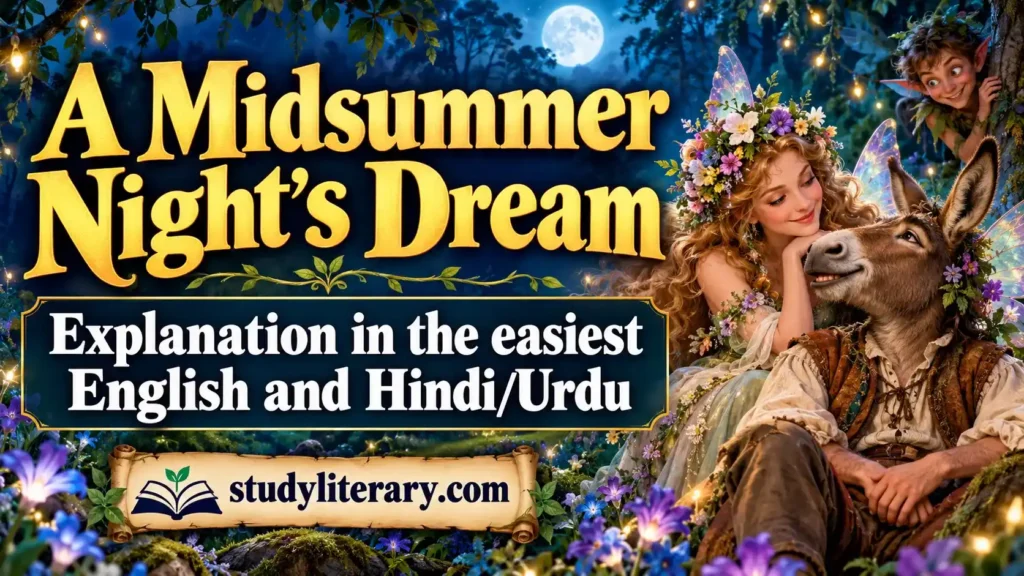
| Stage direction: “Enter Puck and Bottom with the ass-head on.” | Puck has magically given Bottom a donkey’s head. Bottom does not know that his appearance has changed. | Puck ne jaadu se Bottom ka sir gadhe ka bana diya hai. Bottom ko apni badli hui shakal ka pata nahin hai. |
| Bottom: “If I were fair, Thisbe, I were only thine.” | Thisbe, if I were handsome, my beauty would belong only to you. Bottom continues acting as if nothing has happened. | Thisbe, agar main khoobsoorat hota, toh meri khoobsoorti sirf aapke liye hoti. Bottom aise naatak karta rehta hai jaise kuchh hua hi na ho. |
| Quince: “O monstrous! O strange! We are haunted! … Fly…” | This is horrible and strange! There must be spirits here. Run away! | Yeh kitna bhayaanak aur ajeeb hai! Yahaan zaroor bhoot-pret hain. Bhaago! |
| Stage direction: The other actors run away. | The men are terrified by Bottom’s donkey’s head and leave him behind. | Bottom ka gadhe wala sir dekhkar sab dar jaate hain aur use chhodkar bhaag jaate hain. |
| Puck: “I’ll follow you … Through bog, through bush…” | I will chase you through muddy ground, bushes and thorns. I will take different forms and make frightening sounds to confuse you. | Main tumhaara peechha keechad, jhaadiyon aur kaanton tak karoonga. Alag-alag roop lekar aur daraawni awaazein nikaalkar tumhein pareshaan karoonga. |
| Puck: “A horse … a hound … a hog, a headless bear … a fire…” | Puck plans to appear as a horse, dog, pig, headless bear or moving fire, changing his form again and again. | Puck kabhi ghoda, kabhi kutta, kabhi suar, kabhi bina sir ka bhaaloo aur kabhi aag banne ki baat karta hai. |
| Bottom: “This is a knavery of them to make me afeard.” | Why are they running? They must be playing a trick to frighten me. | Yeh bhaag kyun rahe hain? Zaroor mujhe daraane ke liye koi chaal chal rahe hain. |
| Snout: “O Bottom, thou art changed!” | Bottom, your appearance has changed! What has happened to your head? | Bottom, aapki shakal badal gayi hai! Aapke sir ko kya ho gaya hai? |
| Bottom: “You see an ass-head of your own, do you?” | Bottom thinks Snout is insulting him and answers rudely, suggesting that Snout himself is a donkey or fool. | Bottom samajhta hai ki Snout uska mazaak uda raha hai. Woh ulta Snout ko hi gadha ya bewakoof keh deta hai. |
| Quince: “Bless thee … Thou art translated.” | May you be protected, Bottom! You have been transformed. Here, “translated” means changed in form. | Bottom, Bhagwaan aapki hifaazat kare! Aapka roop badal gaya hai. Yahaan “translated” ka matlab tarjuma karna nahin, roop badalna hai. |
| Bottom: “This is to make an ass of me…” | They want to make me look foolish and frighten me. I will stay here and sing to show that I am not afraid. | Yeh mujhe bewakoof banaana aur daraana chahte hain. Main yahin rahoonga aur gaana gaaunga, taaki unhein pata chale ki main nahin darta. |
| Speaker / dialogue cue | Meaning in easy English | Roman Urdu/Hindi explanation |
|---|---|---|
| Bottom’s song: “The ousel cock … The throstle … The wren…” | Bottom sings about different birds: a blackbird with an orange-yellow beak, a tuneful thrush and a small wren. | Bottom alag-alag parindon ke baare mein gaata hai—naarangi-peeli chonch wala kaala parinda, meethi awaaz waala thrush aur chhota wren. |
| Titania: “What angel wakes me from my flowery bed?” | Who is this wonderful singer waking me from my bed of flowers? Because of the spell, she thinks Bottom is lovely. | Kaun farishte jaisi awaaz mein gaakar mujhe phoolon ke bistar se jagaa raha hai? Jaadu ke asar se use Bottom bahut pyaara lagta hai. |
| Bottom’s song: “The finch, the sparrow and the lark … cuckoo grey…” | Bottom continues singing about birds, including the cuckoo with its simple, repeated call. He jokes that nobody should argue with such a foolish bird. | Bottom aur parindon ke baare mein gaata hai. Woh ek hi awaaz dohraane waali cuckoo ka bhi zikr karta hai aur mazaak mein kehta hai ki aise bewakoof parinde se behas kaun karega. |
| Titania: “I pray thee, gentle mortal, sing again…” | Please sing again, dear human. I love your voice, and your appearance has completely charmed me. | Meherbaani karke phir gaaiye. Mujhe aapki awaaz bahut pasand hai aur aapki shakal ne mujhe mohit kar diya hai. |
| Titania: “On the first view … I love thee.” | Your wonderful qualities make me declare that I have fallen in love with you at first sight. | Aapki khoobiyon ki wajah se main keh rahi hoon ki mujhe pehli nazar mein aapse mohabbat ho gayi hai. |
| Bottom: “You should have little reason for that.” | I do not think you have much reason to love me. | Mujhe nahin lagta ki aapke paas mujhse mohabbat karne ki koi khaas wajah hai. |
| Bottom: “Reason and love keep little company together nowadays.” | However, people in love often do not think logically. Love and sensible thinking do not always go together. | Lekin mohabbat mein log aksar soch-samajhkar faisla nahin karte. Mohabbat aur samajhdaari hamesha saath nahin chalti. |
| Bottom: “Some good neighbours will not make them friends … I can gleek…” | It is a pity nobody brings love and reason together. You see, I can make a clever joke sometimes. | Afsos hai ki koi mohabbat aur samajhdaari ki dosti nahin karaata. Dekhiye, main bhi kabhi-kabhi mazedaar baat kar leta hoon. |
| Titania: “Thou art as wise as thou art beautiful.” | You are as intelligent as you are beautiful. | Aap jitne khoobsoorat hain, utne hi samajhdaar bhi hain. |
| Bottom: “If I had wit enough to get out of this wood…” | Not really. I would be satisfied if I were clever enough to find my way out of this forest. | Aisa bhi nahin hai. Agar mere paas is jungle se baahar nikalne jitni samajh ho, toh mere liye wahi kaafi hai. |
| Speaker / dialogue cue | Meaning in easy English | Roman Urdu/Hindi explanation |
|---|---|---|
| Titania: “Out of this wood do not desire to go…” | Do not wish to leave this forest. You will stay here, whether you want to or not. | Is jungle se baahar jaane ki ichchha mat rakhiye. Aap chaahein ya na chaahein, aapko yahin rehna hoga. |
| Titania: “I am a spirit of no common rate…” | I am a powerful and important fairy. Summer itself attends me like a servant. | Main koi saadhaaran pari nahin hoon. Main bahut taaqatwar hoon. Garmiyon ka mausam bhi jaise meri seva mein rehta hai. |
| Titania: “I do love thee: therefore go with me.” | I love you, so come with me. | Main aapse mohabbat karti hoon, isliye mere saath chaliye. |
| Titania: “I’ll give thee fairies to attend on thee…” | Fairies will serve you, bring you precious jewels from the depths and sing while you sleep on a bed of flowers. | Pariyaan aapki seva karengi, gehraaiyon se keemti jawaahiraat laayengi aur jab aap phoolon ke bistar par soyenge, tab gaana gaayengi. |
| Titania: “I will purge thy mortal grossness…” | I will remove the heaviness of your human body so you can move lightly like a spirit. | Main aapke insaani jism ka bhaaripan door kar doongi, taaki aap bhi kisi rooh ki tarah halke hokar chal sakein. |
| Titania calls the four fairies. | Titania calls Peaseblossom, Cobweb, Moth and Mustardseed to serve Bottom. | Titania chaar pariyon ko Bottom ki seva karne ke liye bulaati hai. |
| Fairies: “Ready … And I … Where shall we go?” | The fairies say they are ready and ask for instructions. | Pariyaan kehti hain ki woh taiyaar hain aur poochhti hain ki unhein kahaan jaana hai. |
| Titania: “Be kind and courteous to this gentleman…” | Be gentle and polite to Bottom. Dance and play in front of him as he walks. | Bottom ke saath narmi aur adab se pesh aao. Jab woh chalein, toh unke saamne naacho aur khelo. |
| Titania: “Feed him with apricots and dewberries…” | Give him delicious fruits: apricots, dewberries, purple grapes, green figs and mulberries. | Unhein khoobaani, dewberries, baingani angoor, hare anjeer aur shahtoot jaise phal khilaao. |
| Titania: “Nod to him … and do him courtesies.” | Bow politely and show him respect. | Unke saamne adab se jhuko aur unki izzat karo. |
| Fairies: “Hail, mortal!” | Greetings, human! | Salaam, insaan! |
| Speaker / dialogue cue | Meaning in easy English | Roman Urdu/Hindi explanation |
|---|---|---|
| Bottom: “I beseech your name?” / Cobweb: “Cobweb.” | Bottom politely asks the fairy’s name. The fairy replies, “Cobweb.” | Bottom adab se pari ka naam poochhta hai. Woh jawaab deti hai, “Cobweb.” |
| Bottom: “I shall desire you of more acquaintance…” | I would like to know you better, Master Cobweb. | Janaab Cobweb, main aapse aur jaan-pehchaan badhaana chaahoonga. |
| Bottom: “If I cut my finger, I shall make bold with you.” | If I cut my finger, I may ask for your help. The joke refers to the old practice of using cobwebs to cover small wounds. | Agar meri ungli kat gayi, toh main aapki madad loonga. Yeh mazaak puraane zamaane mein chhote zakhm par makdi ka jaala lagaane ke tareeqe se juda hai. |
| Bottom asks another name / “Peaseblossom.” | Bottom asks the next fairy’s name and learns that it is Peaseblossom, meaning a pea flower. | Bottom agli pari ka naam poochhta hai. Uska naam Peaseblossom hai, yaani matar ka phool. |
| Bottom: “Commend me to Mistress Squash … Master Peascod…” | Give my greetings to your mother and father. Bottom jokingly imagines that the pea flower’s mother is a young pea pod and its father is a pea pod. | Apni ammi aur abbu ko mera salaam kehna. Bottom naam par mazaak karta hai aur matar ke phool ke maa-baap ko bhi matar ki phaliyon se jod deta hai. |
| Bottom: “I shall desire you of more acquaintance too.” | I would like to become better acquainted with you as well. | Main aapse bhi aur jaan-pehchaan badhaana chaahoonga. |
| Bottom asks another name / “Mustardseed.” | Bottom asks the next fairy’s name. The answer is Mustardseed, meaning a mustard seed. | Bottom agli pari ka naam poochhta hai. Woh kehti hai, “Mustardseed,” yaani sarson ka beej. |
| Bottom: “I know your patience well…” | Bottom jokingly praises Mustardseed’s patience because mustard is eaten with beef. He imagines that the large piece of beef has swallowed many members of Mustardseed’s family. | Bottom mazaak mein Mustardseed ke sabr ki tareef karta hai. Sarson ki chutney beef ke saath khaayi jaati hai, isliye woh kehta hai ki bade se gosht ne aapke khaandaan ke bahut logon ko nigal liya hai. |
| Bottom: “Your kindred hath made my eyes water…” | Your relatives have made my eyes water before. He means that strong mustard can bring tears to the eyes. | Aapke rishtedaar pehle bhi meri aankhon mein paani la chuke hain. Uska matlab hai ki tez sarson ki wajah se aankhon mein aansoo aa sakte hain. |
| Bottom: “I desire you of more acquaintance…” | I would like to know you better too, Master Mustardseed. | Janaab Mustardseed, main aapse bhi aur jaan-pehchaan badhaana chaahoonga. |
| Speaker / dialogue cue | Meaning in easy English | Roman Urdu/Hindi explanation |
|---|---|---|
| Titania: “Come, wait upon him; lead him to my bower.” | Serve Bottom and take him to my sheltered resting place among the plants and flowers. | Bottom ki seva karo aur unhein phoolon aur paudhon ke beech mere aaraam karne ki jagah par le chalo. |
| Titania: “The moon … looks with a watery eye…” | The moon looks as though its eyes are full of tears. Titania imagines the moon as a crying person. | Chaand aisa lag raha hai jaise uski aankhon mein aansoo hon. Titania chaand ko ek rote hue insaan ki tarah dikhaati hai. |
| Titania: “When she weeps, weeps every little flower…” | When the moon cries, the flowers cry too. The drops of dew on the flowers are imagined as tears. | Jab chaand rota hai, toh chhote phool bhi rote hain. Phoolon par jami os ki boondon ko aansoo kaha gaya hai. |
| Titania: “Lamenting some enforced chastity.” | It is as though they are mourning someone who is forced to remain apart from love. | Aisa lagta hai jaise woh kisi aise shakhs ka dukh mana rahe hon jise zabardasti mohabbat se door rakha gaya ho. |
| Titania: “Tie up my love’s tongue, bring him silently.” | Stop my beloved from talking and bring him quietly. | Mere pyaare ko bolne se roko aur use khaamoshi se le aao. |
| Stage direction: “Exeunt.” | Everyone leaves the stage. | Sab log stage se chale jaate hain. |